

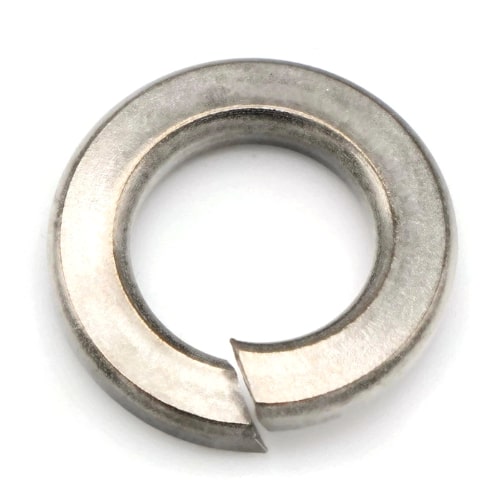
Split Ring Lock Washers
What are split ring lock washers? Split ring lock washers, also called helical spring or split lock washers, are rings split and twisted into a helical shape that exert spring force under a bolt or nut. As the fastener is torqued, the sharp open ends dig into the mating surface to resist loosening from vibration in light-duty joints.
How do split ring lock washers work?
When a nut is tightened over a split ring washer, the helical ring flattens and its two sharp cut ends bite into the bolt head or nut and the mating surface, while the spring force helps maintain tension against loosening. This makes them an economical, easy-to-install choice for light-duty vibration resistance. They work best on softer materials, where the edges dig in more easily, and are less effective under high dynamic loads. Always tighten to the correct torque to activate the spring action, and avoid over-tightening, which can flatten and deform the washer. Choose the material for the environment, with stainless or silicon bronze for corrosion resistance and hardened Grade 8 for higher-strength joints.
Material choices for split ring lock washers
- Stainless (304, 316): corrosion resistance, with 316 for coastal use.
- Metric stainless (A2, A4): A2 comparable to 304, A4 to 316.
- Zinc, galvanized, black oxide: economical and finished steel options.
- Grade 8, aluminum, silicon bronze: hardened, lightweight, and marine choices.
Common applications for split ring lock washers
- Light-duty vibration resistance
- General machinery and equipment
- Electrical and appliance assembly
- Soft-material and marine hardware
For a higher-tension version, see high collar split ring lock washers, and browse every option on the main lock washers category.
Split Ring Lock Washers FAQ
How does a split ring lock washer prevent loosening?
Its sharp cut ends bite into the surfaces while the helical spring maintains tension, resisting rotation and loosening in light-duty vibration.
When are split ring washers less effective?
They work best on softer materials and light-duty loads, and are less effective under high dynamic loads. For heavy vibration, consider a wedge-lock or nylon insert nut.
Can I over-tighten a lock washer?
Avoid over-tightening, which flattens and deforms the washer and compromises its spring action. Tighten to the correct torque to activate the lock.