

Resources
Dome Head Open End Rivets
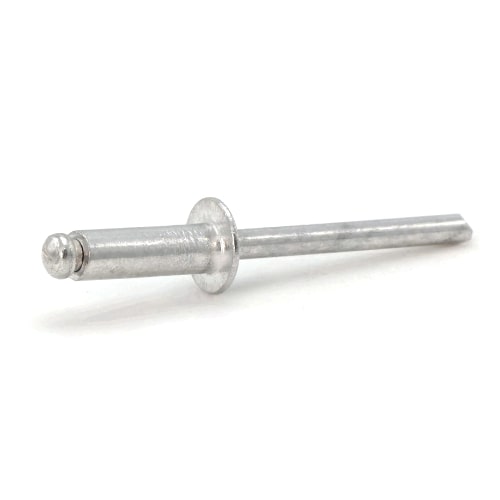
What are dome head rivets? Dome head rivets are open end blind rivets with a low, slightly rounded head roughly twice the diameter of the rivet body. That proportion is the standard against which other head styles are measured, and it is the most commonly specified head in blind riveting because it balances three things well: enough bearing area for general work, a low enough profile to stay out of the way, and a clean finished appearance. Also called round head or button head. AlbanyCountyFasteners.com stocks dome head open end rivets in 304 stainless, aluminum, copper, and zinc plated steel, from 3/32 inch through 1/4 inch.
When should I use a dome head rivet?
Use one unless something specific pushes you elsewhere. Dome head is the default for a reason: the head is wide enough to bear properly on ordinary sheet metal, low enough that it rarely interferes with anything, and neat enough to leave on a visible surface. You move away from it in three cases. If the material is soft, thin, or the hole is oversized, a large flange head gives the extra bearing area you need. If something has to slide across the joint or the surface must read as unbroken, a countersunk head sits flush instead. And if the joint has to keep water out, the head style is not the issue at all, since you need a closed end body regardless of what the head looks like.
Why choose dome head rivets
- The most versatile and widely stocked blind rivet head style
- Head diameter about twice the body gives adequate bearing for most sheet metal work
- Low profile stays clear of moving parts and adjacent components
- Clean, finished appearance suitable for visible surfaces
- Available across the widest range of materials and mandrel pairings
Material and mandrel options
- 304 stainless with stainless mandrel, highest strength and corrosion resistance
- Aluminum with aluminum mandrel, fully matched materials, lowest strength, best galvanic compatibility with aluminum
- Copper with brass mandrel, for electrical, decorative, and restoration work
- Copper with steel mandrel, copper body at lower cost, with a steel component left in the joint
- Zinc plated steel with steel mandrel, strong and economical for general indoor and light exterior use
Common applications
- General sheet metal fabrication and panel assembly
- Ductwork, HVAC, and enclosure work
- Brackets, mounting plates, and interior trim
- Signage, shelving, and display fixtures
- Appliance and equipment housings
- Repair work across trailers, machinery, and general fabrication
For soft material or oversized holes, large flange rivets give more bearing area. Where the surface must sit flush, see countersunk rivets, and for a watertight joint use closed end rivets.
Related Categories
Dome Head Rivet FAQs
What is the difference between dome head and button head rivets?
Usually nothing but the name. Some manufacturers call the same profile button head or low profile head. All three describe a low, rounded head about twice the body diameter. If a specification calls out a particular head height, check the dimensions rather than relying on the name.
How wide is a dome head?
Approximately twice the rivet body diameter. A 3/16 inch rivet has a head around 3/8 inch across. For comparison, a large flange head runs closer to three times the body diameter, which is why it holds so much better in soft material.
Which mandrel material should I choose?
Match the mandrel to the body if the joint will get wet, since part of the mandrel stays inside the rivet permanently. A steel mandrel in a copper or aluminum body costs less and often sets more easily, but the steel remnant can corrode, weaken the joint, and stain the surrounding surface.
What do the rivet size numbers mean?
They are a two-part code. The first number is the body diameter in thirty-seconds of an inch, so 4 means 4/32 or 1/8 inch, and 6 means 6/32 or 3/16 inch. The second number relates to grip length. Always confirm the actual grip range in inches rather than working from the code alone.
Are dome head rivets waterproof?
No, these are open end bodies, so water passes straight through the hollow center. The head style has nothing to do with sealing. For a watertight joint you need a closed end rivet regardless of which head you prefer.
Do dome head rivets need a special tool?
Any standard blind rivet tool sets them, with a nosepiece matched to the body diameter. Stainless bodies need considerably more pulling force than aluminum, so a lever or pneumatic tool is worth having for stainless above 5/32 inch.