

Videos
Play videoWhat Are Standard Coupling Nuts?
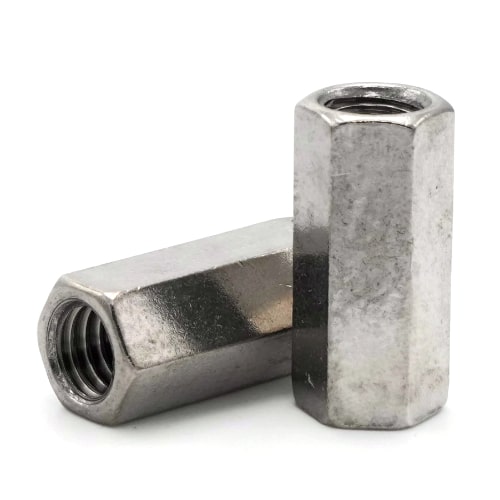
Standard coupling nuts—also called hex couplers or extension nuts—are long, hex-shaped nuts used to join two male threads of the same size and pitch. They’re commonly used to extend threaded rod, connect studs, or build assemblies that need more thread engagement than a regular nut can provide.
Why Choose Standard Coupling Nuts?
- Same-size joining – designed to connect identical thread sizes and pitches for fast, reliable rod extensions.
- Easy wrenching – hex body accepts standard wrenches for quick install and secure tightening.
- Longer engagement – increased internal length improves thread contact and load distribution.
- Economical – carbon steel with protective coatings offers strong value for general use.
Materials & Finishes
- Zinc-Plated Carbon Steel – moderate corrosion resistance for dry indoor or sheltered environments.
- Hot-Dip Galvanized Steel* – heavier zinc for rugged outdoor/structural use (where available).
- 304/316 Stainless Steel* – enhanced corrosion resistance; 316 favored for coastal/marine settings.
*Availability may vary by subcategory.
Common Applications
- Extending threaded rod in construction, MEP, and plant maintenance
- Joining studs and fasteners in plumbing and electrical supports
- Fixture and equipment assembly where extra thread length is required
- General repair, retrofit, and DIY projects
Sizing & Selection Tips
- Match size & pitch – both male threads must be the same (e.g., 3/8"-16 to 3/8"-16, or M10×1.5 to M10×1.5).
- Check hex across-flats – verify wrench size and clearance for your assembly.
- Engagement length – aim for at least one full rod diameter of thread engagement on each side (or per spec).
- Environment – pick the finish/material suited to exposure, load, and code requirements.
Installation Tips
- Square-cut and deburr rod ends; hand-start threads to avoid cross-threading.
- Tighten with properly sized wrenches; follow any project torque specifications.
- Use compatible materials to minimize galvanic corrosion; consider anti-seize on stainless threads to reduce galling.
- For vibration, add jam nuts or an approved thread-locking method if specified.
Standards & Compliance
Standard coupling nuts are typically supplied to common inch or metric thread classes (e.g., UNC/UNF Class 2B, or metric 6H). Verify the thread system, pitch, and class required by your drawing or specification.