

Set Screws
What are set screws?
Set screws are headless threaded fasteners designed to secure one object within or against another, most commonly by locking a gear, pulley, collar, sprocket, bearing, or hub onto a rotating shaft. Unlike traditional screws, set screws have no protruding head, allowing them to sit flush with or below the surface of the component for a clean, low profile installation in applications where space is limited or moving parts require an unobstructed surface. Set screws work by applying pressure through the tip of the fastener to hold components firmly in position and prevent movement caused by vibration, torque, or repeated operation. They are widely used in machinery, power transmission equipment, electric motors, robotics, conveyors, manufacturing equipment, automotive assemblies, and industrial maintenance. Available with a variety of point styles, including cup point, cone point, flat point, dog point, and knurled cup point, set screws can be selected to provide the holding power and shaft protection required for a specific application. Whether you're securing a pulley to a motor shaft, positioning a collar, or locking mechanical components in place, set screws provide a compact, dependable fastening solution without the need for an exposed screw head.
Set Screws
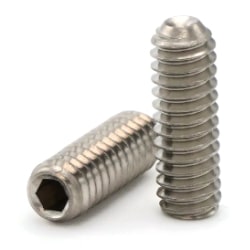
Set Screws Cup Point
Set screws with a recessed cup tip that bites into a shaft for a strong, permanent hold, the most common general-purpose point.
.jpg?ts=1757453414 "Security Set Screws")
Security Set Screws
Set screws with a tamper-resistant drive that requires a special bit, used to deter unauthorized adjustment or removal.
-min.jpg?ts=1757734810 "Set Screws Dog Point")
Set Screws Dog Point
Set screws with a cylindrical extended tip that seats into a matching hole or slot to align and hold parts without marring the shaft.
-min.jpg?ts=1757453414 "Set Screws Half Dog Point")
Set Screws Half Dog Point
Set screws with a shorter cylindrical tip for the same locating function as a dog point where less protrusion is needed.
-min.jpg?ts=1757453408 "Set Screws Cone Point")
Set Screws Cone Point
Set screws with a sharp cone tip that seats into a matching countersink for high holding power and precise permanent location.
-min.jpg?ts=1757453414 "Set Screws Knurled Cup Point")
Set Screws Knurled Cup Point
Set screws with a knurled cup tip that grips harder and resists loosening under vibration.
Videos
Play videoShop Related Categories


What Are Set Screws?
Set screws are headless threaded fasteners used to secure one component within or against another, most commonly to lock a gear, pulley, collar, sprocket, bearing, knob, or other component onto a shaft. Unlike conventional screws with a protruding head, set screws are designed to sit flush with or below the surface of the installed component.
Most set screws use an internal hex socket and are tightened with an Allen key or hex driver. These are commonly called socket set screws, hex socket set screws, or Allen set screws. The screw applies pressure through its point against the shaft or mating component to prevent movement, rotation, or loosening.
Set Screw Point Types
Choosing the correct set screw point style is important because the point determines how the screw contacts the shaft, how securely it holds, and whether it will mark or penetrate the mating surface.
- Cup point set screws – The most common general-purpose style. The recessed cup edge bites into the mating surface for strong holding power.
- Knurled cup point set screws – Feature serrations around the cup that increase grip and help resist loosening in applications subject to vibration.
- Flat point set screws – Provide a flat bearing surface that minimizes damage to the shaft and works well where components may require frequent adjustment.
- Cone point set screws – Use a sharp point that penetrates the mating surface for precise positioning and strong holding power where surface marking is acceptable.
- Dog point set screws – Feature an extended cylindrical tip designed to engage a prepared hole or slot for positive location and indexing.
- Half-dog point set screws – Use a shorter cylindrical tip for shallow holes, slots, and applications where less point projection is required.
- Soft-tip set screws – Nylon, brass, or other soft contact tips help protect finished, polished, soft, or sensitive shafts from damage.

How Do I Choose the Right Set Screw Point?
The best set screw point depends on whether maximum holding strength, vibration resistance, precise positioning, repeated adjustment, or protection of the shaft is most important.
- General-purpose shaft locking: Cup point
- Vibration resistance: Knurled cup point
- Frequent adjustment or reduced shaft marking: Flat point
- Maximum penetration and precise positioning: Cone point
- Positive indexing into a hole or slot: Dog or half-dog point
- Finished or easily damaged shafts: Soft, nylon, or brass tip
Socket Set Screws and Allen Set Screws
Socket set screws use an internal hexagonal drive that allows the fastener to be installed completely inside a threaded component without requiring an external screw head. The recessed drive is tightened with an Allen key, hex key, or compatible hex driver.
Because the entire fastener can sit at or below the surrounding surface, hex socket set screws are especially useful in machinery and assemblies where clearance is limited or where a protruding screw head could interfere with moving components.
Set Screw Materials
Set screw material should be selected based on strength requirements, corrosion exposure, the mating material, and the operating environment.
- Alloy steel: High-strength choice commonly used for machinery and industrial applications. Black oxide provides a dark finish and limited corrosion protection.
- 18-8 / 304 stainless steel: Provides good corrosion resistance for many indoor, outdoor, and general industrial applications.
- 316 stainless steel: Offers increased corrosion resistance for marine, coastal, chloride-rich, and other demanding environments.
- Brass and soft-tip options: Useful where protecting the shaft or mating surface is more important than allowing the point to bite into it.
How Are Set Screws Sized?
Set screws are specified by diameter, thread pitch, and overall length. Inch examples include 1/4"-20 x 3/8" and #10-32 x 1/4", while a metric set screw may be specified as M6-1.0 x 8 mm.
Because set screws do not have a conventional protruding head, their length is measured from end to end. In addition to diameter, thread, and length, select the appropriate point style, material, and drive for the application.
Common Uses for Set Screws
Set screws are widely used in mechanical and industrial assemblies where one component needs to be locked onto a shaft or held in a fixed position without a protruding fastener head.
- Securing gears, pulleys, sprockets, and collars to shafts
- Positioning knobs, handles, and levers
- Locking bearings and shaft-mounted components
- Motors, conveyors, robotics, and power-transmission equipment
- Jigs, tooling, fixtures, and precision mechanisms
- Industrial equipment, appliances, and mechanical assemblies
Set Screw Installation Tips
- Match the point to the mating surface. Use a flat, detent, or prepared hole where required by the selected point style.
- Use the correct hex key or driver. Fully seat the tool in the socket before applying torque to reduce the risk of stripping the drive.
- Do not over-tighten. Excessive torque can damage the internal drive, mating threads, or shaft.
- Consider vibration. Knurled cup points, suitable threadlocker, or another locking method may be appropriate where vibration could cause loosening.
- Protect critical shaft surfaces. Use flat or soft-tip set screws when marking or penetration of the mating surface is undesirable.
Set Screw FAQs
What is a set screw?
A set screw is a headless threaded fastener used to secure one component against another, commonly locking a gear, pulley, collar, sprocket, or knob onto a shaft.
What is a socket set screw?
A socket set screw is a headless set screw with an internal hex drive. It is installed using an Allen key or hex driver and can sit flush with or below the surrounding surface.
Are set screws and grub screws the same thing?
The terms are often used for the same general type of headless fastening screw. Grub screw is particularly common terminology outside the United States, while set screw is widely used in the United States.
What is the most common set screw point?
Cup point is one of the most widely used set screw point styles because its recessed edge bites into the mating surface and provides strong general-purpose holding power.
What is the difference between a cup point and a cone point set screw?
A cup point uses a recessed edge to bite into the mating surface for general-purpose holding. A cone point has a sharp tip that penetrates the mating surface more aggressively for precise positioning and strong holding where surface marking is acceptable.
Which set screw should I use without damaging the shaft?
Flat point or soft-tip set screws are generally better choices when minimizing damage to the mating surface is important. Nylon or other soft tips are especially useful on finished or sensitive shafts.
How do I keep a set screw from loosening?
Correct tightening torque and proper point selection are important. For applications exposed to vibration, a knurled cup point, appropriate threadlocker, or another specified locking method can provide additional resistance to loosening.
How do I measure a set screw?
Set screw length is measured from end to end because the fastener does not have a conventional protruding head. Set screws are ordered by diameter, thread pitch, and overall length.