

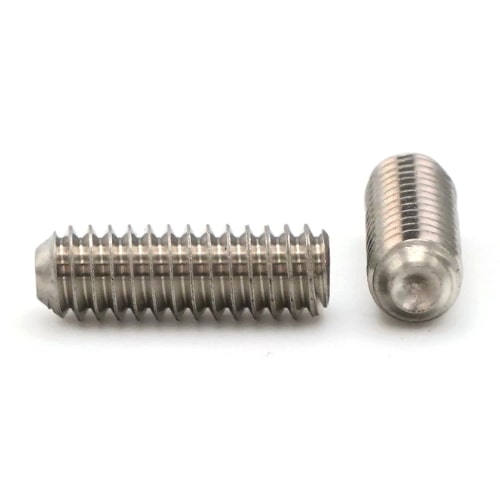
Set Screws, Marine Grade
What are marine grade set screws? Set screws are headless, fully threaded screws driven with an internal hex or slot, used to lock one part against another, most often a collar, gear, or knob onto a shaft. Because they seat below the surface they leave nothing protruding. In marine service, 316 stainless keeps them from seizing and corroding in salt, so the part can still be adjusted or removed later. AlbanyCountyFasteners.com stocks these in 316 stainless and metric 316 (A4).
Holding a shaft in a salt environment
A set screw works by clamping down through a threaded hole onto a shaft or against a mating flat, locking the two parts together with no head protruding above the surface. That flush, snag-free seat is useful anywhere a projecting head would catch, and in marine equipment it keeps collars, pulleys, and knobs fixed on their shafts. The corrosion angle is specific to how set screws are used: they are often left in place for the service life of the assembly, then expected to come out for adjustment or replacement. A corroded set screw seizes in its threaded hole and rounds out its drive recess, and you lose the ability to release the part. 316 stainless resists the salt corrosion that causes that, so the screw stays adjustable. The metric A4 option covers metric equipment with the same corrosion resistance.
Why choose marine set screws
- Headless design seats flush with nothing protruding
- Locks collars, gears, and knobs onto shafts
- 316 stainless resists salt corrosion so the screw stays adjustable
- Internal drive recess for tightening in confined spaces
- Metric 316 (A4) option for metric equipment
Common applications
- Shaft collars and couplings on marine equipment
- Pulleys, gears, and sprockets
- Knobs, levers, and handles
- Instrument and fitting retention
- Metric marine machinery (A4)
- Any shaft-locking task in a salt environment
Marine Set Screw FAQs
What point style should I choose?
Point style sets how the screw grips: a cup point bites the shaft for general holding, a flat point suits a shaft that will be adjusted, and a cone or dog point locates into a matching feature for positive location. Choose by whether you need grip, adjustability, or precise location.
Why does the grade matter if it is hidden?
Because a set screw usually has to come out again. A corroded screw seizes in its hole and rounds its recess, and the part can no longer be released. 316 resists the salt corrosion that causes this, keeping the assembly serviceable.
Is A4 the same as 316 here too?
Yes, the metric set screws are 316-equivalent A4 stainless, so corrosion resistance matches the inch 316 option. The difference is the metric thread and hex size.
Will a stainless set screw mar the shaft?
A cup point deliberately bites and can mark a shaft; that is how it grips. Where you must not mar the shaft, use a flat or soft-tip point, or a shaft with a machined flat for the screw to seat against.
How do I stop it seizing in a tapped stainless hole?
Anti-seize on the thread prevents stainless-on-stainless galling and keeps the screw removable later. This matters most on set screws precisely because they are expected to be released again.
What drive do these take?
Most are internal hex (Allen), which works well in confined spaces and resists cam-out. Keep the correct key size on hand, since a worn key rounds the recess and a corroded, rounded recess is hard to release.