

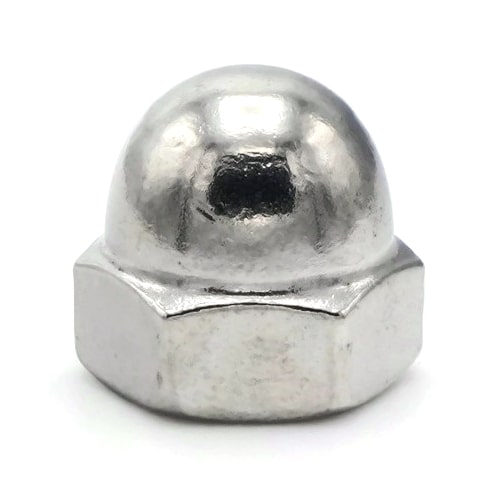
Cap Nuts, Marine Grade
What are marine grade cap nuts? Cap nuts, also called acorn nuts, have a domed closed top that covers the end of the bolt, hiding the exposed thread for a finished appearance and removing the sharp edge a cut thread leaves. On boats and docks that means safety underfoot and around lines, plus a clean look on visible hardware. In salt service they come in 316 stainless so the dome does not corrode and streak. AlbanyCountyFasteners.com stocks these in 316 stainless steel.
Why a cap nut on marine hardware?
Two reasons, and both matter more on a boat than almost anywhere else. The first is safety: an exposed bolt thread is sharp, and in a marine setting people move barefoot, handle lines under load, and brush past hardware in a moving vessel, so a cut thread is a place to snag a rope or open a shin. The domed cap covers the thread completely, removing that hazard. The second is finish: the closed dome looks deliberate and clean on visible railings, trim, and fittings, hiding the bolt end rather than leaving it proud. The closed top also keeps water and debris out of the thread end. The one dimension to check is depth, since the cap has to clear the length of bolt protruding, or the nut bottoms out on the dome before it clamps. In 316 the cap holds its finish where a plated nut would rust at the dome first.
Why choose 316 stainless cap nuts
- Domed top covers exposed thread for safety and finish
- Removes the sharp edge that snags lines and skin
- Clean appearance on visible marine hardware
- Closed top keeps water and debris out of the thread end
- 316 stainless resists corrosion at the dome in salt
Common applications
- Visible railings, stanchions, and trim
- Bolt ends near walkways and bare feet
- Marine hardware where a clean finish matters
- Dock and pier fittings
- Any exposed bolt end that must be covered
- Finishing threaded connections in salt exposure
Marine Cap Nut FAQs
What is the difference between a cap nut and an acorn nut?
They are the same thing: a hex nut with a domed closed top. Acorn refers to the shape. Both cover the bolt thread for safety and finish.
How do I choose the depth?
The dome must clear the length of bolt protruding through the nut, or it bottoms out before clamping. Measure the protrusion and pick a cap deep enough to cover it while still seating fully.
Why 316 for a cap nut?
The cap is visible and the point is a clean, safe finish. A corroding nut streaks rust at the dome. 316 resists salt so the finish and the protection last.
Can I cut the bolt to fit a cap nut?
Yes, trimming the bolt so its end sits within the cap is common. Deburr and, on stainless, dress the cut so the cap threads on cleanly without galling on a rough end.
Do cap nuts lock?
No, a standard cap nut clamps but does not resist vibration. Where loosening is a concern, use thread locker or a locking arrangement suited to the joint, then cap if a finish is still wanted.
Are these full 316 including the dome?
Yes, the whole nut is 316 stainless, dome included, so corrosion resistance is uniform. There is no coating to fail at the closed top.