

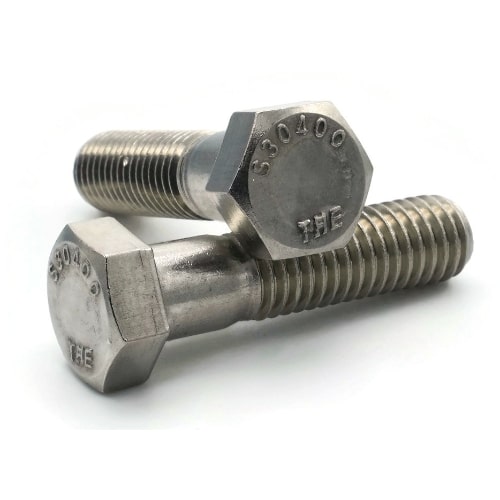
Hex Cap Screws, Marine Grade
What are marine grade hex cap screws? Hex cap screws are hex-headed bolts driven with a wrench or socket, used for structural and machine connections where you need real clamping force and the ability to torque accurately. In 316 stainless they bring that strength to salt-exposed structures: marine railings, dock hardware, boat fittings, and coastal steelwork, resisting the chloride pitting that undermines lesser grades. The six-sided head takes a standard wrench for controlled, repeatable tightening. AlbanyCountyFasteners.com stocks these in 316 stainless steel.
Where hex cap screws earn their place
When a connection has to be torqued to a value and hold it, a hex head is what you want, because a wrench or socket gives controlled, repeatable clamping force in a way no driver recess can. That makes hex cap screws the backbone of structural and mechanical marine connections, from railing bases through-bolted to a deck to machinery mounted on a coastal platform. The 316 alloy matters here as much as the head: a structural fastener that pits and loses section in salt air is a hidden liability, and 316 resists the chloride attack that would do that. Pair them with 316 nuts and washers to keep the whole joint corrosion consistent and to spread load on softer bedding.
Why choose 316 stainless hex cap screws
- Hex head takes a wrench or socket for controlled, repeatable torque
- High clamping force for structural and machine connections
- 316 stainless resists chloride pitting in salt air and spray
- Full section corrosion resistance, no coating to fail
- Pairs with 316 nuts and washers for a consistent joint
Common applications
- Marine railing and stanchion bases
- Dock and pier hardware connections
- Boat fittings and deck hardware
- Coastal structural steel and platforms
- Machinery and equipment mounting near salt water
- Any torqued structural connection facing marine exposure
Marine Hex Cap Screw FAQs
What is the difference between a hex cap screw and a hex bolt?
The terms overlap in everyday use. A hex cap screw is made to tighter tolerances with a washer face under the head, intended to be torqued into a tapped hole or against a nut. Either way, our 316 hex cap screws suit precise, torqued marine connections.
Are these fully threaded or partially threaded?
It depends on length. Shorter hex cap screws are often fully threaded, while longer ones carry a plain shank under the head. If you need full thread specifically, a hex tap bolt is the fully threaded variant.
Why 316 for structural marine bolts?
A structural bolt that corrodes loses cross section and strength where you cannot see it. 316 resists the chloride pitting that would cause that in salt air, so the connection keeps its rating over time.
What torque should I use?
Stainless torque values differ from those for plated steel, and stainless is prone to galling if run dry. Use published 316 torque figures for the size and a suitable anti-seize to reach correct clamp load without seizing the threads.
How do I stop stainless threads galling?
Galling happens when stainless slides on stainless under load and the surfaces cold-weld. Slow the driving speed, keep threads clean, and apply a marine anti-seize. This is standard practice with any stainless fastener assembly.
Can I use these below the waterline?
For deep, sealed, or permanently submerged joints, consider silicon bronze because stainless can suffer crevice corrosion without oxygen. For topside and splash-zone structural work, 316 hex cap screws are well suited.