

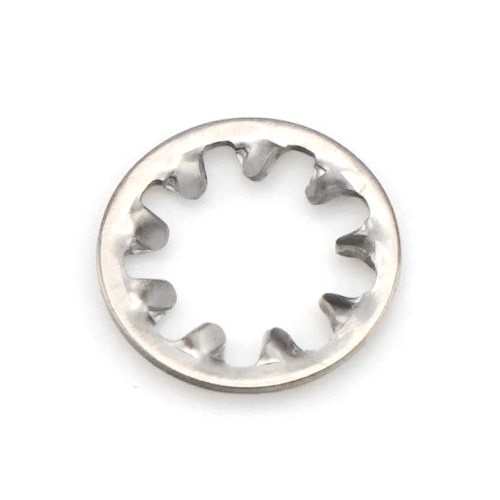
Internal Tooth Lock Washers
What are internal tooth lock washers? Internal tooth lock washers, also called internal star or serrated lock washers, have teeth that face inward around the center hole. As the fastener is tightened, the twisted teeth flatten and bite into the surface and the underside of the bolt head, resisting loosening from vibration while keeping a clean outer edge.
Internal vs external tooth lock washers
The difference is where the teeth sit. Internal tooth washers have their teeth around the inner hole, hidden under the bolt head once installed, which gives a cleaner look and suits smaller-head fasteners and tight spaces. External tooth washers put the teeth on the outer edge, acting on a larger diameter for more grip but a more exposed appearance. Because internal teeth sit closer to the screw centerline, they offer slightly less rotational resistance than external teeth of the same size, but they are compact, neat, and a common choice for electrical grounding and space-limited assemblies. Choose the material for the environment, from 410 and 316 stainless to zinc.
Material choices for internal tooth lock washers
- 410 stainless: hardened, springy stainless that holds tooth bite.
- 316 stainless: marine-grade corrosion resistance for coastal use.
- Metric 18-8 (A2): metric sizing, comparable to 304.
- Zinc plated: economical corrosion resistance for dry use.
Common applications for internal tooth lock washers
- Electrical grounding and bonding
- Smaller-head fasteners and tight spaces
- Electronics and control panels
- Sheet metal and equipment covers
For teeth on the outer edge, see external tooth lock washers, and browse every option on the main lock washers category.
Internal Tooth Lock Washers FAQ
What is the difference between internal and external tooth washers?
Internal tooth washers have inward-facing teeth hidden under the bolt head for a cleaner look and tight spaces. External tooth washers have outward-facing teeth on a larger diameter for more grip.
Why are internal tooth washers used for grounding?
The teeth bite through coatings and oxide to make solid metal-to-metal contact, which is why internal tooth washers are common at electrical ground points.
What fasteners suit internal tooth washers?
They work best with smaller-head fasteners such as fillister head screws, where the head covers the inner teeth.