

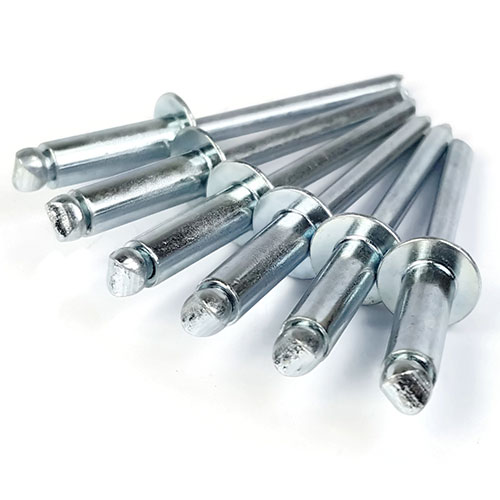
Zinc Plated Steel Dome Head Open End Rivets
What are zinc plated steel dome head rivets? These are open end blind rivets with a low carbon steel body, zinc plated for corrosion protection, and a matched steel mandrel, in the standard dome head profile. All steel construction gives substantially higher shear and tensile values than any aluminum rivet at a fraction of the cost of stainless, which makes it the practical middle ground for general fabrication. The zinc plating provides moderate corrosion protection, suitable for indoor use and light exterior exposure. AlbanyCountyFasteners.com stocks these from 3/32 inch through 1/4 inch.
When is zinc plated steel the right choice?
When you need real strength and the joint is not going to live outdoors. All steel rivets substantially outperform every aluminum variety in both shear and tensile, and they cost far less than stainless, so for structural sheet metal work in a dry environment they are the sensible specification. The limit is the plating. Zinc is a sacrificial coating, thin by nature, and it wears at the mandrel break where the plating was never continuous in the first place. That break point is where corrosion starts, usually as a small rust spot in the center of the head that spreads outward. Indoors that may never matter. On an exterior panel it will show within a season or two, which is where stainless earns its cost.
Why choose zinc plated steel rivets
- Higher shear and tensile strength than any aluminum blind rivet
- Considerably lower cost than stainless at similar strength levels
- Zinc plating gives moderate corrosion protection for indoor and light exterior use
- Matched steel mandrel, so no dissimilar metal inside the fastener
- Compatible with steel panels and framing without a galvanic couple
Sizes and grip ranges
- Body diameters from 3/32 through 1/4 inch, covering sizes 3, 4, 5, 6, and 8
- Grip ranges from about 0.020 inch through 0.625 inch depending on size
- Order by body diameter first, then match grip range to your total material stack
- Include any backup washer thickness in the grip calculation
Common applications
- Steel sheet metal fabrication and enclosure work
- Interior ductwork, HVAC, and mechanical assemblies
- Brackets, frames, and structural sheet connections
- Machinery guards, panels, and equipment housings
- Shelving, racking, and industrial fixtures
- General production work where strength matters and exposure does not
For outdoor or wet service, step up to 304 stainless dome head rivets, which will not stain at the mandrel break. Where you are fastening aluminum, use aluminum rivets to avoid a galvanic couple.
Related Categories
- Dome Head Open End Rivets
- 304 Stainless Dome Head Rivets
- Countersunk Rivets
- Large Flange Rivets
- Rivet Tools
Zinc Plated Steel Rivet FAQs
How much corrosion protection does zinc plating give?
Moderate, and mostly indoors. Zinc is a sacrificial coating that protects the steel beneath by corroding first, but the layer is thin and the mandrel break exposes bare steel at the center of the head. Expect indoor service to be trouble free and exterior exposure to show rust at the break within a season or two.
Are steel rivets stronger than aluminum?
Considerably, in both shear and tensile. The strength order runs aluminum with aluminum mandrel lowest, then aluminum with steel mandrel, then all steel, then stainless highest. All steel gives most of stainless's capability at a much lower price.
Can I use these outdoors?
For light exposure under cover, they will serve. For direct weather, coastal air, or anything visible, use stainless. The rust spot that develops at the mandrel break is small but conspicuous, particularly on a painted or light colored panel.
Do steel rivets need a stronger tool?
More force than aluminum but less than stainless. A hand riveter handles smaller sizes, while 3/16 and 1/4 inch are considerably easier with a lever or pneumatic tool, especially over a long run.
Can I use these on aluminum panels?
Not where moisture is present. Steel and aluminum form a galvanic couple, with the aluminum corroding preferentially around each hole. For aluminum work use aluminum rivets, or stainless if you need more strength.
Is the mandrel also plated?
Mandrels may be supplied plain or coated depending on the manufacturer. Either way the break exposes fresh steel, which is the point where corrosion typically starts on a zinc plated rivet.