

Resources
Countersunk Rivets
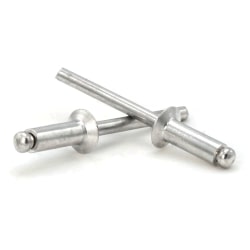
What are countersunk rivets? Countersunk rivets have a flat 120 degree head that seats into a countersunk hole so the finished rivet sits flush with the panel surface. That flush finish is the entire purpose: it leaves nothing protruding to catch, snag, or interfere with a moving part passing over the joint, and it gives a cleaner appearance on visible surfaces. The hole must be countersunk to match, since the head needs somewhere to sit. AlbanyCountyFasteners.com stocks countersunk rivets in aluminum, 304 stainless steel, and zinc plated steel.
Videos
Play videoWhen should I use a countersunk rivet?
Whenever something has to pass over the joint or the surface has to look finished. The classic cases are sliding doors and panels, conveyor and chute surfaces where material moves across the rivet line, machine guards where a proud head would snag, and any visible architectural or product surface where a row of dome heads reads as unfinished. The requirement that comes with it is preparation: you have to countersink each hole to match the 120 degree head angle. Skip that and the head sits proud anyway, defeating the purpose, or worse, the rivet sets crooked and the joint is weak.
Why choose countersunk rivets
- Flush finish with nothing protruding above the panel surface
- No snag point for material, hands, or moving components passing over the joint
- Clean appearance on visible and architectural surfaces
- Allows clearance for parts that travel across the fastened area
- Available in matched materials for corrosion critical work
Material options
- Aluminum with aluminum mandrel, lightweight and matched, well suited to aluminum panels
- 304 stainless with stainless mandrel, highest strength and corrosion resistance for exposed and marine work
- Zinc plated steel with steel mandrel, strong and economical for general indoor and light exterior use
Common applications
- Sliding doors, panels, and covers where clearance is needed
- Conveyor beds, chutes, and hoppers with material moving across the surface
- Machine guards and enclosures where a proud head would snag
- Visible architectural panels and product surfaces
- Aircraft and vehicle skins where surface profile matters
- Any joint that will be covered by trim, gasket, or a mating surface
Where a flush finish is not required, open end rivets need no countersinking and cost less. If the material is too thin to countersink, large flange rivets are usually the better answer.
Related Categories
Countersunk Rivet FAQs
Do I have to countersink the hole?
Yes. The head needs a matching conical seat or it will sit proud and set crooked. Use a 120 degree countersink to match the head angle, and take the depth to just below flush so the head can seat fully without standing above the surface.
What angle are countersunk rivet heads?
120 degrees is the standard for blind rivets, which is a wider angle than the 82 degree countersink common on machine screws. Using an 82 degree countersink will not seat a 120 degree head correctly, so match the tool to the fastener.
How thin can the material be?
Thin enough to countersink without breaking through, which is the limiting factor. If countersinking would leave a knife edge or perforate the sheet, the material is too thin for this style. Use a large flange rivet instead and accept the proud head.
Are countersunk rivets weaker than dome head?
Slightly, in tensile, because the head has less bearing area and the countersinking removes material from the panel. In shear the difference is minor. For a flush joint under significant tensile load, step up a diameter to compensate.
Can countersunk rivets seal?
Not on their own, these are open end bodies. For a flush joint that also seals, you would need to combine a sealed style or apply sealant, since the countersunk seat itself is not a water barrier.
Which material for exterior use?
304 stainless with a stainless mandrel for anything exposed or coastal. Zinc plated steel handles general exterior work at lower cost but will eventually show corrosion at the mandrel break, which is more visible on a flush surface than a domed one.