

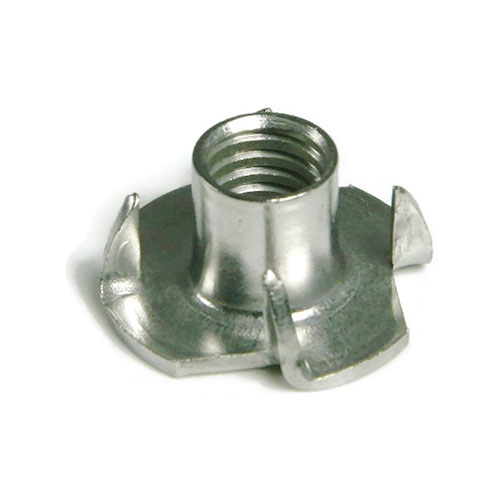
T-Nuts, Marine Grade
What are marine grade T-nuts? T-nuts have a long barrel and a flange, often with prongs, that embeds into wood or panel material to provide a strong, flush machine-screw thread where the material itself cannot be tapped. Driven or pressed in from one face, they let a bolt thread into timber, plywood, or composite repeatedly. In marine service they come in 316 stainless. AlbanyCountyFasteners.com stocks these in 316 stainless steel.
Giving wood a durable machine thread
Wood and panel materials do not hold a machine thread on their own, and a wood screw cannot be removed and refitted many times without wearing its hold. The T-nut solves both: its barrel sits in a drilled hole and its prongs or flange bite the surface, embedding a steel thread into the material so a machine bolt can be driven in and out repeatedly with full strength. On marine joinery, removable panels, and hardware mounts that will be unbolted for service, that reusable metal thread is exactly what is wanted. The flange seats flush on the back face, and the prongs stop the nut spinning as the bolt tightens. The material point is that the T-nut is often embedded in damp marine timber, where a corroding nut would swell, stain the wood, and lose its thread; 316 resists that, keeping the embedded thread sound. Match it to a 316 bolt so the whole connection stays corrosion consistent.
Why choose 316 stainless T-nuts
- Embeds a machine thread into wood, plywood, or composite
- Prongs or flange resist spinning as the bolt tightens
- Allows repeated bolt removal with full thread strength
- Seats flush on the back face
- 316 stainless resists corrosion embedded in damp timber
Common applications
- Marine joinery and cabinetry
- Removable panels and access covers
- Hardware mounts unbolted for service
- Plywood and composite fixings
- Repeated-use threaded holes in timber
- Any embedded machine thread in salt exposure
Marine T-Nut FAQs
How does a T-nut install?
Drill a hole for the barrel, then press or drive the T-nut in from one face so its prongs or flange bite the surface. The barrel sits in the hole and provides a machine thread for a bolt from the other side.
Why use a T-nut instead of a wood screw?
A T-nut gives a reusable machine thread that a bolt can drive in and out of repeatedly with full strength, where a wood screw wears its hold with each removal. Use it where the joint will be unbolted for service.
Why 316 for a T-nut?
Embedded in damp marine timber, a corroding nut swells, stains the wood, and loses its thread. 316 resists salt so the embedded thread stays sound and the wood unstained.
Which face does the flange sit on?
The flange seats on the back or blind face, with the bolt entering from the front. The prongs grip that back face to stop the nut spinning as the bolt is tightened.
Will it hold in thin panel?
Holding depends on the barrel length and the material thickness gripping it. In thin panel, choose a T-nut sized to the thickness, and in soft material a larger flange spreads the load better.
Should the bolt be 316 too?
Yes, matching a 316 bolt to the 316 T-nut keeps the connection corrosion consistent and avoids galvanic mismatch inside damp timber.