

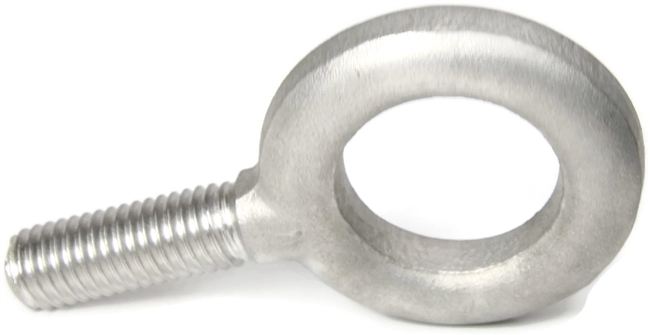
Plain Pattern Eye Bolts
What are plain pattern eye bolts? Plain pattern eye bolts are non-shouldered eye bolts with a looped head on a threaded shank, designed for straight vertical, in-line lifts and general attachment. Without a shoulder, they are not rated for angular loads and should only be used where the pull is directly in line with the shank.
Videos
Play videoPlain pattern vs shoulder pattern eye bolts
The difference is the shoulder, and it matters for safety. A plain pattern eye bolt has no shoulder where the eye meets the shank, so it is designed for vertical, in-line lifts only and must never be used for angular or side loading, where even a small angle can bend or break it. A shoulder pattern eye bolt adds a shoulder that seats against the load to handle angular lifts when properly derated. Use plain pattern for straight vertical lifts, tie-downs, and general attachment, and step up to shoulder pattern whenever a sling or pull could be at an angle. Choose the material for the environment, from 304 and 316 stainless to zinc, galvanized, and 8620 alloy steel.
Material choices for plain pattern eye bolts
- 304 and 316 stainless: corrosion resistance, with 316 for coastal use.
- Zinc plated: economical corrosion resistance for dry use.
- Hot dipped galvanized: durable coating for outdoor use.
- 8620 steel: alloy steel for strength.
Common applications for plain pattern eye bolts
- Straight vertical, in-line lifts
- Tie-downs and anchor points
- Cable, rope, and chain attachment
- General rigging and suspension (in-line)
For angular lifts, see shoulder pattern eye bolts, and browse every option on the main eye bolts category.
Plain Pattern Eye Bolts FAQ
Can I use a plain pattern eye bolt for angular lifts?
No. Plain pattern eye bolts have no shoulder and are rated for vertical, in-line lifts only. Even a small angle can bend or break them. Use a shoulder pattern eye bolt for any angular load.
When should I choose plain pattern?
Choose plain pattern for straight vertical lifts, tie-downs, and general attachment where the pull is directly in line with the shank.
What is the difference from a nut version?
A plain pattern with nut version has an extended shank secured by a nut from the far side, for through-hole mounting where you have access to both sides.