

Self Drilling Screws
Resources
What are self-drilling screws?
Self drilling screws, commonly referred to as TEK® screws, are self tapping fasteners with an integrated drill point that drills a pilot hole and forms mating threads in a single installation step. By eliminating the need for separate drilling, self drilling screws significantly reduce installation time while providing strong, reliable fastening in a wide range of metal fabrication and construction applications. Designed primarily for fastening metal to metal and metal to wood, self drilling screws are commonly used in steel framing, metal roofing, siding, HVAC ductwork, structural steel, trailers, equipment enclosures, and other commercial and industrial applications. Available with multiple drill point sizes, head styles, drive types, thread configurations, materials, and corrosion resistant finishes, they can be matched to different material thicknesses and environmental conditions for optimal performance. Whether you're installing metal panels, fastening steel studs, assembling equipment, or completing general construction projects, self drilling screws provide a fast, dependable fastening solution that combines drilling, tapping, and fastening into one efficient operation.
Self Drilling Screws
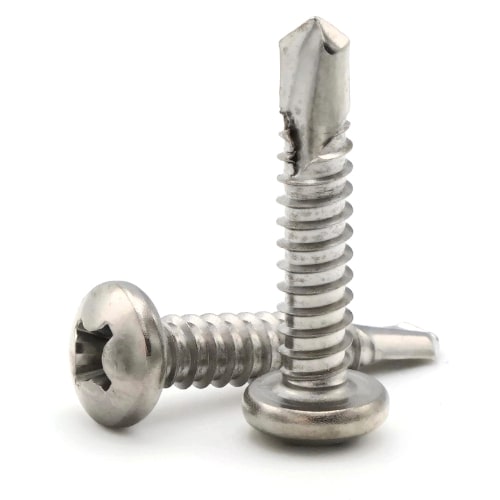
Phillips Pan Head
Self-drilling screws with a rounded pan head and Phillips drive, the general-purpose choice for fastening metal without a pilot hole.
.jpg?ts=1755909497 "Phillips Flat Head")
Phillips Flat Head
Countersunk self-drilling screws with a Phillips drive that sink flush while boring their own hole.
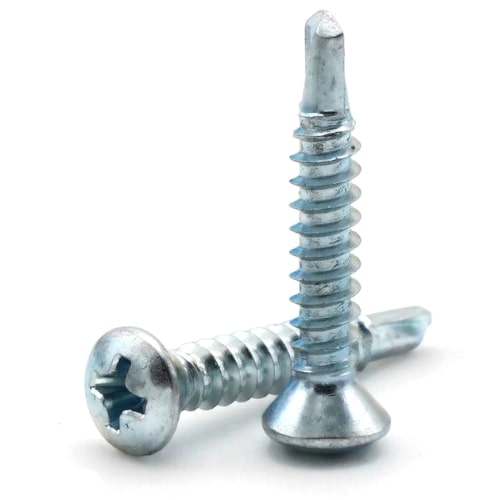
Phillips Oval Head
Countersunk self-drilling screws with a Phillips drive and slightly raised decorative dome.

Phillips Wafer Head
Self-drilling screws with a very wide, thin low-profile head and Phillips drive that spread load and sit close to flush.
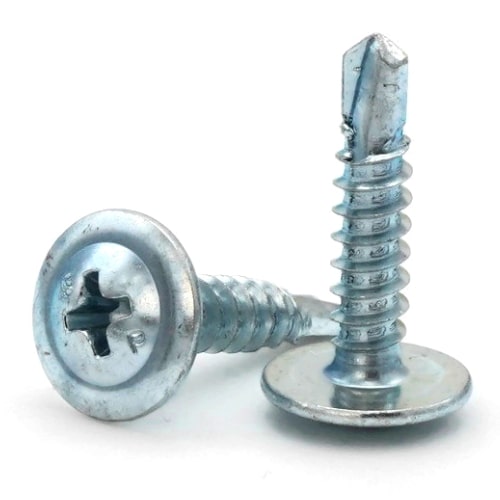
Phillips Modified Truss Head
Self-drilling screws with an extra-wide truss head and Phillips drive for maximum bearing on thin material.
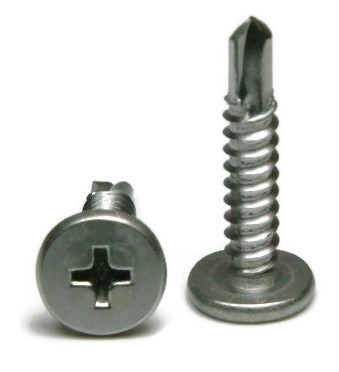
Phillips Pancake Head
Self-drilling screws with a thin, wide flat head and Phillips drive that sit nearly flush under overlapping panels.
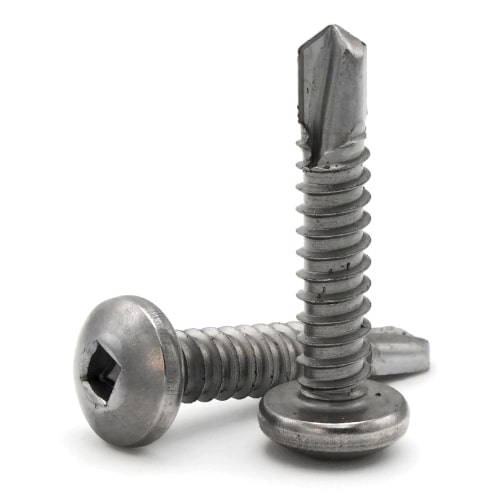
Square Drive Pan Head
Pan-head self-drilling screws with a square drive that resists cam-out under high torque.
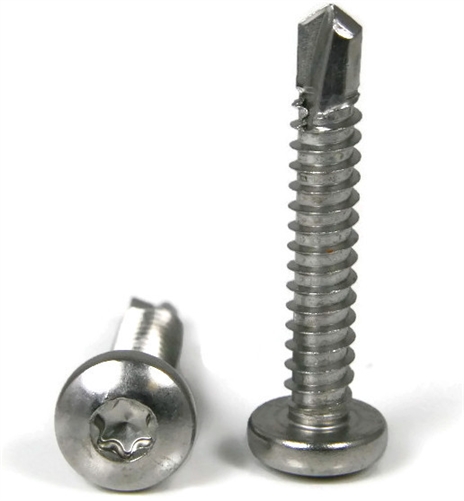
Torx Star Drive Pan Head
Pan-head self-drilling screws with a Torx star drive that minimizes stripping under high torque.

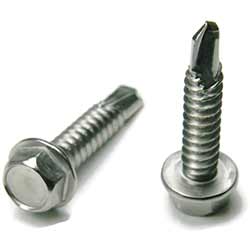
Hex Washer Head
Self-drilling screws with an integrated washer under a hex head, driven with a nut driver for high torque and a wide clamp against metal.
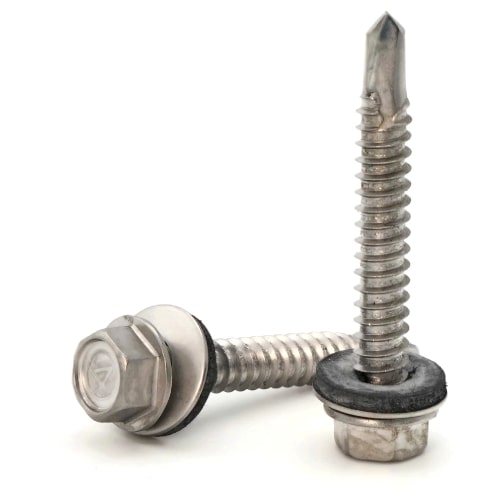
Hex Washer EPDM head
Self-drilling screws with a hex washer head and bonded EPDM sealing washer that closes out the hole against water, used on roofing and siding.
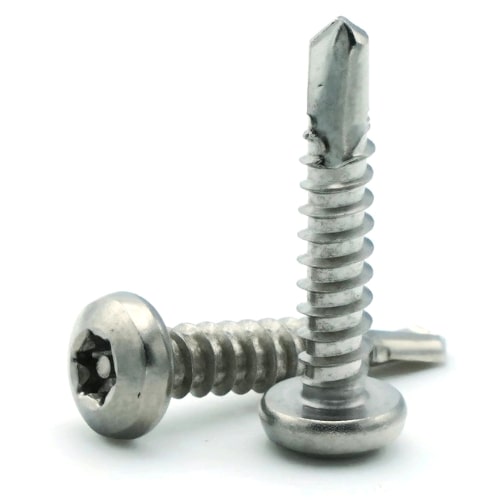
Pan Head Torx Star Pin In
Security drilling/tapping screws with a rounded pan head and center-pin Torx recess for tamper resistance.
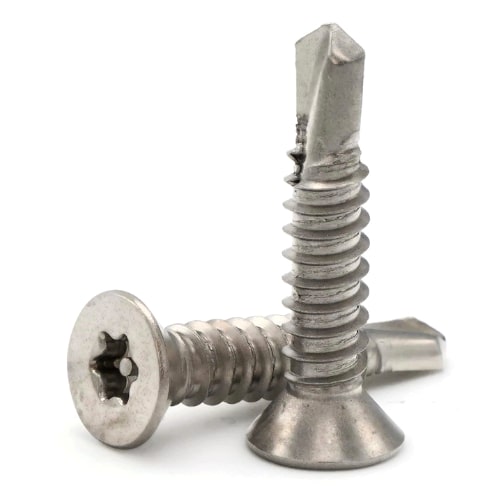
Videos
Play videoShop Related Categories
.jpg?ts=1755907166)


How do TEK drill-point numbers work on self-drilling screws?
The TEK number indicates the drill-point length/geometry and, by extension, the maximum steel thickness the screw can drill. Higher numbers are for thicker steel. Choose the point number specified on the product chart for your total stack-up.
- TEK 1–2 — thin sheet and light-gauge work
- TEK 3 — common for 14 ga and similar
- TEK 4–5 — heavier structural steel and thicker stack-ups
What head and drive options do self-drilling screws have?
- Hex-washer — high torque transfer and wide bearing for exterior panels and framing
- Pan / button / truss — broad bearing on thin sheet; clean appearance
- Flat (countersunk) — sits flush in a countersink for a smooth finish
- Roofing and siding heads — paired with sealing washers for weather-tight installs
- Drives — hex, Phillips, combo, Torx/6-lobe, and security drives
Which materials and finishes are best for self-drilling screws?
- Coated carbon steel — economical with corrosion-resistant coatings for exterior work
- 410 stainless — heat-treated magnetic stainless for hard drill points and good corrosion resistance
- 18-8 / 304 stainless — used on certain styles where maximum corrosion resistance is prioritized (drill-point capability varies)
- Zinc-plated steel — bright finish for dry interior environments
How do I size and specify self-drilling screws?
Order by diameter × thread × length (e.g., #10-16 × 1″, 1/4″-14 × 1-1/2″, M5-0.8 × 25 mm). Measure length from under the head (flat heads measured overall). Always match the TEK number to the total material thickness.
When should I use self-drilling screws vs self-tapping screws?
- Choose self-drilling to drill and tap in one step for steel studs, purlins, and panels
- Choose self-tapping when pilot holes are already present or for plastics/thin sheet that favor tapping points
Common applications for self-drilling screws
- Metal framing, purlins, and structural attachments
- Roofing and siding panels with sealing washers where required
- HVAC, electrical, and mechanical fastenings to steel
- Automotive, trailer, and equipment assembly
Installation tips for self-drilling screws
- Use the correct driver speed: let the drill point cut before applying full torque
- Keep the driver square; steady pressure minimizes walking and broken points
- Select sealing washers for exterior panels when specified
- For stainless threads, consider a compatible anti-seize to reduce galling
Safety and performance notes for self-drilling screws
- Verify steel thickness and stack-up against the product’s TEK rating
- Do not over-torque; stop when the washer seats and the panel is clamped
- Avoid mixing dissimilar metals that could cause galvanic corrosion