

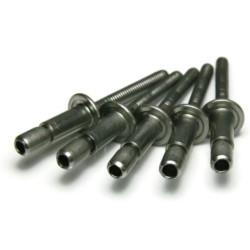
302 Stainless Steel Structural Rivets
What are 302 stainless structural rivets? These are structural blind rivets in 302 stainless with a matched stainless mandrel. What makes a rivet structural is the mandrel lock: the retained stem is mechanically held in the body rather than sitting by friction, so it cannot vibrate out and continues carrying load for the life of the joint. That gives substantially higher shear values and much better clamp-up than a standard blind rivet. Pairing it with 302 stainless adds corrosion resistance for outdoor and marine service. AlbanyCountyFasteners.com stocks these in 3/16 and 1/4 inch.
Rivet Number, Diameter:
Why does the locked mandrel matter?
Because on an ordinary blind rivet, the mandrel head is held only by friction, and friction loses to vibration eventually. When that stem works free, the rivet loses whatever strength the stem was contributing and you are left with a thin hollow body carrying the joint alone. In a high vibration assembly such as a vehicle chassis or a machine frame, that is a slow failure nobody sees coming, because the head still looks fine from the outside. A structural rivet locks the stem into the body mechanically, so the mandrel becomes a permanent part of the fastener. It is also why structural rivets break the stem flush with the head across the full grip range, since a stem left proud would mean the lock had not fully engaged.
Why choose 302 stainless structural rivets
- Mechanically locked mandrel that cannot vibrate free of the body
- Substantially higher shear and tensile strength than standard blind rivets
- High clamp-up force, pulling joint materials tightly together
- Stem breaks flush with the head across the full grip range
- Matched stainless mandrel, so nothing inside the rivet can rust
- 302 stainless suits outdoor, marine, and washdown service
Sizes and grip ranges
- 3/16 inch body with a wide grip range from 0.059 through 0.270 inch
- 1/4 inch body with a wide grip range from 0.080 through 0.375 inch
- The wide grip ranges are characteristic of structural rivets and reduce sizes needed
- Order by body diameter, then confirm your material stack falls inside the range
Where structural rivets are required
- Load bearing joints where standard blind rivets are not rated
- High vibration assemblies including vehicle and machinery mounting
- Transportation and trailer structural connections
- Equipment frames and chassis work
- Marine and outdoor structural joints needing corrosion resistance
- Joints that must not loosen across years of service
For general work at lower cost, open end rivets are the standard choice, and multi-grip rivets offer more strength than open end without moving to a full structural fastener. If the joint needs a reusable thread rather than a permanent clamp, consider rivet nuts.
Related Categories
302 Stainless Structural Rivet FAQs
What is 302 stainless?
An austenitic stainless very close to 304 in composition and corrosion behavior, with slightly higher carbon that supports greater strength after work hardening. It is a common choice for spring and high strength stainless fasteners, which is why it appears in structural rivets.
How much stronger are structural rivets?
Significantly, particularly in shear, and they deliver much higher clamp-up. Exact values vary by size and manufacturer, so check the published shear and tensile figures against your requirement rather than substituting on the assumption they are stronger.
Do these need a special tool?
Usually yes. Structural rivets require considerably more pulling force than standard rivets, so a hand riveter is generally inadequate. Plan on a lever tool or a pneumatic riveter rated for the diameter and material.
Why is the grip range so wide?
Structural rivets are designed to break flush across their entire grip range, and that design tends to accommodate a wider span of material thickness than a standard rivet. It is a practical benefit, since one size covers more of your work.
Can these replace bolts?
In many shear applications, and they will not loosen the way a threaded fastener can. They cannot be disassembled without drilling and do not develop the same preload as a torqued bolt, so they are not a direct substitute in every engineered connection.
Are they suitable for marine use?
302 stainless handles salt air, spray, and washdown well, and the matched stainless mandrel means nothing inside the rivet will rust. For constant saltwater immersion, 316 offers better pitting resistance, though 302 covers most marine structural work.