

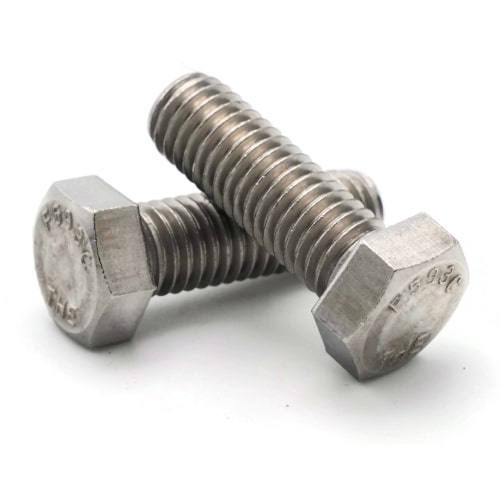
Hex Tap Bolts, Marine Grade
What are marine grade hex tap bolts? A hex tap bolt is a fully threaded hex-headed bolt, the full-thread version of a hex cap screw. That full thread suits tapped holes, thinner assemblies, and any joint where you want thread engagement all the way to the head. AlbanyCountyFasteners.com stocks these in three marine options: 316 stainless for general corrosion resistance and strength, silicon bronze for wooden and sealed-joint work, and metric 316 stainless (A4) for metric assemblies.
Full thread, and which material
The full thread is the defining feature. Where a partially threaded bolt leaves a plain shank under the head, a tap bolt is threaded end to end, so it engages fully in a tapped hole and lets you clamp thin stacks where a shank would waste length. On material choice, the three options map to three jobs. 316 stainless is the general-purpose marine pick, strong and chloride resistant for topside structural and machine work. Silicon bronze is for wood and for deep or sealed joints where stainless risks crevice corrosion, bringing the same anaerobic corrosion resistance that makes bronze the boatbuilder's metal. Metric 316, marked A4, is the same 316 alloy in metric threads for assemblies built to metric standards. A4 and 316 are the same material designation, so expect identical corrosion behaviour.
Why choose marine hex tap bolts
- Fully threaded for tapped holes and thin assemblies
- 316 stainless resists chloride pitting for general marine use
- Silicon bronze suits wood and sealed, oxygen-starved joints
- Metric 316 (A4) covers metric assemblies with identical corrosion resistance
- Hex head takes a wrench for controlled, repeatable torque
Common applications
- Tapped-hole connections in marine hardware
- Thin plate and bracket assemblies
- Boat fittings and railings
- Wooden boat and dock work (silicon bronze)
- Metric-standard marine equipment (A4)
- Any full-thread structural connection in a salt environment
Marine Hex Tap Bolt FAQs
What is the difference between a tap bolt and a cap screw?
A tap bolt is fully threaded to the head; a cap screw of the same size may have a plain shank under the head on longer lengths. Choose a tap bolt when you want thread engagement all the way up, such as in a tapped hole or a thin stack.
Is A4 the same as 316?
Yes. A4 is the metric designation for the 316-equivalent austenitic stainless, so its corrosion resistance and general properties match 316. The difference is thread standard, metric versus inch, not material.
When would I pick silicon bronze here?
For fastening into wood and for deep or sealed joints where a stainless bolt could suffer crevice corrosion in the absence of oxygen. Bronze resists corrosion in those conditions and will not stain surrounding timber.
Do fully threaded bolts hold as well as shanked ones?
For clamping in tapped holes and thin joints, yes, and they engage more thread. In joints subject to shear across a plain shank, a partially threaded bolt can be preferred so the shank, not the threads, takes the shear. Match the bolt to the loading.
Will stainless tap bolts gall in tapped stainless holes?
They can, since stainless on stainless is prone to galling under load. Use anti-seize, drive slowly, and keep threads clean. This is standard for stainless-into-stainless assembly.
Can I mix a bronze bolt with a stainless nut?
They sit fairly close galvanically, so the risk is modest, but in a wet salt environment it is best to keep a joint in one metal where practical, or isolate with bedding. For a bronze bolt, a bronze nut keeps the joint consistent.