

Stainless Steel Hex Bolts and Hex Cap Screws
What are stainless steel hex head bolts? Stainless steel hex head bolts are corrosion-resistant fasteners with a six-sided head, driven with a wrench or socket for use with a nut or in a tapped hole. Made from stainless, they resist rust in wet, coastal, and outdoor conditions across machinery, structural, and general assembly.
Stainless Steel Hex Bolts

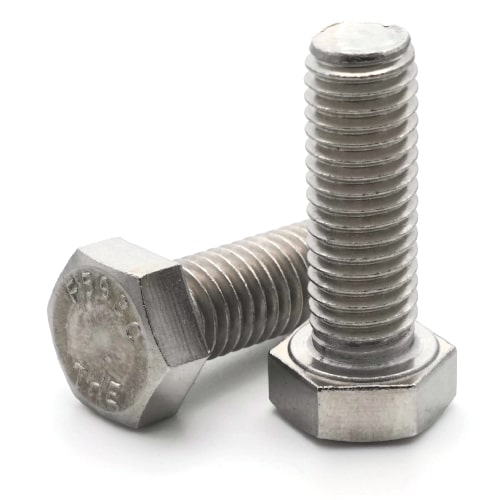
Hex Tap Bolts
Corrosion-resistant fully threaded hex bolts in stainless for tapped holes and thin-material clamping where full engagement is needed.

Flange Bolts
Corrosion-resistant 18-8 stainless hex bolts with a built-in flange that spreads load and speeds assembly, no separate washer needed.
What Are Stainless Steel Hex Bolts?
Stainless steel hex bolts are corrosion-resistant threaded fasteners with a six-sided head designed for installation with a wrench or socket. Depending on the fastener style, they may be used with a matching nut or installed into a tapped hole.
Albany County Fasteners carries stainless steel hex head fasteners in several configurations, including hex cap screws, fully threaded hex tap bolts, and flange bolts. Available stainless options include 18-8, 316, metric A2, and metric A4 stainless steel for applications ranging from machinery and equipment assembly to outdoor, marine, and corrosion-sensitive installations.
Types of Stainless Steel Hex Head Bolts
Stainless Steel Hex Cap Screws
Hex cap screws are precision hex-head fasteners designed for use with a nut or in a tapped hole. They are available in partially threaded and, depending on size and product style, fully threaded configurations.
Shop our 18-8 Stainless Steel Hex Cap Screws and 316 Stainless Steel Hex Cap Screws.
Stainless Steel Hex Tap Bolts
Hex tap bolts are fully threaded hex-head fasteners with threads extending along the available shank length. They are useful in tapped holes and applications where thread engagement is required close to the bolt head.
Stainless Steel Flange Bolts
Flange bolts have an integrated flange beneath the hex head that provides a wider bearing surface. The flange can distribute clamping force across a larger area and may eliminate the need for a separate flat washer in applications where the fastener design and engineering requirements permit.
18-8 vs. 316 Stainless Steel Hex Bolts
Choosing between 18-8 and 316 stainless steel is one of the most important decisions when selecting stainless steel hex bolts. Both provide corrosion resistance, but they are suited to different exposure conditions.
18-8 Stainless Steel Hex Bolts
18-8 stainless steel describes a family of austenitic stainless steels containing approximately 18% chromium and 8% nickel. It is commonly associated with 300-series stainless steels and provides good corrosion resistance for many indoor, outdoor, freshwater, machinery, equipment, and general-purpose applications.
18-8 stainless is an excellent general-purpose choice when strong corrosion resistance is needed but the fastener will not be exposed to highly aggressive chloride, saltwater, or chemical environments.
316 Stainless Steel Hex Bolts
316 stainless steel contains molybdenum in addition to chromium and nickel, providing increased resistance to chloride-related corrosion compared with common 18-8 stainless grades. This makes 316 stainless steel particularly valuable for marine, coastal, saltwater, washdown, and other demanding corrosion environments.
For docks, boats, coastal construction, marine equipment, and other applications with significant salt or chloride exposure, 316 stainless steel is generally preferred over standard 18-8 stainless steel when the application specifications permit.

How to Choose Between 18-8 and 316 Stainless Steel
- General indoor use: 18-8 stainless steel is suitable for many corrosion-resistant fastening applications.
- General outdoor use: 18-8 stainless may be appropriate depending on environmental exposure and application requirements.
- Freshwater applications: 18-8 stainless is commonly used where severe chloride exposure is not present.
- Marine and saltwater environments: 316 stainless steel provides greater resistance to chloride-related corrosion.
- Coastal environments: 316 stainless is often preferred where airborne salt and moisture create more aggressive conditions.
- Chemical or washdown environments: Material selection should be based on the specific chemicals, temperature, exposure, and engineering requirements.
Material compatibility and corrosion performance depend on the entire assembly and environment. Always verify the stainless grade and applicable specifications for critical or engineered applications.
Metric A2 and A4 Stainless Steel Hex Bolts
Metric stainless fasteners are commonly identified using A2 and A4 stainless designations.
- A2 stainless steel: A commonly used austenitic stainless classification for general corrosion-resistant metric fastening. A2 is frequently compared with 304-family stainless steel in general application discussions, although the applicable fastener specification should be used when exact material requirements matter.
- A4 stainless steel: A molybdenum-bearing stainless classification offering increased resistance to chloride environments and commonly selected for marine, coastal, and more corrosive applications. It is frequently compared with 316-family stainless steel.
Always verify the specific material standard and property class required for the application rather than assuming inch and metric stainless designations are directly interchangeable.
Where Are Stainless Steel Hex Bolts Used?
Stainless steel hex bolts are used anywhere corrosion resistance, strength, serviceability, and a wrench-driven hex head are beneficial. Common applications include:
- Machinery and industrial equipment
- OEM and manufacturing assemblies
- Outdoor fixtures and equipment
- Construction and structural assemblies where the specified fastener is appropriate
- Marine and dock hardware
- Food equipment and washdown environments where the selected stainless grade is suitable
- Automotive and equipment service
- Railings, brackets, frames, and mounting hardware
- Coastal and corrosion-sensitive applications
Stainless Steel Hex Bolts for Marine and Coastal Applications
Stainless steel is widely selected for marine and coastal fastening because it provides significantly greater corrosion resistance than many uncoated carbon steel fasteners. However, not every stainless steel grade provides the same resistance to salt and chloride exposure.
For applications near saltwater or in other chloride-rich environments, 316 Stainless Steel Hex Cap Screws are generally preferred over standard 18-8 stainless fasteners when compatible with the application requirements.
For less aggressive environments, 18-8 Stainless Steel Hex Cap Screws provide dependable corrosion resistance for many general-purpose applications.
Hex Bolt vs. Hex Cap Screw: What Is the Difference?
The terms hex bolt and hex cap screw are frequently used interchangeably in everyday purchasing and product searches, but dimensional standards can distinguish between specific fastener types.
Hex cap screws are typically manufactured to defined dimensional requirements that include characteristics such as the head dimensions, bearing surface, thread length, and body tolerances. In practical applications, the correct fastener should be selected according to the required dimensions, thread, material, strength, and applicable specification rather than relying only on the general product name.
Browse Hex Bolts in all available materials to compare stainless steel with zinc plated steel, Grade 5, Grade 8, galvanized, and other available options.
How Are Stainless Steel Hex Bolts Sized?
Inch hex bolts and hex cap screws are typically specified by diameter, thread count, and length, such as 1/2"-13 x 3". The first number identifies the nominal diameter, the second identifies the number of threads per inch, and the final dimension identifies the fastener length.
Metric fasteners are commonly specified by diameter, thread pitch, and length, such as M10-1.5 x 50 mm.
Hex bolt length is generally measured from beneath the head to the end of the fastener. Always verify thread length, thread pitch, dimensional standard, and other required specifications when replacing an existing fastener.
Coarse vs. Fine Thread Stainless Steel Hex Bolts
Inch stainless steel hex bolts may be available with coarse or fine threads depending on diameter and product family.
- UNC coarse threads: Commonly used for general-purpose fastening and provide fewer threads per inch.
- UNF fine threads: Provide more threads per inch and may be specified where finer adjustment, particular thread engagement, or application requirements call for a fine-thread fastener.
The bolt and mating nut or tapped hole must always have the same diameter and thread series.
Fully Threaded vs. Partially Threaded Hex Bolts
The required thread configuration depends on the joint design.
Hex tap bolts are fully threaded, making them useful when thread engagement is needed along most or all of the fastener length. Many longer hex cap screws have an unthreaded portion of the shank that can pass through the joined material before the threaded section engages the nut or tapped hole.
Always verify the actual thread length when an application requires a specific grip length or thread engagement.
Preventing Galling on Stainless Steel Hex Bolts
Stainless steel threaded fasteners can experience galling, a form of adhesive wear that can cause mating threads to seize during installation. Galling risk can increase with high installation speed, friction, excessive torque, damaged threads, or stainless-on-stainless assemblies.
To help reduce galling:
- Keep threads clean and free of damage or debris
- Avoid unnecessarily high installation speeds
- Use appropriate installation torque and tools
- Consider a compatible anti-seize or thread lubricant when appropriate for the application
- Stop tightening if the fastener begins to bind unexpectedly
Lubrication can affect the relationship between installation torque and clamp load, so engineered applications should follow the specified installation procedure.
How to Identify Bolt Grades and Head Markings
Bolt head markings can provide useful information about the material or strength classification of many fasteners. Watch our Fasteners 101 guide to learn what common bolt head markings mean and how different bolt grades are identified.
Watch: Bolt Head Markings: What Do They Mean? | Fasteners 101 →
Matching Stainless Steel Nuts and Washers
A stainless steel hex bolt is only one part of the fastening assembly. Nuts and washers should be selected to match the required diameter, thread, material compatibility, mechanical requirements, and environmental exposure.
Shop Stainless Steel Hex Nuts and Flat Washers to complete your assembly.
For additional stainless fastener styles, browse our Stainless Steel Screws & Bolts.
Frequently Asked Questions About Stainless Steel Hex Bolts
What are stainless steel hex bolts?
Stainless steel hex bolts are threaded fasteners with a six-sided head manufactured from corrosion-resistant stainless steel. They are installed with a wrench or socket and may be used with a matching nut or in a compatible tapped hole.
What is the difference between 18-8 and 316 stainless steel hex bolts?
18-8 stainless steel provides good general-purpose corrosion resistance for many indoor, outdoor, and freshwater applications. 316 stainless contains molybdenum and provides increased resistance to chloride-related corrosion, making it a preferred option for many marine, coastal, and saltwater environments.
Is 18-8 stainless steel the same as 304 stainless steel?
Not exactly. The term 18-8 describes a broader family of stainless steels containing approximately 18% chromium and 8% nickel. Type 304 is a commonly encountered stainless grade within the broader 18-8 family. When a project specifically requires Type 304 or another defined grade, verify the actual material specification rather than relying only on the 18-8 designation.
Is 316 stainless steel better than 18-8?
Neither grade is universally better for every application. 316 stainless generally provides greater resistance to chloride and salt exposure, while 18-8 stainless provides excellent corrosion resistance for many less aggressive environments and is often more economical. Choose the material based on environmental exposure and application requirements.
Are stainless steel hex bolts suitable for saltwater?
316 stainless steel is commonly selected for saltwater, marine, and coastal environments because of its increased resistance to chloride-related corrosion. The suitability of any fastener still depends on the exact exposure, mating materials, mechanical requirements, and applicable project specifications.
Are stainless steel hex bolts strong enough for structural applications?
Strength depends on the specific stainless steel material, fastener specification, diameter, thread, and required mechanical properties. Do not substitute a stainless steel fastener for a specified structural bolt based only on diameter. Verify the required tensile strength, yield strength, applicable fastener standard, and engineering requirements for the connection.
Why do stainless steel bolts seize?
Stainless steel threads can seize because of galling, which occurs when friction and pressure cause mating thread surfaces to adhere to one another. Proper installation speed, clean threads, suitable torque practices, and compatible anti-seize or lubricant when appropriate can help reduce the risk.
Can stainless steel hex bolts be used outdoors?
Yes. Stainless steel is commonly selected for outdoor applications because of its corrosion resistance. The appropriate grade depends on the severity of moisture, salt, chemical, and environmental exposure.
What is the difference between a hex cap screw and a tap bolt?
A hex tap bolt is fully threaded along its available shank length. A hex cap screw may have a partially unthreaded shank depending on the fastener length and applicable dimensional standard. Both use a six-sided head driven with a wrench or socket.
What nuts should I use with stainless steel hex bolts?
Use nuts with a compatible diameter, thread pitch, material, and mechanical requirements. For corrosion-sensitive applications, matching stainless steel hardware is commonly used, but the complete assembly should always meet the requirements of the application.
What does A2 or A4 stainless steel mean?
A2 and A4 are stainless steel classifications commonly used for metric fasteners. A2 is widely used for general corrosion-resistant applications, while A4 contains molybdenum and provides greater resistance to chloride environments. Always verify the specific fastener standard and property class required for the application.