

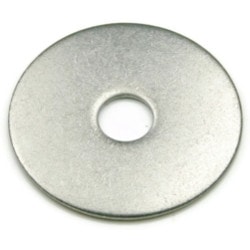
Fender Washers, Marine Grade
What are marine grade fender washers? Fender washers have a large outside diameter relative to their hole, giving an oversized bearing surface that spans big or slotted holes and spreads clamping load across thin or soft material. The name comes from their use on sheet-metal fenders, and the same trait suits marine sheet work, soft alloy, and any joint where a normal washer would pull through. In salt service they come in 316 stainless, with a metric 316 (A4) option. AlbanyCountyFasteners.com stocks these in marine materials.
When you need the oversized washer
A fender washer solves a specific problem: the hole is too big, or the material too thin or soft, for a normal washer to bear against. Its wide face bridges an oversized or slotted hole so the fastener cannot pull through, and it spreads clamp load across a large area so thin sheet or soft alloy is not dished or torn. On boats that means panel work, thin brackets, and repairs where the original hole has enlarged; on docks and coastal structures it means fastening through soft or weathered material. The wide face also distributes load on the back of a sealed penetration. In 316 the washer does all this without corroding, which matters most on the thin sheet where a rusting washer would stain and weaken the joint fastest.
Why choose marine fender washers
- Oversized outside diameter spans large and slotted holes
- Spreads clamp load across thin sheet and soft material
- Prevents fastener pull-through and material dishing
- 316 stainless resists chloride corrosion on thin sheet
- Metric 316 (A4) option for metric assemblies
Common applications
- Boat panel and sheet-metal work
- Thin brackets and soft alloy fittings
- Enlarged or slotted holes
- Spreading load on the back of sealed penetrations
- Repairs where the original hole has worn
- Metric marine assemblies (A4)
Marine Fender Washer FAQs
What makes a fender washer different?
Its outside diameter is large relative to the hole, giving much more bearing area than a standard washer. That lets it span big or slotted holes and spread load across thin or soft material without pulling through.
When should I use one?
When the hole is oversized or slotted, the material is thin or soft, or a normal washer would dish or pull through. Common on sheet panels, soft brackets, and worn or enlarged holes.
Why 316 for fender washers?
Fender washers often sit on thin sheet where a corroding washer streaks and weakens the joint fastest. 316 resists chloride corrosion so the wide washer keeps protecting the material over time.
Can a fender washer replace a backing plate?
For moderate loads on thin material it spreads clamp well, but for heavy loads a proper backing plate distributes force better. Use a fender washer for spread and hole spanning, a plate where the load is high.
Does the big washer look out of place on hardware?
On a neat metal fitting a fender washer can look oversized; there an SAE or standard washer suits better. Choose the fender washer where its function, spanning and spreading, is actually needed.
Is the metric version the same grade?
Yes, the metric fender washers are 316-equivalent A4 stainless, matching the inch 316 corrosion resistance. Only the sizing standard differs.