

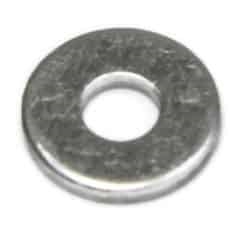
Aluminum Rivet Washers
What are aluminum rivet washers? These are backup washers in aluminum that sit on the blind side of a riveted joint, giving the rivet a wide, firm surface to form against instead of soft or thin material. Aluminum is the right choice when you are using aluminum rivets in aluminum panels, since it keeps the entire joint to a single metal and eliminates any galvanic couple in a cavity you cannot inspect. AlbanyCountyFasteners.com stocks these in 1/8, 5/32, 3/16, and 1/4 inch at 0.062 inch thick.
When should the washer be aluminum?
When everything else in the joint already is. Aluminum panel work has a consistent logic to it: aluminum rivet, aluminum mandrel, aluminum washer, no dissimilar metal anywhere. Break that chain with a steel or stainless washer and you have introduced a more noble metal into a sealed cavity behind the panel, with the aluminum skin as the sacrificial partner. In a dry interior that may never matter. On a boat hull, a trailer skin, or anything seeing weather, it means the panel corrodes around the washer where you cannot see it, and the first symptom is a rivet losing its grip. Matching the washer to the rest of the assembly is the cheap way to avoid that.
Why choose aluminum rivet washers
- Keeps an aluminum joint free of any dissimilar metal
- Pairs correctly with aluminum rivets and aluminum mandrels
- Prevents pull-through in thin aluminum, fiberglass, and soft substrates
- Lightest backup washer option
- Naturally corrosion resistant through aluminum's own oxide layer
Sizes stocked
- 1/8 inch, 0.133 inch inner diameter and 0.375 inch outer diameter
- 5/32 inch, 0.165 inch inner diameter and 0.437 inch outer diameter
- 3/16 inch, 0.197 inch inner diameter and 0.500 inch outer diameter
- 1/4 inch, 0.263 inch inner diameter and 0.562 inch outer diameter
- All 0.062 inch thick, which counts toward your rivet grip range
Common applications
- Aluminum boat hulls, trim, and marine fittings
- Aluminum trailer skins, RV panels, and truck bodies
- Thin aluminum sheet where the rivet would pull through
- Fiberglass and composite panels on aluminum framing
- Screen doors, window frames, and architectural aluminum
- Any aluminum assembly where a dissimilar washer would corrode the panel
Pair these with aluminum dome head rivets to keep the whole joint in one metal. For stainless assemblies, use 304 stainless rivet washers instead.
Related Categories
- Rivet Washers
- 304 Stainless Steel Rivet Washers
- Aluminum Dome Head Rivets
- Aluminum Large Flange Rivets
- Blind Rivets
Aluminum Rivet Washer FAQs
Are aluminum washers strong enough?
For their purpose, yes. The washer's job is to present a wider, firmer bearing surface than the panel itself, and aluminum is considerably harder than fiberglass, plastic, or wood. Against a steel panel a harder washer may serve better, but you would not normally use aluminum there anyway.
Can I use an aluminum washer with a stainless rivet?
It is not ideal in wet conditions, since the aluminum washer becomes sacrificial against the more noble stainless. Match the washer to the rivet, or at least to the panel, wherever moisture is a factor.
Does the washer count toward grip range?
Yes. At 0.062 inch these add measurably to your material stack, and it is easy to forget when selecting a rivet. Add the washer thickness before checking the grip range.
What size do I need?
Match the washer to the rivet diameter. A 1/4 inch rivet takes the 1/4 inch washer with its 0.263 inch inner diameter, sized to slip over the body without excess clearance.
Which side does it go on?
The blind side, so the rivet forms against it. Slide the rivet through the panel, place the washer over the protruding body on the far side, then set. This means you need some access behind the joint to fit it.
Are aluminum washers thicker than stainless?
Marginally, at 0.062 inch against 0.058 for the stainless. The difference is small but worth noting if you are close to the edge of a grip range.