

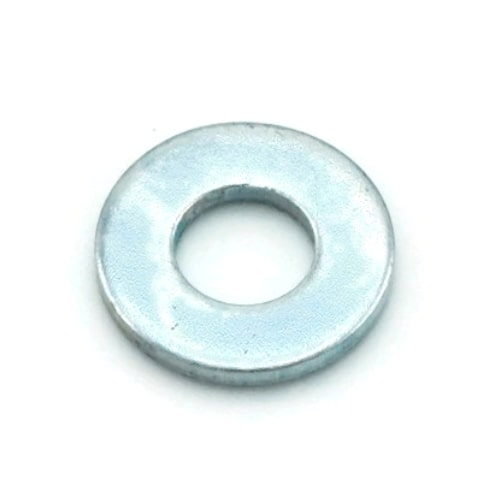
Zinc Plated Steel Rivet Washers
What are zinc plated steel rivet washers? These are backup washers in steel with a zinc plated finish, sitting on the blind side of a riveted joint to give the rivet a hard, wide surface to form against instead of soft or thin material. Steel is harder than either aluminum or stainless in this role, which means the washer resists deforming as the rivet pulls up, and the zinc plating adds sacrificial corrosion protection. AlbanyCountyFasteners.com stocks these in 1/8, 5/32, 3/16, and 1/4 inch at 0.062 inch thick.
When is steel the right backup washer?
When the washer itself needs to stay flat under load. A backup washer works by refusing to deform: the rivet body pulls up against it, and whatever the washer will not give way to gets transferred out across its full diameter instead of concentrating on the panel. Steel is harder than aluminum and holds that shape better under a firm set, which matters when you are riveting into a rigid substrate or pulling a joint up tight. The zinc plating gives sacrificial protection, so the steel underneath is shielded as long as the coating holds. What it will not do is survive a wet cavity indefinitely, and since a backup washer is sealed behind the panel where nobody can inspect it, sustained moisture is an argument for stainless instead.
Why choose zinc plated steel rivet washers
- Harder than aluminum, so the washer resists deforming as the rivet sets
- Zinc plating provides sacrificial corrosion protection for the steel beneath
- Lower cost than stainless for volume and production work
- Correct galvanic match when used with steel rivets in steel panels
- Prevents pull-through in thin sheet, plastic, wood, and composite
Sizes stocked
- 1/8 inch, 0.133 inch inner diameter and 0.375 inch outer diameter
- 5/32 inch, 0.165 inch inner diameter and 0.437 inch outer diameter
- 3/16 inch, 0.197 inch inner diameter and 0.500 inch outer diameter
- 1/4 inch, 0.262 inch inner diameter and 0.562 inch outer diameter
- All 0.062 inch thick, which counts toward your rivet grip range
Common applications
- Steel sheet metal work and enclosure assembly
- Interior panels in plastic, wood, and composite over steel framing
- Machinery guards and equipment housings
- Production and high volume assembly where cost per piece matters
- Shelving, racking, and industrial fixtures
- Dry indoor joints where full stainless is more than the job requires
For joints exposed to weather or washdown, use 304 stainless rivet washers, since a corroding washer fails where you cannot see it. In aluminum assemblies, aluminum rivet washers keep the joint free of dissimilar metal.
Related Categories
- Rivet Washers
- 304 Stainless Steel Rivet Washers
- Aluminum Rivet Washers
- Large Flange Rivets
- Blind Rivets
Zinc Plated Steel Rivet Washer FAQs
How much protection does zinc plating give?
Moderate, and it works by sacrificing itself. Zinc corrodes preferentially to protect the steel beneath, which is effective while the coating lasts. In a dry interior cavity that is indefinitely. In a joint that sees moisture, expect the plating to be consumed eventually and the steel to follow.
Should I match the washer to the rivet material?
Wherever moisture may reach the joint, yes. A steel washer against an aluminum rivet makes the aluminum sacrificial in a cavity you cannot inspect. Steel washer with steel rivet is the consistent pairing.
Does the washer count toward grip range?
Yes. At 0.062 inch these add measurably to your material stack, and it is easy to overlook when selecting the rivet. Add the washer thickness before checking the range.
Why choose steel over stainless?
Cost and hardness. Steel washers cost noticeably less per piece, which adds up in production work, and the greater hardness resists deformation as the rivet pulls up. Stainless wins wherever corrosion is a genuine concern.
Which side does the washer go on?
The blind side, behind the material, so the rivet body forms against it. You need enough access to place the washer over the protruding body before setting the rivet.
Can I use these outdoors?
For covered or intermittent exposure they will serve. For sustained weather, washdown, or marine service, use stainless, since a washer sealed behind a panel gives no warning when it starts to fail.