

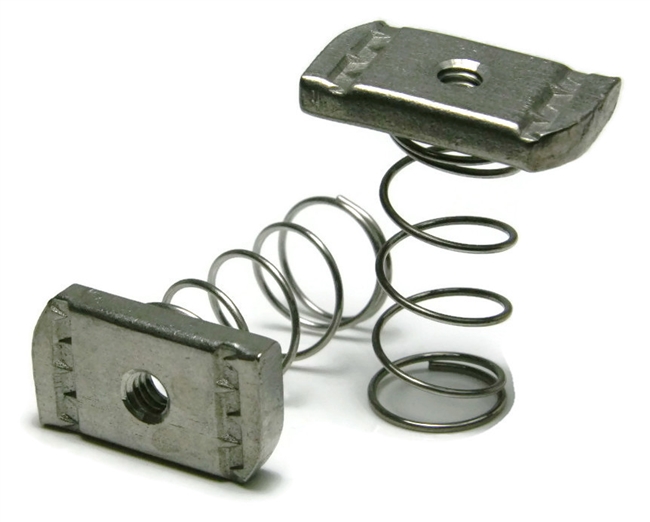
Strut Channel Nuts
What are strut channel nuts? Strut channel nuts, also called spring nuts, strut nuts, or channel nuts, are toothed rectangular nuts that drop into slotted strut channel and rotate 90 degrees to lock their serrated edges against the channel lips. Sized for standard 1-5/8 inch Unistrut-style channel, they create an adjustable threaded connection point anywhere along a run without drilling or welding, in 316 stainless and electro galvanized steel.
How strut channel nuts lock into channel
You compress the spring, tilt the nut into the open slot of the strut channel, then rotate it about 90 degrees so its serrated teeth bite the inturned channel lips for a secure, adjustable mechanical lock. Spring versions hold the nut in position while you thread in a bolt or rod, which allows one-person overhead installation, while plain versions without a spring cost less where you can hold the nut by hand. The spring is not part of the load capacity, it only holds the nut in place for faster assembly.
Strut channel nut styles
- Standard spring: the spring holds the nut in place for one-hand setting.
- Without spring: economical plain nut where space is tight or a spring is not needed.
- Top lock spring: extra serrated grip that bites the channel under vibration.
- Short spring: a shorter spring matched to shallow channel depth.
Materials and corrosion resistance
- Electro galvanized steel: economical zinc finish for dry and indoor framing, not for salt or chemicals.
- 316 stainless: marine grade that resists salt water, harsh weather, and most chemicals for outdoor, coastal, and wash-down strut.
How to choose strut channel nuts
- Channel series: standard nuts fit common 1-5/8 inch Unistrut-style slotted channel; confirm your series.
- Thread size: match the bolt or threaded rod, such as 1/4-20, 3/8-16, or 1/2-13.
- Spring length: pick the spring that preloads the nut to your channel depth so it stays put.
- Material: galvanized for dry indoor, 316 stainless for wet, coastal, and sanitary.
Common applications for strut channel nuts
- Unistrut-style framing and support systems
- Pipe, conduit, and cable tray hangers
- Electrical panels, junction boxes, and enclosures
- Mechanical, HVAC, solar, and equipment racking
Pair these with matching strut bolts and washers, and browse the full range on the main spring channel nuts and strut channel components categories.
Strut Channel Nuts FAQ
How do you install a strut channel nut?
Compress the spring, tilt the nut into the open face of the channel, then rotate it about 90 degrees so the serrated edges align with and bite the channel lips. Thread in your bolt or rod to lock it.
Is the spring part of the nut's strength?
No. The spring only holds the nut in position for one-hand assembly. The mechanical hold comes from the serrated teeth biting the channel lips, and the bolt carries the load.
What size strut do these nuts fit?
Standard channel nuts fit common 1-5/8 inch Unistrut-style slotted channel in threads like 1/4-20, 3/8-16, and 1/2-13. Confirm your channel series and thread size against your bill of materials.
How do I choose the right spring length?
Match the spring to your channel depth. Deeper channels need a longer spring to preload the nut, while shallow channels need a shorter spring to avoid interference.
Which material should I use outdoors?
Electro galvanized handles dry and indoor use but not salt or chemicals. For wet, coastal, sanitary, or chemical exposure, choose 316 stainless.
Can strut channel nuts be repositioned?
Yes. That is their main advantage. You can loosen the bolt, slide or lift the nut to a new spot along the channel, and re-lock it without drilling or welding.