

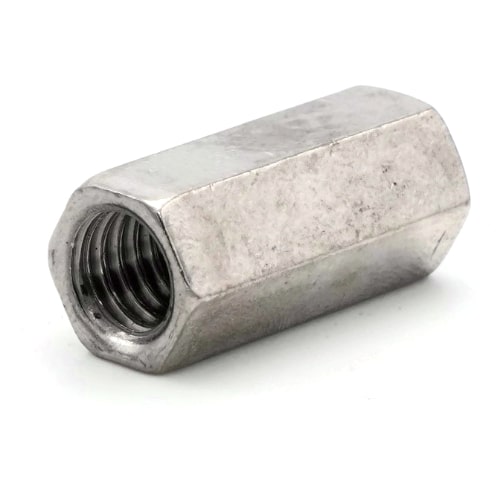
Coupling Nuts, Marine Grade
What are marine grade coupling nuts? Coupling nuts are long hex nuts that join two lengths of threaded rod end to end, or extend a thread, by engaging both pieces deep inside a single nut. The extra length gives full thread engagement on each rod for a strong join. In marine service they come in 316 stainless so the join resists salt and stays serviceable. AlbanyCountyFasteners.com stocks these in 316 stainless steel.
Joining and extending threaded rod in salt
A coupling nut solves a simple problem: you need a threaded run longer than a single rod, or you need to connect two threaded components in line. Its length lets each rod thread deep into the nut, so the join develops full thread engagement on both sides rather than the shallow bite a standard nut would give. That makes it the standard way to extend hanger rod, connect turnbuckle-style assemblies, and build up threaded runs on marine and coastal services. The length is also what to watch on installation: for full strength each rod should thread in to the centre, and a sight hole or a mark helps confirm both sides are fully engaged rather than one rod carrying the join. In 316 the nut resists chloride corrosion, so a threaded run that may be hard to reach later stays sound and adjustable.
Why choose 316 stainless coupling nuts
- Joins two threaded rods or extends a thread in line
- Length gives full thread engagement on each rod
- Strong join for hanger rod and threaded runs
- 316 stainless resists chloride corrosion in salt
- Keeps hard-to-reach threaded runs serviceable
Common applications
- Extending threaded hanger rod on marine services
- Joining threaded rod end to end
- Connecting threaded components in line
- Coastal support and suspension runs
- Building up custom-length threaded assemblies
- Any threaded rod join in salt exposure
Marine Coupling Nut FAQs
How far should each rod thread into the nut?
For full strength, each rod should engage to about the centre of the nut, so both sides carry equal thread. A sight hole or a witness mark helps confirm neither rod is short of full engagement.
Can I join two different thread sizes?
A standard coupling nut has one thread size through its length, so it joins matching threads. Joining two different sizes needs a reducer coupling nut made for that, not a standard one.
Why 316 for a coupling nut?
A threaded join is often in a run that is hard to reach later, and a corroded nut seizes and weakens. 316 resists salt corrosion so the join stays sound and adjustable over time.
Is the join as strong as continuous rod?
With full engagement on both rods and a nut matched to the rod grade, the join is strong, though any coupling introduces a connection to inspect. For critical loads, confirm engagement and match materials to the rod.
Can I use a coupling nut as a standoff?
Its length can act as a spacer or standoff in some assemblies, threading a bolt into each end. Confirm the load path suits, since a coupling nut is designed primarily for joining thread, not as a structural spacer.
Should the rod be 316 too?
Yes, matching 316 rod and nut keeps the join corrosion consistent and avoids galvanic mismatch. A stainless nut on a plated rod still leaves the rod to corrode.