

Weld Studs
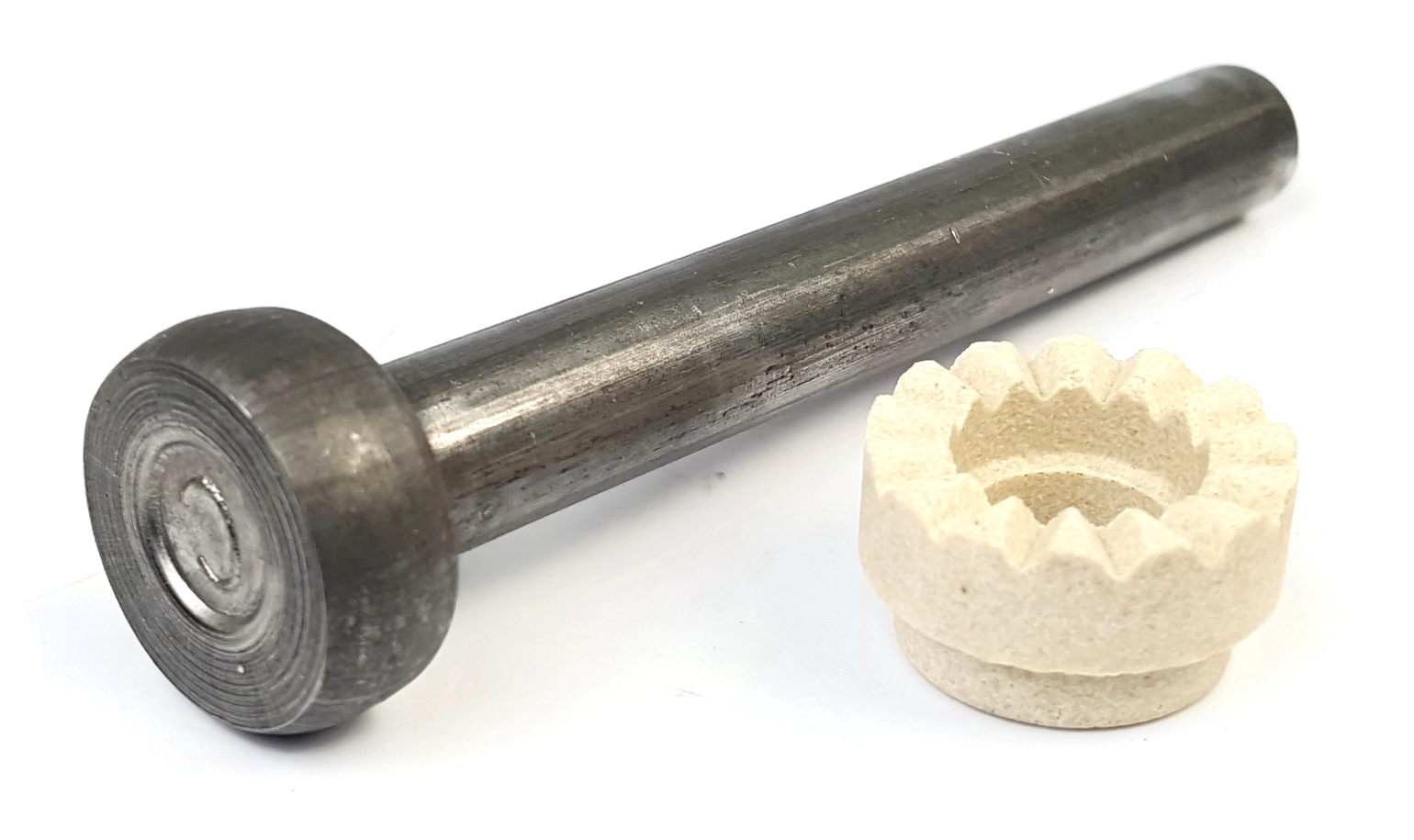
What are weld studs? Weld studs are fasteners welded directly to a steel surface by the drawn arc process, creating a full fusion bond without drilling, tapping, or reaching the back side. A stud welding gun lifts the stud to strike an arc, melts both the stud tip and the base metal, then plunges the stud into the molten pool, all inside a ceramic ferrule that contains the weld. The result is a joint stronger than the stud itself. AlbanyCountyFasteners.com stocks headed concrete anchor studs, shear connector studs, and the ceramic ferrules the process requires.

-min.jpg?ts=1755908143 "Ferrules")
Headed concrete anchors vs shear connectors
They look nearly identical and they are not interchangeable, which catches people out. Both are headed drawn arc studs made to ASTM A108 carbon steel and qualified under AWS D1.1, but they do different structural jobs. A headed concrete anchor is an embedment anchor: welded to an embed plate or bearing plate, it anchors steel into concrete and is designed primarily around tension and combined tension and shear, governed by ACI 318. A shear connector is a composite construction element: welded to the top flange of a steel beam and embedded in the slab above, it transfers horizontal shear between the two so they act as one member, specified under AISC 360. If a drawing calls for shear connectors, substituting anchors is a specification change, not a swap.
What we stock
- Headed concrete anchor studs in 3/8, 1/2, and 5/8 inch diameters, plain steel
- Shear connector studs in 3/4 and 7/8 inch diameters, plain steel
- Ceramic ferrules sized to match, from 3/8 through 7/8 inch
- Every drawn arc weld requires one ferrule per stud, so order them together
How drawn arc stud welding works
- The stud loads into the gun chuck, with a ceramic ferrule held around its base
- The gun presses the assembly against the work and lifts the stud to strike an arc
- The arc melts the stud tip and a pool in the base metal, contained by the ferrule
- The gun plunges the stud into the pool and the metal fuses
- Once cool, the ferrule is broken away, exposing the weld fillet around the stud base
- Studs are listed at length before weld, since the process consumes a small amount
Common applications
- Composite floor and bridge deck construction
- Embed plates, bearing plates, and structural steel to concrete connections
- Precast and cast in place concrete anchoring
- Steel building frames and girders
- Equipment bases and machinery mounting to concrete
- Structural fabrication where no through hole is acceptable
For anchoring steel into concrete, see our headed concrete anchor studs. For composite beam construction, see shear connector studs, and remember to add matching ceramic ferrules.
Related Categories
Weld Stud FAQs
What is AWS D1.1 Type B?
AWS D1.1 classifies studs by type. Type A covers general purpose studs where shear transfer is not the primary function. Type B covers headed, bent, or otherwise configured studs used as an essential component in composite beam design and construction, and carries higher minimum mechanical properties including elongation. Type C covers cold worked deformed bar anchors.
Do I need a ferrule for every stud?
Yes. Standard ceramic ferrules are single use. The thermal shock of the weld cracks them, and they are broken away afterwards to expose the fillet. Order one ferrule per stud plus a margin for breakage during handling.
Why is the stud shorter after welding?
The process consumes a small amount of the stud tip in the weld. Studs are specified at length before weld, with the reduction depending on diameter, roughly 3/16 inch on 3/4 and 7/8 inch studs. Account for this when the finished length matters.
Can I use capacitor discharge welding for these?
No. CD welding suits small diameters on thin base material, generally 1/4 inch and below. Structural studs in these diameters require the drawn arc process, which delivers the full penetration fusion weld that AWS D1.1 mechanical requirements depend on.
How thick does the base metal need to be?
Thick enough to take the weld penetration without burn through, and the requirement scales with stud diameter. Check the manufacturer's guidance for your stud size, and note that welding through metal deck changes the requirement again.
Are weld studs stronger than a bolted connection?
The weld itself is typically stronger than the stud, so the stud governs rather than the joint. What weld studs remove is the need for a hole, which preserves the section of the base material and speeds installation considerably.