

Rivet Products
.jpg?ts=1755909529 "Rivet Products")
What are rivet products? Rivet products are the fasteners, tools, and accessories used to make permanent joints from one side of a workpiece. The family covers four things: blind rivets that clamp two panels together, rivet nuts that install a threaded insert into thin material, the setting tools that install each type, and backup washers that spread load in soft or thin stock. What ties them together is single sided access. Every one of them installs without reaching behind the joint, which is why they dominate sheet metal, panel, and tube work. AlbanyCountyFasteners.com stocks all four in aluminum, steel, stainless steel, and copper.
Rivet Products

Blind Rivets
Tubular rivets set from one side with a rivet tool, forming a second head on the back where you can't reach, for quick permanent fastening.

Rivet Washers
Washers placed under a rivet on the blind side to spread load and prevent pull-through in soft or thin material.
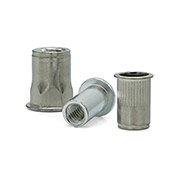
Rivet Nuts
Internally threaded inserts installed from one side of the material to create a strong machine thread in sheet metal, tube, and panels where you can't reach the back.

Rivet Tools
Hand, pneumatic, and pneudraulic tools that pull the mandrel to set blind rivets and rivet nuts.
Videos
Play videoRivets vs rivet nuts: which do I need?
It depends on whether anything has to attach later. A blind rivet clamps two pieces of material permanently, and that is the end of the job. A rivet nut does something different: it installs into a single panel and leaves behind a machine thread, so you can bolt something to thin sheet that could never hold a tapped thread on its own. Think of a blind rivet as replacing a bolt and nut, and a rivet nut as replacing a tapped hole or a weld nut. If you need to bolt an accessory to a tube, a panel, or a chassis rail, you want a rivet nut. If you are joining two panels for good, you want a blind rivet.
What we stock
- Blind rivets, in open end, closed end, large flange, countersunk, multi-grip, colored, tri-fold, and structural styles for permanent panel joints
- Rivet nuts, threaded inserts in 18-8 stainless and aluminum, thinwall and thickwall, in inch and metric threads
- Rivet tools, hand riveters, lever tools, pneumatic guns, and cordless kits for blind rivets, plus dedicated rivet nut tools
- Rivet washers, backup washers in aluminum, 304 stainless, and zinc plated steel that prevent pull-through in soft material
Choosing tools for the job
- Blind rivets and rivet nuts use different setting tools, and they are not interchangeable
- Hand riveters handle small diameter blind rivets in aluminum and light steel
- Lever and pneumatic tools become worthwhile above about 3/16 inch, and for steel or stainless bodies
- Rivet nut tools thread onto the insert and pull it, so the mandrel must match the thread size
- Ratcheting and pneudraulic rivet nut tools reduce effort on production runs and larger threads
Common applications
- Sheet metal fabrication, ductwork, and HVAC assemblies
- Trailer bodies, truck panels, and transportation equipment
- Metal building panels, roofing, siding, and flashing
- Chassis and tube frames, where rivet nuts add threads to closed sections
- Boat and marine hardware, where material pairing drives corrosion life
- Signage, display fixtures, appliance, and general product assembly
Most jobs start with blind rivets and a compatible setter from our rivet tools range. If you need a threaded fastening point in thin material instead of a clamped joint, look at rivet nuts. For soft or thin stock, add rivet washers behind the joint.
Related Categories
Rivet Product FAQs
What is the difference between a rivet and a pop rivet?
Pop rivet is a brand name that became the generic term. POP was the original trade name for the blind rivet system, and the phrase stuck. When someone says pop rivet they mean a blind rivet, the kind with a mandrel you set with a hand riveter.
What is a rivet nut used for?
Creating a strong machine thread in material too thin to tap. It installs like a blind rivet, from one side, but instead of clamping two panels it leaves a threaded insert in a single panel. That gives you a reusable bolt point in sheet metal, tubing, or a chassis rail where a tapped hole would strip out.
Do rivets and rivet nuts use the same tool?
No. A blind rivet tool grips the mandrel and pulls it. A rivet nut tool threads onto the insert, then pulls while holding the head, so it needs a mandrel matched to the thread size. Some kits include multiple mandrels to cover a range of threads.
Which rivet material should I choose?
Match the fastener to what you are joining wherever possible. Aluminum for aluminum, steel for steel, stainless for stainless or for outdoor exposure. Mixing metals with moisture present invites galvanic corrosion, where the less noble metal corrodes first and the joint loosens.
Can rivets be removed?
Only by drilling. Center punch the head, drill with a bit matched to the rivet diameter, and the head separates so the body can be pushed through. If the assembly needs regular service, use a threaded fastener or a rivet nut instead.
When do I need a rivet washer?
When the back material is soft, thin, or oversized at the hole. A backup washer spreads the clamping load over a wider area so the formed rivet head cannot pull through plastic, fiberglass, thin sheet, or wood. Remember to count the washer thickness in your grip range.