

Flange Bolts
What Are Flange Bolts?
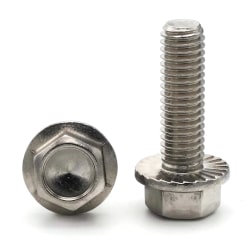
Flange bolts are hex-head fasteners with an integrated washer under the head. The built-in flange increases bearing surface and distributes clamping force more evenly than a standard hex bolt alone, often reducing the need for a separate flat washer and speeding installation.
Serrated vs. Non-Serrated Flange Bolts
- Serrated flange bolts: The underside of the flange has radial serrations that bite into the mating surface to help resist loosening from vibration. Use where a locking action is desired and surface marring is acceptable.
- Non-serrated flange bolts: Smooth bearing surface under the flange for applications where you want the load distribution of a flange but prefer not to mark the surface or where parts need to be repositioned.
Full-Thread vs. Partial-Thread Flange Bolts
- Fully threaded (FT): Threads run the full shank—best for thin stacks and maximum thread engagement.
- Partially threaded (PT): Includes a smooth shoulder that can aid alignment and provide shear/bearing area under the head.
Materials & Finishes
- Carbon/alloy steel: Offered in common inch grades (e.g., Grade 2, 5, 8) and metric property classes (e.g., 8.8, 10.9, 12.9).
- Stainless steel: 18-8/304 for general corrosion resistance; 316 for harsher or marine environments.
- Coatings: zinc or yellow zinc for interior service, hot-dip galvanized (HDG) for heavy-duty outdoor protection, and black oxide for a matte appearance (limited corrosion resistance).
Flange Bolt Sizes & Threads
Order by diameter × thread × length (e.g., 3/8"-16 × 1-1/2" or M10-1.5 × 40 mm). Inch threads are typically UNC (coarse) or UNF (fine). Length is measured from under the head to the tip.
Common Uses for Flange Bolts
- Automotive, equipment, and machinery assemblies subject to vibration
- Steel framing, brackets, and base plates where fast installation is valuable
- Applications where a wide bearing surface is needed without a separate washer
Installation Tips for Flange Bolts
- Match nuts and any washers to the bolt’s grade/material and thread.
- For HDG fasteners, use compatible HDG nuts to account for coating thickness.
- On painted or delicate surfaces, prefer non-serrated flanges or add a protective washer.
- Use appropriate torque; for stainless, a suitable anti-seize can reduce the risk of galling.
- Where vibration is severe, combine with prevailing-torque nuts or approved thread-locking methods.
Related Hardware
- Flange nuts (to mirror the increased bearing area)
- Hex nuts, lock nuts, and washers (when required by spec)