

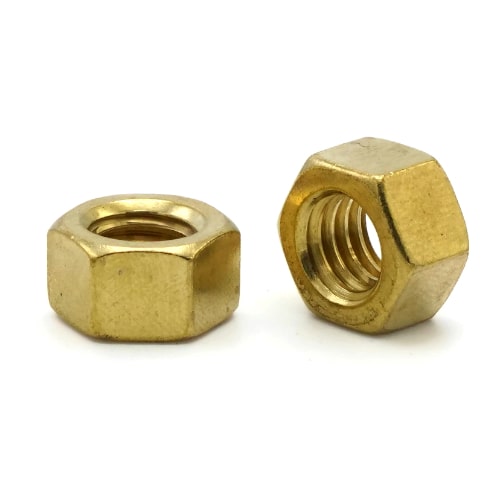
Nuts, Brass
What are brass nuts? Brass nuts are copper-zinc alloy nuts that pair with brass screws and rod, chosen for electrical conductivity, a matching golden appearance, and non-magnetic behaviour. They complete a brass joint without a mismatched metal, whether the priority is conductivity at a terminal or looks on visible hardware. AlbanyCountyFasteners.com stocks hex machine nuts, hex jam nuts, nylon insert lock nuts, and knurled thumb nuts in brass.
Completing a brass connection
A brass nut finishes what a brass screw or terminal starts, and the reason to match is the same reason the fastener was brass in the first place. On an electrical connection, a brass nut keeps the current path in a conductive metal and avoids introducing a dissimilar one. On visible hardware, it keeps the whole joint the same warm gold rather than showing a steel nut on the back. And on instruments, it keeps the assembly non-magnetic throughout. The four patterns cover the common needs: a hex machine nut for general clamping on machine screws, a hex jam nut for locking against another nut or fitting tight clearances, a nylon insert lock nut whose collar resists vibration loosening, and a knurled thumb nut with a textured edge for hand tightening where a tool is not wanted. As with all brass, the threads are soft, so start by hand and avoid overtightening to prevent stripping. Matched to brass screws and rod, these keep a joint that is conductive, good-looking, and non-magnetic from end to end.
Why choose brass nuts
- Match brass screws and rod for a consistent joint
- Conduct for electrical terminals and connections
- Golden color on visible hardware
- Nylon lock version resists vibration loosening
- Knurled thumb version tightens by hand, no tool
Common applications
- Electrical terminals and connections
- Completing brass fastener joints
- Visible and decorative hardware
- Vibrating connections (nylon lock)
- Hand-adjusted fittings (knurled thumb)
- Non-magnetic assemblies
Brass Nut FAQs
Why use brass nuts?
To match brass screws and rod for a consistent joint, keep an electrical connection conductive, maintain a golden look on visible hardware, and stay non-magnetic. Matching the nut avoids introducing a dissimilar metal.
Which brass nut do I need?
A hex machine nut for general clamping, a hex jam nut for locking or tight clearances, a nylon insert lock nut to resist vibration, or a knurled thumb nut for hand tightening. Choose by the job.
What is a knurled thumb nut for?
Its textured edge lets you tighten and loosen by hand without a tool, for connections that are adjusted often. The brass version suits electrical and decorative hand-adjusted fittings.
Does the nylon lock nut have a temperature limit?
Yes, the nylon softens and loses grip above roughly 250°F, like any nylon insert nut. Within that range it resists vibration loosening on brass joints.
Will brass nuts strip?
Brass is soft, so threads can strip if overtightened. Start by hand, tighten with care, and avoid forcing to protect the threads.
Are brass nuts good for electrical connections?
Yes, brass conducts, so brass nuts suit terminals and electrical connections, keeping the current path in a conductive metal and matching brass hardware.