

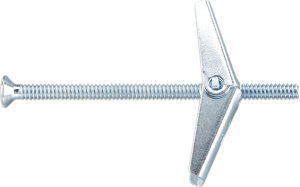
Flat Head Toggle Bolts
What are Flat Head Toggle Bolts? Flat head toggle bolts are hollow wall anchors with spring-loaded wings and a flat head machine screw designed for countersunk or low-profile fastening in drywall, plaster, and compatible hollow wall materials. They are commonly used for mounting plates, brackets, signs, fixtures, wall hardware, and other items where the fastener needs behind-the-wall support with a flatter finished head.
Videos
Play videoWhy Choose Flat Head Toggle Bolts?
Flat head toggle bolts are useful when a hollow wall fastening application needs support behind the wall and a lower-profile screw head at the fixture surface. The toggle wings open behind the wall, while the flat head can sit in a countersunk hole or provide a cleaner finished look than a raised head style.
This category includes flat head toggle bolt anchors in zinc plated steel. These anchors are commonly selected for drywall, plaster, and compatible hollow wall applications where the fastening point does not line up with a stud and the fixture needs a flat head screw style.
Common Uses for Flat Head Toggle Bolts
Flat head toggle bolts are commonly used for installing plates, signs, brackets, wall-mounted fixtures, hardware, decorative panels, shelves, and other components into drywall or plaster where a countersunk or lower-profile fastener head is preferred.
They are often selected for hollow wall applications where the item being mounted needs a wider load-bearing area behind the wall. Match the toggle bolt size, screw length, wall thickness, fixture thickness, countersink style, and load rating to the item being installed before mounting.
How Flat Head Toggle Bolts Work
Flat head toggle bolts use a machine screw with spring-loaded wings. The wings are folded together and pushed through a pre-drilled hole. Once inside the wall cavity, the wings spring open behind the wall surface.
As the screw is tightened, the open wings pull against the back side of the wall, helping hold the mounted fixture in place. Proper installation matters because the hole size, wall thickness, screw length, wing clearance, and countersink fit all affect how the toggle bolt seats behind the wall.
Flat Head Toggle Bolts vs Mushroom Head Toggle Bolts
Flat head toggle bolts are used when the screw head needs to sit flatter against the fixture or fit into a countersunk hole. They are often selected for plates, signs, brackets, and hardware where a raised dome-style head is not preferred.
Mushroom head toggle bolts have a broader rounded head that remains raised on the fixture surface. Choose mushroom head toggle bolts when a rounded finished head is acceptable, and choose flat head toggle bolts when a countersunk or lower-profile head is needed.
Flat Head Toggle Bolts vs Round Head Toggle Bolts
Flat head toggle bolts provide a lower-profile head style when used with a compatible countersunk fixture hole. Round head toggle bolts leave a rounded head visible on the mounted item.
Choose flat head toggle bolts for countersunk plates, brackets, and hardware. Choose round head toggle bolts when a raised round head is acceptable or when the fixture is not countersunk.
Flat Head Toggle Bolts vs Self Drilling Drywall Anchors
Flat head toggle bolts use wings that open behind the wall, giving the fastener a wider support area inside the wall cavity. They are often chosen when the application needs more hollow wall support than a threaded self drilling drywall anchor.
Self drilling drywall anchors thread directly into drywall from the front of the wall. They are commonly used for lighter wall-mounted items and quick installations. Choose toggle bolts when behind-the-wall support is preferred, and choose self drilling drywall anchors when the mounted item is lighter and the anchor rating fits the job.
Flat Head Toggle Bolts vs Hollow Wall Anchors
Flat head toggle bolts use spring-loaded wings that open behind the wall. Hollow wall anchors expand or clamp behind the wall depending on the anchor style, wall thickness, and installation method.
Both styles are used for hollow wall fastening, but the best option depends on the wall material, fixture thickness, screw size, load rating, and whether the fastener may need to be removed later. Flat head toggle bolts are often selected when a wing-style anchor and a lower-profile screw head are useful.
Zinc Plated Steel Flat Head Toggle Bolts
Zinc plated steel flat head toggle bolts are commonly used for dry indoor wall fastening applications where a plated steel fastener is suitable. The zinc plated finish is a practical option for many household, office, maintenance, and commercial hollow wall mounting jobs.
For damp, outdoor, corrosive, or moisture-sensitive applications, compare the project requirements with available corrosion-resistant fastener options. Choose the fastener material based on the wall material, fixture material, exposure level, and installation requirements.
When to Use a Stud Instead of a Toggle Bolt
A wall stud is usually the better fastening point for heavy shelves, cabinets, TV mounts, grab bars, safety-related hardware, and other high-load items. Toggle bolts can help support items in hollow walls, but they are still limited by the wall material and the anchor rating.
Before mounting heavier items, confirm the load, wall condition, stud location, toggle bolt rating, fixture requirements, and manufacturer instructions. When the item is heavy, frequently handled, or safety-related, fastening into framing is usually the better option.
How to Choose the Right Flat Head Toggle Bolt
Choose the flat head toggle bolt based on the wall material, wall thickness, screw diameter, screw length, fixture thickness, countersink style, hole size, load rating, and available wall cavity space. The wings need enough room behind the wall to open fully.
After confirming the wall and fixture requirements, choose a flat head toggle bolt when the installation needs behind-the-wall support with a flatter or countersunk head style. For raised head applications, compare mushroom head or round head toggle bolts. For lighter wall-mounted items, compare self drilling drywall anchors or plastic wall anchors.
Related Anchor Categories
Browse related anchor categories to compare flat head toggle bolts, zinc plated flat head toggle bolts, mushroom head toggle bolts, round head toggle bolts, self drilling drywall anchors, hollow wall anchors, sleeve anchors, wedge anchors, and concrete screws.
- Anchors
- Anchors for Drywall & Plaster
- Toggle Bolts
- Flat Head Toggle Bolts
- Zinc Plated Steel Flat Head Toggle Bolts
- Mushroom Head Toggle Bolts
- Round Head Toggle Bolts
- Self Drilling Drywall Anchors
- Hollow Wall Anchors
- Concrete Screws
Flat Head Toggle Bolt FAQs
What are flat head toggle bolts?
Flat head toggle bolts are hollow wall anchors with spring-loaded wings and a flat head machine screw used for drywall, plaster, and compatible hollow wall fastening.
When should I use flat head toggle bolts?
Use flat head toggle bolts when mounting an item into a hollow wall and the fixture needs behind-the-wall support with a flat or countersunk screw head.
What is the difference between flat head and mushroom head toggle bolts?
Flat head toggle bolts are used for lower-profile or countersunk fastening. Mushroom head toggle bolts have a rounded raised head that remains visible on the fixture surface.
What is the difference between flat head and round head toggle bolts?
Flat head toggle bolts sit flatter when used with a countersunk fixture hole. Round head toggle bolts leave a raised rounded head on the mounted item.
Do flat head toggle bolts need a pilot hole?
Yes. Toggle bolts require a hole large enough for the folded wings to pass through the wall before opening behind the surface.
Can flat head toggle bolts be used in concrete?
No. Flat head toggle bolts are for hollow wall materials such as drywall and plaster. For concrete, brick, or block, use a masonry anchor, concrete screw, wedge anchor, or sleeve anchor.
What happens if I remove the screw from a flat head toggle bolt?
With many standard toggle bolts, the wings can fall into the wall cavity if the screw is fully removed. Consider this before using toggle bolts for items that may need frequent removal.
How do I choose the right flat head toggle bolt?
Choose the toggle bolt based on the wall material, wall thickness, screw diameter, screw length, fixture thickness, countersink style, hole size, load rating, and available space behind the wall for the wings to open.