

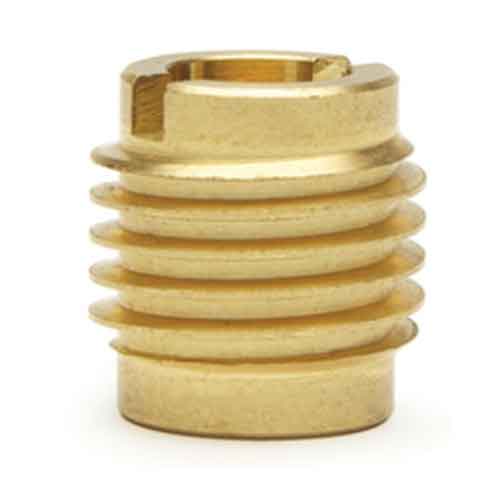
Why Use Micro Threaded Inserts in Wood?
Wood and wood-based materials do not hold threads well on their own. A screw threaded directly into wood can strip the surrounding fibers with repeated assembly and disassembly, and wood threads have limited pullout strength compared to a metal thread. Micro threaded inserts solve this by providing a permanent brass insert with a precision internal thread that accepts a standard micro screw.
Once installed, the insert creates a reusable metal thread that can accept a micro screw many times over without degrading. This is especially useful in small woodworking projects, instrument cases, furniture hardware, cabinetry, RC vehicle bodies, model construction, and any wood or MDF assembly that uses #4-40 or M3 screws and requires a reliable, repeatable thread.
Products on This Page
This category includes two micro threaded inserts, both brass and both designed for wood applications at 0.375" installed length:
- Threaded Insert, Brass, Application Wood, #400-004, #4-40 x .375" (Imperial, Diameter #4)
- Metric Threaded Insert, Brass, Application Wood, #400-M3, M3 x .375" (Metric, Diameter M3)
Choose the #4-40 insert when working with imperial micro screws. Choose the M3 insert when working with metric micro screws. The two are not interchangeable and accept different screw threads.
How Wood Application Threaded Inserts Work
Wood application threaded inserts have an externally coiled or knurled outer surface designed to grip the surrounding wood fibers when installed. The insert is driven into a pre-drilled hole using a hex key or installation tool, which engages the internal thread of the insert to drive it straight and flush into the material. As the insert is driven in, the outer coil or knurl cuts into and compresses the surrounding wood, locking the insert in place and resisting pullout.
Once installed, the internal thread of the insert accepts the mating micro screw. The screw can be installed and removed repeatedly without affecting the insert, as the metal-to-metal thread engagement is far more durable than threading directly into wood.
Installation Instructions for Wood Threaded Inserts
To install a micro threaded insert in wood, drill a pilot hole to the diameter recommended for the specific insert. The pilot hole must be sized correctly: too small and the insert may split the surrounding material during installation; too large and the insert will not grip securely.
Thread the installation tool or hex key into the internal thread of the insert, then drive the insert straight into the pilot hole by turning clockwise. Drive the insert until it is flush with or just below the surface of the material. Do not overtorque, as the surrounding wood can split or the insert can strip out of the hole if excessive force is applied. In harder wood species, pre-lubricating the pilot hole with a small amount of wax can help the insert seat more easily.
What Materials Can These Inserts Be Used In?
The inserts on this page are designed for wood applications. They are suitable for solid wood, MDF, plywood, particleboard, and similar wood-based sheet materials. The outer coil is designed to cut into and grip wood fibers specifically, and these inserts are not intended for use in metal, plastic, or other non-wood materials.
For plastic or soft material applications, heat-set threaded inserts or press-fit inserts are typically more appropriate. For metal applications, standard threaded inserts or tapped holes are the correct choice. If you need inserts for plastic or metal, contact us and we can help identify the right product.
Brass Material Benefits
Both inserts on this page are brass. Brass is the standard material for wood threaded inserts for several reasons. It is soft enough to be driven into wood without splitting the surrounding material, hard enough to maintain a durable thread under repeated use, corrosion resistant in most indoor environments, and non-magnetic. Brass inserts also provide a clean appearance when installed flush or slightly recessed into the wood surface.
#4-40 vs M3 Threaded Inserts
The #4-40 insert accepts imperial #4-40 micro screws with 40 threads per inch. The M3 insert accepts metric M3 x 0.5 screws with a 0.5mm pitch. Both are close in size but are not interchangeable. A #4-40 screw will not thread into an M3 insert and vice versa.
Choose the #4-40 insert for assemblies using imperial micro screws. Choose the M3 insert for assemblies using metric micro screws, including imported electronics enclosures, camera housings, optical instruments, and other products designed to metric fastener standards. If you are not sure which thread standard your screw uses, use a thread gauge or contact us before ordering.
Micro Threaded Inserts vs Tapping Wood Directly
Tapping a thread directly into wood is possible but produces a weak, short-lived joint that degrades quickly with repeated assembly and disassembly. Wood fibers compress and tear with each insertion of a metal screw, and the thread engagement diminishes over time until the screw no longer holds. In softwoods and MDF this can happen after just a few cycles.
A brass threaded insert eliminates this problem by replacing the wood thread with a permanent metal thread. The insert stays in place indefinitely, and the mating screw engages clean metal threads on every use. For any application requiring repeated access, adjustment, or disassembly, a threaded insert is the correct solution.
Related Categories
Micro Threaded Inserts FAQs
What thread sizes are available for micro threaded inserts?
This page carries two sizes: #4-40 for imperial micro screw assemblies and M3 for metric micro screw assemblies. Both are brass wood application inserts, 0.375" in length.
Can I use these inserts in MDF or plywood?
Yes. These inserts are designed for wood and wood-based materials including solid wood, MDF, plywood, and particleboard. MDF holds inserts well due to its consistent density, though the pilot hole size is important. Drill to the recommended pilot hole diameter for the insert and drive carefully to avoid splitting the material.
What tool do I use to install a wood threaded insert?
Drive the insert using a hex key or allen wrench threaded into the internal bore of the insert. For #4-40 inserts, use a hex key sized for the internal socket. Drive slowly and steadily to keep the insert going in straight. An off-angle installation can result in a misaligned thread that will not accept the mating screw correctly.
Will a #4-40 micro screw fit the M3 insert?
No. The #4-40 and M3 thread standards are not interchangeable. Always match the insert to the screw being used. A #4-40 screw is used with a #4-40 insert. An M3 screw is used with an M3 insert.
How deep should I drill the pilot hole?
The pilot hole depth should be at least as deep as the insert length (0.375") plus a small margin to allow for sawdust and debris at the bottom of the hole. Driving the insert into a blind hole without sufficient depth can cause the insert to bottom out before it is fully seated, cracking the surrounding material.
Do you carry micro threaded inserts for plastic or metal?
The inserts on this page are designed for wood applications only. If you need threaded inserts for plastic or metal, contact us and we can help identify the right product for your application.