

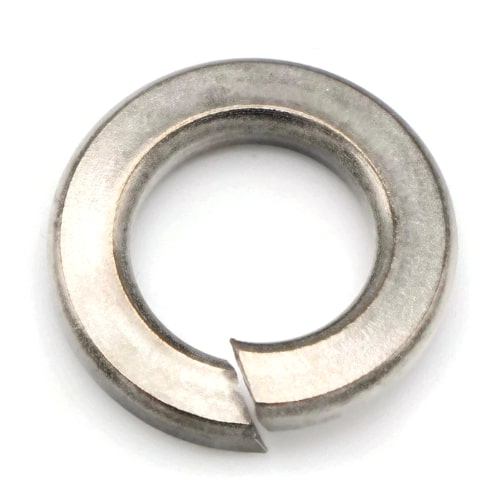
Split Ring Lock Washers, Marine Grade
What are marine grade split ring lock washers? Split ring lock washers are a single coil with a gap, which flattens as the nut tightens and stores spring tension that keeps the threads loaded and adds friction against backing off. They are the most common lock washer, suiting general connections that see vibration. In marine service they come in 316 stainless and silicon bronze, so the spring does not corrode and lose its temper in salt. AlbanyCountyFasteners.com stocks these in marine materials.
How the split ring resists loosening
The mechanism is spring tension. As the nut draws down, the coiled washer flattens and pushes back, keeping the fastener under load even if it tries to rotate loose; the split ends also dig slightly into the nut and surface to add friction. It is a general-purpose lock, easy to fit, reasonably reusable while the spring lasts, and effective on the everyday connections that make up most of a boat or dock. Its limit is severe or high-frequency vibration, where a tooth washer's direct bite or a dedicated locking nut resists better. The material point is specific to the mechanism: the whole function depends on retained spring temper, and a corroding washer loses that. 316 and silicon bronze both hold up in salt, so the spring keeps its tension over the life of the joint.
Why choose marine split ring lock washers
- Stores spring tension to resist vibration loosening
- Most common, easy-to-fit lock washer for general joints
- Reusable while the spring temper lasts
- 316 stainless keeps its temper in salt exposure
- Silicon bronze option for traditional and bronze-fastened joints
Common applications
- General marine hardware connections
- Railings, brackets, and fittings that vibrate
- Equipment mounts with moderate vibration
- Traditional wooden boat work (silicon bronze)
- Joints matched to bronze fasteners
- Any general joint at risk of loosening in salt
Marine Split Ring Lock Washer FAQs
How does a split ring washer lock a joint?
It flattens under the nut and stores spring tension, keeping the threads loaded against back-off, while the split ends add friction against the nut and surface. It is a spring-based lock rather than a biting one.
When should I choose a tooth washer instead?
For severe or high-frequency vibration, where teeth biting the surfaces resist rotation more aggressively than spring tension. For general connections, the split ring is simpler and reuses better.
Why 316 or bronze for a split ring?
The lock depends on retained spring temper, and corrosion destroys that. 316 and silicon bronze both resist salt, so the washer keeps its spring and keeps locking over time.
Can I reuse a split ring lock washer?
A few times, if it still springs back to shape. Once it stays flat it has lost its tension and should be replaced, since a flattened washer no longer locks.
Which should I pick, 316 or bronze?
316 for general marine work and to match stainless fasteners; bronze for traditional joints and to match a bronze fastener, keeping the connection galvanically consistent.
Do I still need a flat washer with it?
Often yes: a flat washer under the lock washer protects the surface and spreads load, while the lock washer handles anti-loosening. The two commonly work together in one joint.