

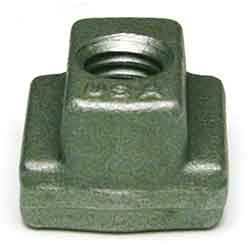
T-Slot Nuts
What are T-slot nuts? T-slot nuts are T-shaped nuts that drop into the T-slots of a machine table or fixture and slide along the slot to any position. Threaded to take a stud or bolt, they let clamps, vises, and workpieces be secured anywhere along the slot without drilling holes.
How do T-slot nuts work?
A machine table's T-slot is an undercut groove, narrow at the top and wider below, so a T-slot nut with its matching T profile drops in and cannot pull up out of the slot. It slides freely along the length, letting you position a clamp, vise, or workpiece anywhere, then a stud or bolt threads into the nut and a strap clamp and step block hold the work down. The wide base spreads clamping load across the slot so the table is not damaged. This is the backbone of milling, drilling, and fixture setups, giving adjustable holding points with no drilled holes. Choose a nut sized to your slot width and thread, snug enough to use the metal's full strength but free enough to slide with a little chip debris present. Carbon steel gives the strength these clamping loads demand.
Why choose T-slot nuts
- Slides to any position: clamp anywhere along the T-slot.
- No drilling: adjustable holding points without new holes.
- Spreads load: wide base protects the slot from damage.
- Strong: carbon steel for high clamping loads.
Common applications for T-slot nuts
- Milling machine and drill press tables
- Clamping workpieces, vises, and fixtures
- Strap clamp and step block setups
- Machine tool and fabrication workholding
Browse every option on the main lifting hardware category.
T-Slot Nuts FAQ
What is a T-slot nut used for?
Securing clamps, vises, and workpieces to a machine table by dropping into the table's T-slot and sliding to any position, then taking a stud or bolt.
How do I size a T-slot nut?
Match the nut to your table's slot width and to the stud or bolt thread you are using. It should slide freely in the slot but be sized to carry the clamping load.
Why is the bottom thread sometimes blocked?
The thread is often swaged or deformed at the bottom so a stud cannot pass through and bottom out on the slot, which would jack the nut and risk breaking out the T-slot.