

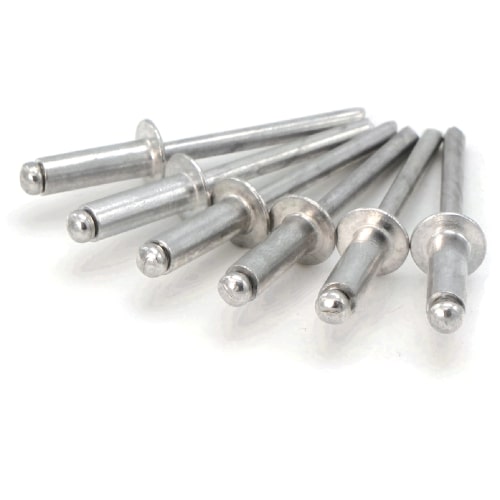
Aluminum Dome Head Open End Rivets
What are aluminum dome head rivets? These are open end blind rivets with an aluminum body and a matching aluminum mandrel, in the standard low profile dome head. All aluminum construction means no dissimilar metal anywhere in the fastener, which is what makes them the correct choice for riveting aluminum: the joint has no galvanic couple to drive corrosion. They are also the lightest and easiest to set of any blind rivet, at the cost of the lowest shear and tensile values. AlbanyCountyFasteners.com stocks aluminum dome head rivets from 1/8 inch through 1/4 inch.
Why use aluminum rivets on aluminum?
To stop the joint corroding from the inside. When two dissimilar metals sit in contact with any moisture present, the less noble one becomes a sacrificial anode and corrodes preferentially. Aluminum is well down the galvanic series, so putting a steel or stainless rivet into an aluminum panel means the aluminum around each hole goes first. Boat owners see this constantly: the holes enlarge, the surface turns to white chalky powder, and eventually the panel is compromised around every fastener. An all aluminum rivet, body and mandrel both, removes the couple entirely. It is the lowest strength option available, and for aluminum work that is usually the right trade.
Why choose aluminum dome head rivets
- No dissimilar metal in the fastener, so no galvanic couple with aluminum panels
- Lightest blind rivet option, useful where weight matters
- Easiest to set, so a basic hand riveter handles them across the size range
- Naturally corrosion resistant through aluminum's own oxide layer
- Lower cost than stainless for general and high volume work
Sizes and grip ranges
- Body diameters from 1/8 through 1/4 inch, covering sizes 4, 5, 6, and 8
- Grip ranges from about 0.020 inch through 0.750 inch depending on size
- Order by body diameter first, then match grip range to your total material stack
- Include any backup washer thickness in the grip calculation
Common applications
- Aluminum boat hulls, trim, and marine fittings
- Aluminum trailer skins, truck bodies, and RV panels
- Aluminum ductwork and lightweight sheet metal fabrication
- Signage and display work on aluminum substrate
- Screen doors, window frames, and architectural aluminum
- General light duty assembly where load is modest
Where you need more strength in an aluminum body, multi-grip rivets with a steel mandrel set harder, though at some corrosion cost. For sealed aluminum joints, see closed end rivets in aluminum with aluminum mandrel.
Related Categories
Aluminum Dome Head Rivet FAQs
How strong are aluminum rivets?
They have the lowest shear and tensile values of any break mandrel blind rivet. That is not a defect, it is the trade for galvanic compatibility and easy setting. For heavier loads, step up a diameter before switching material, since a larger aluminum rivet may give you what you need without introducing a dissimilar metal.
Can I use aluminum rivets on steel?
It is generally a poor pairing in wet conditions, because the aluminum rivet becomes the sacrificial metal and corrodes around every hole. In dry indoor service it is fine. Outdoors, stainless usually makes more sense for a mixed metal joint.
What aluminum alloy are these?
Blind rivet bodies are typically 5050, 5052, 5056, or similar alloys chosen for formability and corrosion resistance, with mandrels in a higher strength alloy. Exact alloy varies by manufacturer and size, so contact us if your specification calls out a particular grade.
Do aluminum rivets corrode?
Aluminum forms its own protective oxide layer, which is why it survives outdoors without plating. It will corrode in strongly alkaline conditions or where salt deposits sit against it undisturbed, but for typical exterior service it holds up well, especially against aluminum.
Are these easier to install than stainless?
Considerably. Aluminum needs much less pulling force, so a basic hand riveter sets them comfortably across the whole size range. That makes them practical for long runs by hand, where stainless would require a lever or powered tool.
Why choose an aluminum mandrel over steel?
Because part of the mandrel stays in the rivet. A steel mandrel gives a stronger set but leaves carbon steel inside an aluminum fastener, which rusts in wet service and stains the panel. For anything that gets wet, the matched aluminum mandrel is the correct call.