

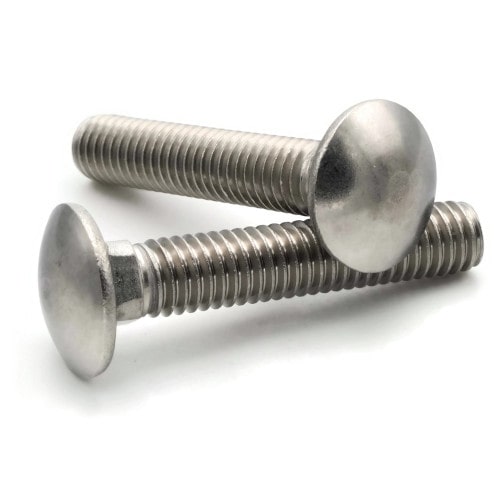
Carriage Bolts, Marine Grade
What are marine grade carriage bolts? Carriage bolts are round-headed bolts with a square shoulder under the head that pulls down into wood as the nut is tightened, locking the bolt against spinning so you can tighten from one side. In 316 stainless they bring that self-anchoring convenience to salt-exposed timber: docks, boat trailers, waterfront railings, and outdoor structures where a plated carriage bolt would streak and seize within a season. The smooth domed head also leaves no recess to trap water or catch on lines. AlbanyCountyFasteners.com stocks these in 316 stainless steel.
Why a carriage bolt for marine timber?
The square neck is the whole point. Driven into a slightly undersized or pre-bored hole, it bites the wood and holds the bolt still, so a single wrench on the nut does the work with no second tool on the head. That matters on a dock or a hull where the head side is often inaccessible or underwater. The domed head has no socket or slot, which in a marine setting is a quiet advantage: nothing to hold standing water against the surface, nothing to snag a mooring line, and a clean look on a visible rail. In 316 the bolt shrugs off the salt that would turn a plated carriage bolt into a rust streak and a frozen nut.
Why choose 316 stainless carriage bolts
- Square neck locks into wood for single-wrench tightening
- Smooth domed head sheds water and will not snag lines
- 316 stainless resists the chloride pitting that destroys plated bolts
- No recess to trap salt water against the surface
- Clean finished appearance on visible railings and trim
Common applications
- Dock and pier timber framing
- Boat trailer bunks and cross members
- Waterfront railings, gates, and fences
- Outdoor furniture and structures in coastal air
- Wooden boat and deck construction
- Any through-timber connection tightened from one side
Marine Carriage Bolt FAQs
Do I need a special hole for the square neck?
Bore the through-hole to the bolt diameter. The square shoulder is designed to pull into the wood as you tighten, seating itself and locking the bolt. In very hard timber a light tap seats it before the nut goes on.
Why 316 rather than 304 for carriage bolts?
304 pits in salt water and salt air because it lacks molybdenum. On an exposed dock or trailer that means rust streaks and a nut you cannot remove later. 316 resists chloride corrosion and stays serviceable.
Can I use these below the waterline?
For deep, permanently submerged, or sealed timber joints, silicon bronze is the safer choice because stainless can suffer crevice corrosion where oxygen cannot reach it. For above-water and splash-zone timber, 316 carriage bolts perform well.
What nut and washer should I pair with them?
Match the metal: a 316 nut and washer keep the whole connection corrosion resistant and avoid galvanic mismatch. A washer under the nut spreads load and protects the timber as the bolt draws up.
Will the head loosen over time?
The square neck resists rotation, so once seated the bolt holds while you retighten the nut. In service, timber shrinkage can slacken any wood bolt, so a periodic check and nip-up is good practice on structural connections.
Are they suitable for freshwater and pool environments too?
Yes. 316 handles chlorinated pool water, brackish water, and general wet outdoor exposure as well as it handles salt, so it is a sound choice for any corrosive-water setting, not only the ocean.