

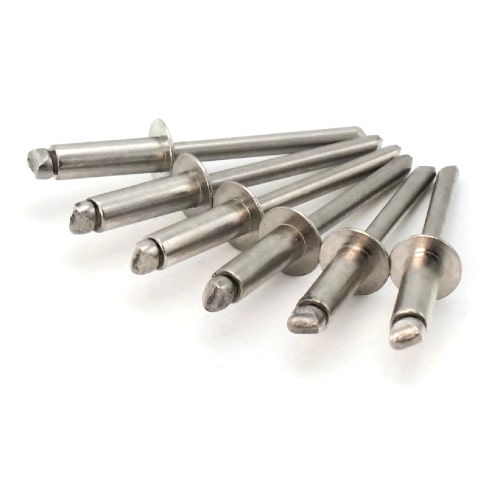
304 Stainless Steel Dome Head Open End Rivets
What are 304 stainless dome head rivets? These are open end blind rivets with a 304 stainless body and a matching stainless mandrel, in the standard low profile dome head. The matched mandrel is the important part: because a portion of the mandrel stays inside the rivet permanently, a stainless body with a steel mandrel leaves a corroding component buried in an otherwise corrosion resistant joint. All stainless construction avoids that entirely. This combination also delivers the highest shear and tensile values of any standard blind rivet. AlbanyCountyFasteners.com stocks these from 3/32 inch through 1/4 inch.
Why choose all stainless over a steel mandrel?
Because the mandrel does not leave. Setting a blind rivet breaks the mandrel and most of it falls away, but the head end stays lodged inside the body for the life of the joint. Pair a stainless body with a cheaper steel mandrel and you have buried a piece of carbon steel inside a fastener you selected specifically for corrosion resistance. In wet service that steel rusts, and the corrosion products expand, weaken the set, and bleed rust streaks down the panel from the center of each rivet. On an exposed stainless installation that staining is both a cosmetic failure and a signal the joint is degrading. Matched stainless costs more and is worth it wherever water reaches the joint.
Why choose 304 stainless dome head rivets
- Highest shear and tensile strength of any standard blind rivet material
- Matched stainless mandrel leaves no corroding component inside the rivet
- No rust staining from the mandrel break on exposed panels
- Excellent corrosion resistance in outdoor, marine, and washdown service
- Standard dome head profile suits general and visible panel work
Sizes and grip ranges
- Body diameters from 3/32 through 1/4 inch, covering sizes 3, 4, 5, 6, and 8
- Grip ranges from about 0.020 inch through 0.625 inch depending on size
- Order by body diameter first, then match grip range to your total material stack
- Remember to include any backup washer thickness in the grip calculation
Where these are used
- Marine hardware, boat fittings, and dock equipment
- Outdoor panels, signage, and architectural work
- Food processing and commercial kitchen equipment subject to washdown
- Coastal installations where salt air attacks lesser materials
- Trailer and transportation panels exposed to road salt
- Any exposed installation where rust streaking would be unacceptable
For a stainless joint that also seals against water, use closed end rivets in 304 stainless. Where the head needs more bearing area on soft material, see large flange rivets.
Related Categories
- Dome Head Open End Rivets
- Closed End Rivets
- Large Flange Rivets
- Rivet Washers
- Stainless Steel Rivets
304 Stainless Dome Head Rivet FAQs
Is 304 stainless good enough for marine use?
For most marine work above the waterline, yes. 304 handles salt air, spray, and washdown well. For constant saltwater immersion or heavy chloride exposure, 316 offers better pitting resistance, though 304 remains the common choice for general boat and dock hardware.
Are stainless rivets harder to set?
Yes, noticeably. Stainless requires more pulling force than aluminum or steel, and a stainless mandrel resists breaking more than a steel one. A hand riveter struggles above 5/32 inch in stainless, so plan on a lever, pneumatic, or cordless tool for larger sizes.
Can I use stainless rivets on aluminum panels?
You can, but understand the galvanic pairing. Stainless is more noble than aluminum, so in wet conditions the aluminum around each rivet corrodes preferentially, eventually enlarging the holes. For aluminum panels in wet service, aluminum rivets with aluminum mandrels are the safer specification.
Are these magnetic?
They may show slight magnetic response. 304 is austenitic and nominally non-magnetic, but the cold working involved in forming a rivet body induces some magnetism. This is normal and does not indicate the wrong material.
Will these rust at all?
304 resists corrosion but is not immune. In heavy salt exposure you may see light surface tea staining over years, particularly where deposits sit undisturbed. Rinsing exposed installations extends appearance and service life considerably.
What is the strength difference versus aluminum?
Substantial. The order runs aluminum with aluminum mandrel lowest, then aluminum with steel mandrel, then all steel, then stainless highest, in both shear and tensile. Where load matters, stainless gives the most capacity at any given diameter.