

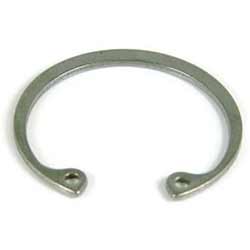
Internal Retaining Rings
What are internal retaining rings? Internal retaining rings are spring steel rings that seat into a groove machined inside a bore or housing, forming a shoulder that keeps bearings, seals, pistons, and end caps from moving out of position. They work opposite to external rings: instead of expanding over a shaft, they compress to pass into the bore and then spring outward against the groove. Lug holes at each end accept internal retaining ring pliers, which squeeze the ring smaller rather than spreading it. AlbanyCountyFasteners.com stocks internal retaining rings in stainless steel and black phosphate, in inch sizes from 1/4 inch through 1-3/4 inches and metric sizes from 13mm through 46mm.
How do internal retaining rings work?
An internal ring is manufactured larger than the bore it goes into. You compress it with pliers until it clears the bore opening, feed it down to the groove, then release and let it spring outward until it seats around the full circumference. Once seated it stands proud of the bore wall, and whatever you are retaining bears against that shoulder. The load path runs through the ring into the groove wall, not through the ring's spring tension, so groove depth is what actually determines how much thrust the assembly holds. Most internal rings are tapered, thickest opposite the opening, which keeps the exposed shoulder an even height all the way around instead of thinning out near the lugs.
Why choose internal retaining rings
- Retain bearings, seals, and end caps inside a housing with no threaded fasteners or machined shoulder
- Tapered section gives a consistent shoulder height through the full 360 degrees
- Lug holes accept standard internal retaining ring pliers for controlled installation
- Remove cleanly for service, so bearings and seals can be replaced without cutting anything
- Stocked in inch and metric sizes in both stainless steel and black phosphate
Materials and finishes we stock
- Stainless steel, for wet, humid, washdown, and outdoor housings where corrosion would seize the ring in its groove
- Black phosphate, an economical finish for enclosed and lubricated assemblies where the ring stays dry
- Metric stainless steel, sized to millimeter bores for imported and DIN 472 specified equipment
Common applications
- Retaining ball bearings and bushings inside gearbox and motor housings
- Holding seals, wear sleeves, and end caps in bores
- Hydraulic and pneumatic cylinders, retaining piston assemblies and gland nuts
- Automotive transmissions, differentials, and wheel hub assemblies
- Pumps, compressors, and rotating equipment housings
- Pulley and sheave bores, idler assemblies, and conveyor components
For rings that seat on a shaft rather than in a bore, see our external retaining rings. If the assembly needs a clip that installs from the side rather than along the axis, look at E-style retaining rings.
Related Categories
- Stainless Steel Internal Retaining Rings
- Metric Stainless Steel Internal Retaining Rings
- Black Phosphate Internal Retaining Rings
- External Retaining Rings
- Retaining Ring Pliers
Internal Retaining Ring FAQs
How do you install an internal retaining ring?
Fit internal retaining ring pliers into the two lug holes and squeeze the handles, which brings the tips together and compresses the ring. Shrink it just enough to clear the bore, guide it down to the groove, then release slowly and let it spring outward into place. Over-compressing is the common mistake, since a ring squeezed past its elastic limit will not expand fully to the groove again.
What size internal retaining ring do I need?
Order by the bore diameter, not the ring's own outside diameter. A 1 inch bore takes a 1 inch internal ring, and that ring will measure larger than 1 inch when uninstalled because it is meant to spring outward into the groove. Confirm the groove diameter and groove width as well.
Are internal and external retaining ring pliers different?
Yes, and they are not interchangeable. Internal pliers bring the tips together when you squeeze, compressing the ring into a bore. External pliers push the tips apart, expanding a ring over a shaft. Convertible pliers switch between both actions.
Which way does an internal retaining ring face?
The stamped ring has one sharp edge and one slightly rounded edge. Install with the sharp edge facing away from the retained part, so the sharp corner bears against the groove wall and resists being cammed out under thrust.
How do I know the ring is fully seated?
Look for even engagement all the way around the groove. The ring should sit flush against the groove and rotate freely without any section standing proud of the bore wall. A ring lifting at one point has not fully expanded and will release under load.
What is the difference between internal and external retaining rings?
Where the groove is. If the groove is cut inside a bore or housing, you need an internal ring that compresses to go in and springs outward. If the groove runs around the outside of a shaft, you need an external ring that expands to go on and springs inward. They are sized by different dimensions and cannot substitute for each other.