

Coupling Nuts
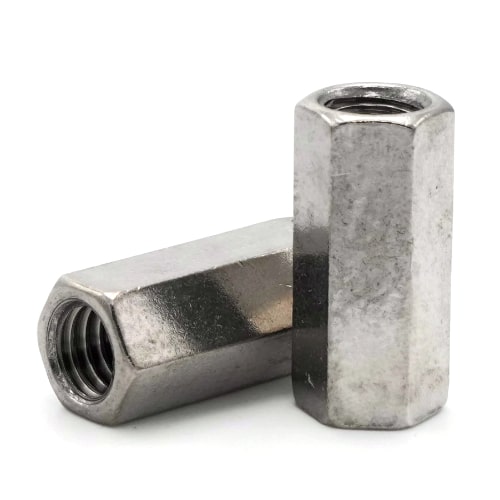
Coupling Nuts
Standard Coupling Nuts
Long hex nuts that connect two same-size male threads to extend length or join threaded rod.
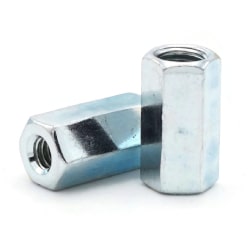
Coupling Reducer Nuts
Coupling nuts with two different internal thread sizes that join rods or bolts of unlike diameters.
Videos
Play videoWhat Are Coupling Nuts?
Coupling nuts—also called extension nuts—are long hex nuts used to join two externally threaded parts, most commonly threaded rods. The extended body gives greater thread engagement than a standard hex nut, creating a strong, reliable connection that you can tighten with a wrench.
When Should You Use a Reducer Coupling Nut?
Use a reducer coupling nut when you must connect different thread sizes or diameters (e.g., 5/16"-18 to 1/4"-20, or M10 to M8). Reducers are ideal for retrofits, transitions between assemblies, or adapting legacy hardware without replacing every component.
Common Applications for Coupling Nuts
- Extending threaded rod for hangers, strut, cable trays, and mechanical supports
- Joining anchor rods to meet projection requirements in structural installs
- Field repairs where short studs/rods must be combined
- OEM machinery, conveyors, racking, telecom, solar, and signage
- Agricultural, utility, and marine hardware where adjustability matters
Coupling Nut Materials & Finishes
- 18-8 / 304 Stainless Steel: General corrosion resistance for outdoor/damp environments.
- 316 Stainless Steel: Enhanced resistance for coastal/marine or chemically harsh settings.
- Hot-Dip Galvanized Steel: Heavy zinc for rugged exterior/structural work (threads tapped oversize).
- Zinc-Plated Steel: Economical indoor protection with a bright finish.
- Aluminum: Lightweight and corrosion resistant where weight matters.
Sizing, Threads & Lengths
- Thread forms: UNC/UNF (inch) and coarse/fine metric—match size and pitch on each end.
- Hex across-flats: Pick for tool access and torque capacity.
- Body length: Longer bodies provide more engagement and easier alignment.
- Handedness: Standard parts are right-hand; left-hand or RH/LH hybrids are special-purpose.
Selection Tips for Coupling Nuts
- Verify thread size, pitch, and tolerance class for both parts before ordering.
- Choose material/finish for the environment: indoor, outdoor, marine, chemical, or high-temp.
- For heavy-duty/structural work, use HDG or stainless per spec and follow project requirements.
- Use reducers only when a size change is required; same-size couplers offer highest capacity.
Installation Tips for Coupling Nuts
- Prep threads: Square-cut rods, deburr, and chase damaged threads if needed.
- Start by hand: Hand-start both ends to avoid cross-threading; then torque with proper wrenches.
- Engagement: Aim for full thread engagement from both sides (typically at least one rod diameter each end).
- Locking & sealing: Use thread-locker or jam nuts for vibration; apply anti-seize with stainless.
- Compatibility: Keep materials compatible (e.g., stainless to stainless) to limit galvanic corrosion.
Coupling Nuts vs. Turnbuckles
Coupling nuts join same-hand threads to create a fixed-length extension tightened with a wrench. Turnbuckles use opposite-hand threads for in-place length adjustment by rotating the body.
Compliance & Best Practices
- Follow engineer/spec for grade, coating, and inspection.
- Do not mix inch and metric threads.
- Use specified lubricants, torque values, and verification procedures on critical connections.