

Open End Rivets
Resources
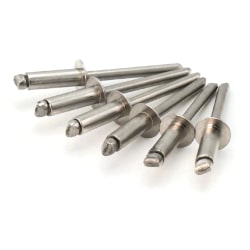
What are open end rivets? Open end rivets are the standard blind rivet, with a hollow body open all the way through. After setting, the mandrel head stays lodged inside the body but does not seal it, so the rivet is not watertight. This is the most common and least expensive blind rivet, and it is the default choice for general sheet metal and panel work where sealing is not a requirement. AlbanyCountyFasteners.com stocks open end rivets in aluminum, all steel, stainless steel, and copper, with matched or steel mandrels.
Open End Rivets
Dome Head
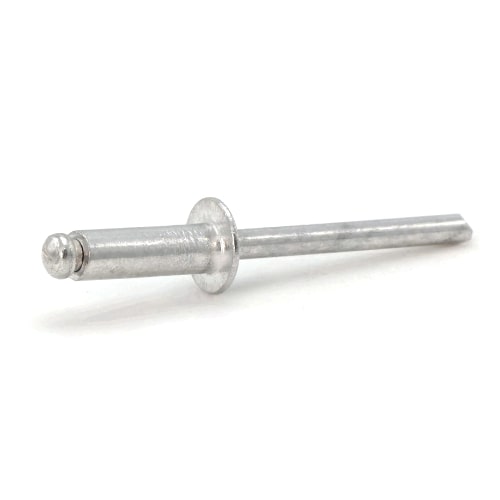
Open end rivets with a standard rounded dome head, the general-purpose head that spreads load across the surface.
Large Flange Rivets
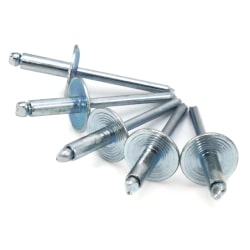
Blind rivets with an oversized flange head that spreads load over a wider area, ideal for soft, thin, or oversized-hole material to resist pull-through.
Countersunk Rivets
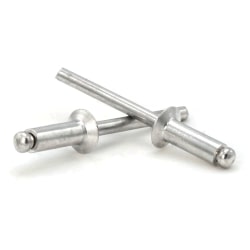
Blind rivets with a beveled head that sits flush in a countersunk hole for a smooth surface on visible panels.
Videos
Play videoWhen should I use an open end rivet?
Use one whenever sealing is not part of the job, which covers most riveting. Open end rivets carry a wide load spread, cost less than every other style, and come in the broadest range of materials and sizes, which is why they account for the bulk of blind rivet use. What they will not do is keep water or air out. The body stays hollow after setting, so moisture can travel straight through the rivet and out the back. If the panel sees weather, holds fluid, or has to stay airtight, a closed end rivet is the correct part even though it costs more.
Why choose open end rivets
- Lowest cost per joint of any blind rivet style
- Widest availability across materials, diameters, and grip ranges
- Fast setting with any standard hand riveter or pneumatic tool
- Broad load spread suits general purpose sheet metal work
- Available with matched mandrels for corrosion critical assemblies
Material options
- Aluminum with aluminum mandrel, best galvanic compatibility with aluminum panels, lowest strength
- Aluminum with steel mandrel, stronger set than all aluminum, at the cost of a steel component left in the joint
- All steel, higher shear and tensile than aluminum at moderate cost, least corrosion resistant
- Stainless steel, highest strength and best corrosion resistance for outdoor and marine work
- Copper with brass or steel mandrel, for electrical, decorative, and restoration work
Common applications
- General sheet metal fabrication and panel assembly
- Ductwork and HVAC where sealing is handled separately
- Interior trim, brackets, and mounting plates
- Signage, shelving, and display fixtures
- Appliance and equipment housings
- Repair and maintenance work across trailers, machinery, and enclosures
If the joint has to keep water out, use closed end rivets instead. Where the hole is oversized or the material is soft, large flange rivets spread the load better. For a flush surface, see countersunk rivets.
Related Categories
Open End Rivet FAQs
Are open end rivets waterproof?
No. The body remains hollow through the center after setting, so water and air pass straight through. The mandrel head plugs the blind side but does not seal it. For any watertight or airtight joint, use a closed end rivet.
What is the difference between open end and closed end rivets?
The blind end of the body. An open end rivet is a tube open at both ends. A closed end rivet has a solid cup at the far end that stays sealed after setting, blocking moisture and gas. Closed end rivets also run higher in shear and tensile strength at the same size and material.
Which mandrel should I choose?
Match the mandrel to the body when the joint will get wet. A steel mandrel in an aluminum body sets stronger and costs less, but the steel remnant left inside can rust, weaken the joint, and streak the panel. In dry indoor work the steel mandrel is a sensible economy.
Do the mandrel heads fall out?
They can, on open end rivets. The mandrel head is retained by friction, not by a mechanical lock, so vibration can eventually shake it loose. That is one reason structural rivets exist, since their mandrels are locked in place and cannot vibrate out.
What head style do open end rivets come in?
Dome head is standard, a low, slightly rounded profile that suits most work. Large flange and countersunk versions are stocked separately, since the head style changes both the load spread and the finished appearance.
Can I use aluminum rivets on steel panels?
You can, but consider corrosion. Aluminum is less noble than steel, so in the presence of moisture the aluminum rivet corrodes preferentially and the joint loosens over time. For mixed metal joints outdoors, stainless is usually the safer specification.