

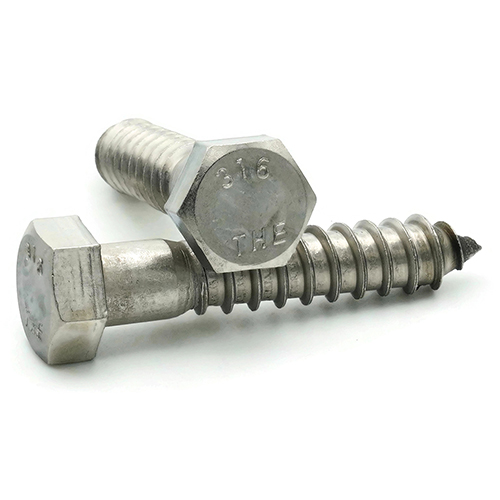
Hex Lag Screws, Marine Grade
What are marine grade hex lag screws? Hex lag screws are heavy, coarse-threaded screws with a hex head, driven with a wrench to bite deep into timber for high holding power where a bolt cannot pass all the way through. In marine service they anchor ledgers, brackets, and heavy hardware to dock framing, pilings, and structural timber. AlbanyCountyFasteners.com stocks them in 316 stainless for general salt exposure and in silicon bronze for wooden construction and sealed joints where stainless can suffer crevice corrosion.
Lag into timber, and which metal
A lag screw is what you reach for when the connection is into wood and too heavy for an ordinary screw but a through-bolt is impractical. The coarse thread cuts into the timber and the hex head lets you apply serious torque with a wrench, developing holding power a driver-run screw cannot. Material choice follows the same marine logic as the rest of the range. 316 stainless is the general pick for salt exposure, chloride resistant and strong. Silicon bronze is the specialist choice for wooden construction and for deep, sealed joints: driven into wet timber where oxygen cannot reach, a stainless lag can suffer crevice corrosion, whereas bronze resists corrosion in exactly those anaerobic conditions and will not stain the wood. For a dock ledger or a piling fitting, that distinction decides which metal to buy.
Why choose marine hex lag screws
- Coarse thread bites deep into timber for high holding power
- Hex head takes a wrench for high driving torque
- 316 stainless resists chloride corrosion in salt exposure
- Silicon bronze suits wood and sealed, oxygen-starved joints
- Anchors heavy hardware where a through-bolt will not fit
Common applications
- Dock ledgers and framing connections
- Piling and heavy timber hardware
- Waterfront brackets, cleats, and fittings
- Wooden boat structural fastening (silicon bronze)
- Coastal deck and pergola structures
- Any heavy timber anchor in a salt environment
Marine Hex Lag Screw FAQs
Do I need to pre-drill for lag screws?
Yes. Lag screws require a pilot hole sized to the shank and thread, both to prevent splitting and to let the screw develop full holding power without twisting off. Hardwoods and dense timber especially need a correctly sized pilot.
When should I choose bronze lag screws?
For wooden boat construction and for deep or sealed timber joints where a stainless lag could suffer crevice corrosion. Bronze resists corrosion in oxygen-starved conditions and will not stain the surrounding wood.
Why 316 rather than galvanized lags?
Galvanizing wears and the zinc is eventually consumed in salt exposure, after which the steel rusts. 316 stainless resists chloride corrosion through its full section, so it outlasts galvanized in a marine setting.
How deep should the screw penetrate?
Holding power comes from thread engagement in sound timber, so the screw should reach well into solid wood beyond any bracket or ledger thickness. Follow the connection design; more engagement in good timber means more capacity.
Will stainless lags react with treated timber?
316 resists the corrosive preservatives in modern treated lumber far better than plated steel, which is why it suits treated dock framing. It avoids the accelerated corrosion those chemicals cause in cheaper fasteners.
Can I use a bronze lag with a stainless bracket?
They sit reasonably close galvanically, so the risk is modest, but in wet salt conditions keeping the connection in one metal is safer where possible, or isolate the dissimilar contact with bedding compound.