

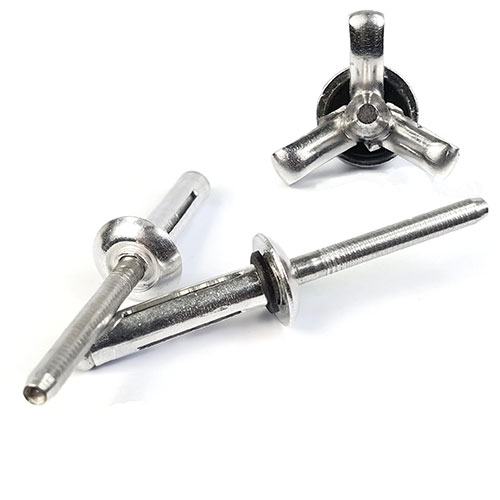
Aluminum Recessed Crown Dome Head Tri-Fold Rivets
What are aluminum recessed crown tri-fold rivets? These are tri-fold rivets with an all aluminum body and mandrel and a dome head formed with a central recess. The recess seats the sealing washer so it cannot creep out under vibration, and sets the mandrel break below the crown where it is shielded from weather. The body folds into three legs on the blind side for a wide clamp in thin material, while matched aluminum construction keeps the joint free of dissimilar metals. AlbanyCountyFasteners.com stocks these in 3/16 and 1/4 inch, across six grip ranges.
Why this combination for exterior aluminum panels?
Because it addresses every failure mode an exposed panel rivet faces. Thin aluminum skin pulls through under a concentrated head, so the tri-fold legs spread the load. Sealing washers creep out from under smooth domes over years of vibration, so the recess gives the washer a seat. Mandrel breaks sit at the most weather exposed point of a standard head, so the recess drops the break below the crown. And a dissimilar metal against aluminum corrodes the skin around every hole, so the all aluminum construction removes the couple. None of those is dramatic on its own, but on a trailer panel with two hundred rivets facing years of road spray, each one is a place the joint could start to fail.
Why choose aluminum recessed crown tri-fold rivets
- Recess seats the sealing washer against creep under vibration
- Mandrel break shielded below the crown rather than exposed at the high point
- Three folding legs prevent pull-through in thin aluminum skin
- No dissimilar metal in the fastener against an aluminum panel
- Clean finished appearance with no shaving or finishing step
Sizes and grip ranges
- 3/16 inch in grip ranges from 0.250 through 0.500 inch
- 1/4 inch in grip ranges from 0.250 through 0.500 inch
- Order by body diameter, then match grip range to your total material stack
- Include the sealing washer thickness in the grip calculation
Common applications
- Aluminum trailer and RV exterior panels in road spray
- Horse trailer and cargo trailer skins
- Aluminum siding, cladding, and metal building panels
- Marine panels and boat trim facing weather
- Repairs over enlarged holes on exposed aluminum surfaces
- Any exterior aluminum joint where seal life matters
For a standard dome without the recess, see aluminum dome head tri-fold rivets. Where the head must match solid buck rivets, use aluminum shave head tri-fold rivets.
Related Categories
- Recessed Crown Dome Head Tri-Fold Rivets
- Aluminum Dome Head Tri-Fold Rivets
- Aluminum Shave Head Tri-Fold Rivets
- Tri-Fold Rivets
- Rivet Washers
Aluminum Recessed Crown Tri-Fold Rivet FAQs
How is this different from a standard dome head?
The center of the head is recessed below the raised crown. That gives the sealing washer a positive seat and places the mandrel break in a sheltered position rather than at the highest point of the head.
Does the recess collect water?
The sealing washer sits in it, filling the recess in normal installation. Where the washer has been removed, standing water in the recess is worth considering on an upward facing surface, in which case a standard dome or a sealant is the better route.
Are these as strong as steel tri-fold rivets?
No. Aluminum with an aluminum mandrel is the lowest strength combination, which is the trade for galvanic compatibility with aluminum skin. For heavier loads on steel panels, steel tri-fold rivets carry considerably more.
Can I use these on painted panels?
Yes, and the sealing washer helps protect the paint at the hole edge from moisture ingress. Set the rivet without overdriving, since crushing the washer distorts the seal and can mark the finish around the head.
What size hole do I drill?
Slightly larger than the rivet body so it slips in without forcing. Verify the specification for your exact part rather than working from a general chart, since tri-fold rivets can differ from standard blind rivet hole sizing.
Do I need a special tool?
No, a standard blind rivet tool with a matching nosepiece sets these. Use a riveter with full stroke travel, since the tri-fold formation requires a longer pull than a conventional rivet.