

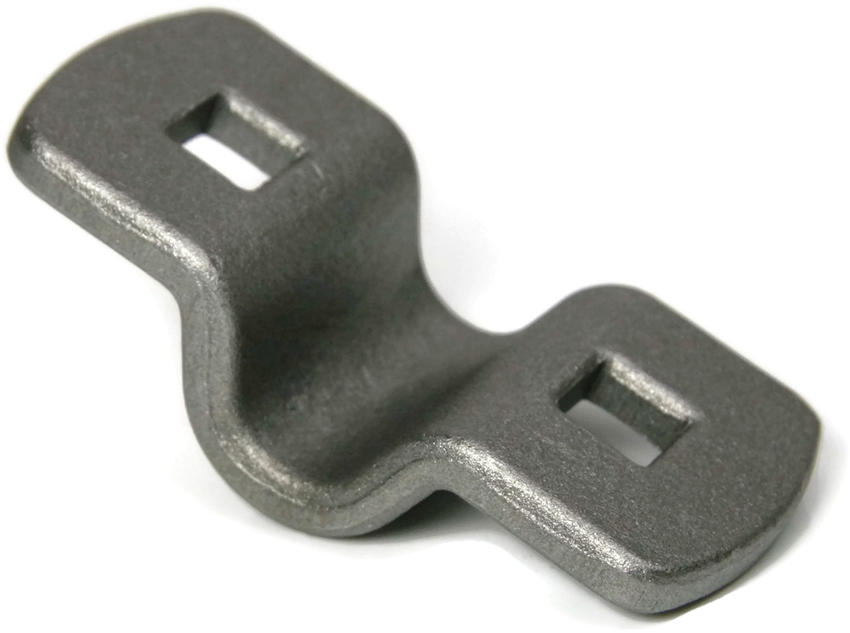
C1018-C1020 Carbon Steel D-Ring Bolt-On Clips
What are C1018-C1020 D-ring bolt-on clips? These are D-ring mounting brackets in low carbon steel, attached with bolts rather than welded. C1018-C1020 contains roughly 0.18 to 0.20 percent carbon, a general purpose grade that forms cleanly, machines well, and takes paint or plating readily. For a bolted bracket the priority is a consistent, well formed part that seats flat against the deck and holds its shape under load. AlbanyCountyFasteners.com stocks these in 3/8 and 1/2 inch to match our C1045 D-ring range.
Why the clip material matters less than the installation
Worth being straight about: on a bolt-on anchor, the bracket is rarely the limiting factor. What governs capacity is whether the bolts pass fully through the deck, whether there is a backing plate spreading the load on the far side, and whether the deck material itself can take what the anchor transmits. A well formed low carbon bracket bolted through a steel frame with proper backing will hold to its rating. The same bracket held by short screws into plywood will not, regardless of what the bracket is made from. So specify the clip, then spend your attention on the hardware and the backing, because that is where bolt-on anchors actually fail.
Why choose C1018-C1020 bolt-on clips
- Low carbon steel forms consistently and seats flat against the deck
- Takes paint, powder coat, and plating readily for corrosion protection
- No welding equipment or qualified welder needed
- Repositionable and replaceable without cutting the deck
- Sized to match our C1045 D-ring range
Sizes stocked
- 3/8 inch, for 3/8 inch D-rings
- 1/2 inch, for 1/2 inch D-rings
- D-rings sold separately, order both in matching sizes
- Mounting bolts not included, specify to suit your deck thickness
Common applications
- Wooden trailer decks and truck beds
- Aluminum trailers where welding is impractical
- Retrofit anchor points on existing vehicles
- Light to medium duty cargo securement
- Rental and fleet equipment needing replaceable anchors
- Installations where anchor positions may change
Order matching C1045 D-rings alongside these. For permanent, higher capacity mounting, D-ring weld-on clips are the alternative.
Related Categories
- D-Ring Bolt-On Clips
- C1045 Carbon Steel D-Rings
- C1018-C1020 D-Ring Weld-On Clips
- D-Rings & Clips
- Lifting Hardware
C1018-C1020 Bolt-On Clip FAQs
What hardware should I use?
Through bolts sized to the clip holes, long enough to pass fully through the deck, with a backing plate or large washers on the far side. Use lock nuts or thread locker, since road vibration works ordinary nuts loose.
Do I need a backing plate?
On anything other than solid steel structure, yes. A backing plate spreads load across a wider area of deck rather than concentrating it at the bolt holes, which is what prevents the anchor pulling through wood or thin sheet under shock loading.
Will these rust?
Plain carbon steel corrodes outdoors. These take paint, powder coat, or plating well, so finish them before or after installation as suits, and pay attention to the bolt holes where water collects.
Can I bolt these to a wooden deck?
Yes, and it is a common application, but bolt through the full thickness with backing rather than using lag screws into the wood. Wood grip degrades as the deck weathers and the hole enlarges.
How do these compare to weld-on for strength?
Lower in equivalent size, and far more dependent on installation quality. A properly through-bolted anchor performs well, but weld-on develops higher capacity and cannot loosen under vibration.
Are these rated for lifting?
No. D-rings and clips are cargo securement hardware, not rated lifting equipment. Overhead lifting requires hardware rated and marked for that purpose.