

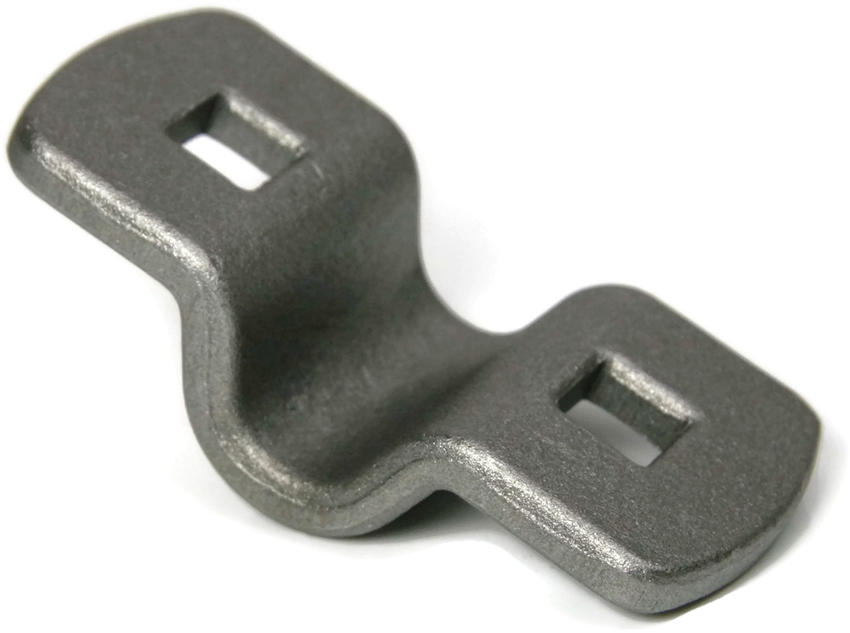
D-Ring Bolt-On Clips
What are D-ring bolt-on clips? D-ring bolt-on clips are mounting brackets attached with hardware rather than welding. They trade some capacity for practicality: no welding equipment, no qualified welder, no heat, and the anchor can be moved or replaced later without cutting the deck. That makes them the sensible choice for wooden decks, aluminum trailers where welding is difficult, and any installation where the anchor layout may need to change. AlbanyCountyFasteners.com stocks these in C1018-C1020 carbon steel, in 3/8 and 1/2 inch to match our D-ring range.
How to get full capacity from a bolt-on anchor
Bolt all the way through. This is the single detail that determines whether a bolt-on anchor performs as rated, and it is the one most often skipped. Bolts threaded into a deck or held by short fasteners rely on whatever the deck material can grip, which in wood or thin sheet is very little under a shock load. Bolting through the full thickness with a backing plate or large washers on the far side puts the load into the fastener in shear and tension rather than into the deck material, which is what the rating assumes. The other consequence of bolting is that bolted joints loosen: road vibration works fasteners free over thousands of miles, so bolt-on anchors need periodic checking in a way welded ones do not.
Why choose D-ring bolt-on clips
- No welding equipment or qualified welder required
- Anchors can be repositioned or replaced without cutting the deck
- Suitable for wooden decks and aluminum trailers where welding is impractical
- No heat, so no damage to coatings or nearby materials
- Faster to install than welding for a one off retrofit
Sizes stocked
- 3/8 inch, matching 3/8 inch D-rings
- 1/2 inch, matching 1/2 inch D-rings
- D-rings sold separately, order both in matching sizes
- Mounting hardware not included, so specify bolts to suit your deck thickness
Common applications
- Wooden trailer and truck bed decks
- Aluminum trailers where welding is difficult
- Retrofit anchor points on existing vehicles
- Light to medium duty cargo securement
- Installations where the anchor layout may change
- Rental or fleet equipment needing replaceable anchors
Order matching D-rings alongside these. For permanent installations and heavier duty use, D-ring weld-on clips develop higher capacity and cannot loosen.
Related Categories
D-Ring Bolt-On Clip FAQs
What bolts do I need?
Hardware is not included, so specify bolts sized to the clip holes and long enough to pass fully through the deck with a backing plate or large washers. Use a grade appropriate to a load bearing connection and lock nuts or thread locker to resist vibration.
Can I use lag screws into a wooden deck?
Not for full capacity. Lag screws rely on wood fibre grip, which is a fraction of what a through bolt with backing develops and degrades as the wood weathers and the hole wallows. Bolt through wherever possible.
How often should I check the bolts?
Regularly, and certainly as part of routine trailer inspection. Bolted connections work loose under road vibration, so periodic retorquing is part of owning bolt-on anchors. This is the main practical disadvantage against weld-on.
Are bolt-on anchors weaker than weld-on?
Generally yes in equivalent size, and the gap widens if installation is poor. A properly through-bolted anchor with backing performs well, but the rating depends far more on installation quality than a welded anchor does.
Can I move them later?
Yes, which is their main advantage. Unbolt, relocate, and patch the old holes. Bear in mind that holes through a deck are a water ingress path in wood and a corrosion start point in steel, so plug or seal them.
Why the same steel as weld-on clips?
C1018-C1020 is a general purpose low carbon steel that forms well and takes coating readily, so it suits the bracket regardless of mounting method. The material was chosen for weldability, and it happens to serve the bolt-on version equally well.