

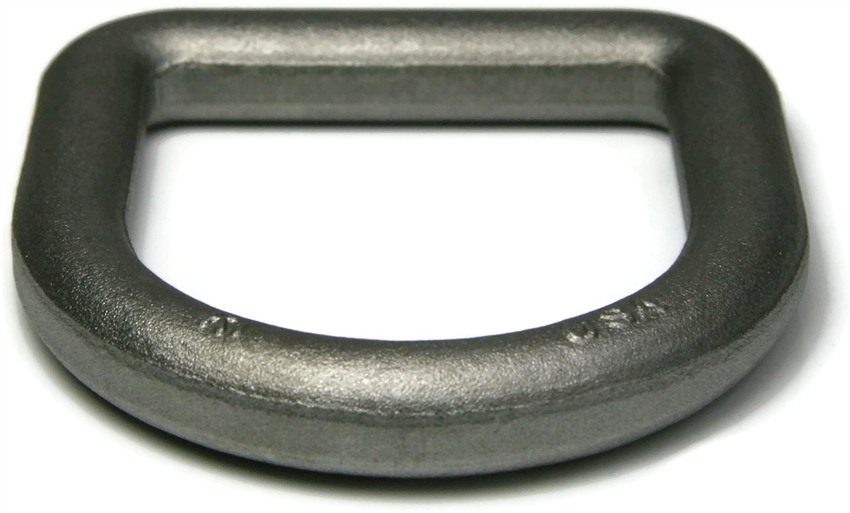
C1045 Carbon Steel D-Rings
What are C1045 carbon steel D-rings? These are tie-down anchor rings in C1045, a medium carbon steel containing roughly 0.45 percent carbon. That carbon content is what matters: it is high enough that the steel responds to heat treatment and develops substantially more strength than the low carbon grades used for brackets and general fabrication. Since the ring is the part carrying the load in a tie-down assembly, that strength is where it needs to be. AlbanyCountyFasteners.com stocks these in 3/8, 1/2, 5/8, 3/4, and 1 inch.
Why C1045 for the ring and not the clip
Because the two parts fail in different ways and need different properties. The ring is loaded in tension every time a strap comes tight, so it wants strength, and C1045 delivers that through its carbon content and the heat treatment that content makes possible. The clip is welded or bolted to a deck, and there the same carbon that gives strength becomes a liability: higher carbon steels are more prone to cracking in the heat affected zone of a weld, which is exactly the wrong failure mode in a mounting bracket. So clips use C1018-C1020 low carbon steel that welds cleanly. Splitting the materials this way puts strength where the load is and weldability where the joint is.
Why choose C1045 D-rings
- Medium carbon steel with meaningfully higher strength than low carbon grades
- Responds to heat treatment, unlike C1018-C1020
- Suited to the tension loading a tie-down ring sees in service
- Five sizes covering light trailer work through heavy equipment transport
- Folds flat in its clip when not in use
Sizes stocked
- 3/8 inch, for lighter cargo and smaller trailers
- 1/2 inch, the most common general purpose size
- 5/8 inch, for heavier loads
- 3/4 inch, for equipment and machinery transport
- 1 inch, for the heaviest securement work
- Order a matching clip in the same size, sold separately
Common applications
- Flatbed and utility trailer tie-down points
- Truck bed and pickup cargo securement
- Heavy equipment, machinery, and vehicle transport
- Enclosed trailer and van interior anchoring
- Shipping container and marine deck lashing
- Retrofitting anchor points to existing decks
Pair these with D-ring weld-on clips for permanent installation or D-ring bolt-on clips where you may need to reposition.
Related Categories
- D-Rings
- C1018-C1020 D-Ring Weld-On Clips
- C1018-C1020 D-Ring Bolt-On Clips
- D-Rings & Clips
- Lifting Hardware
C1045 D-Ring FAQs
What does C1045 mean?
It is an AISI grade designation. The 10 indicates plain carbon steel, and the 45 indicates roughly 0.45 percent carbon content. That places it in the medium carbon range, above the 0.18 to 0.20 percent of the C1018-C1020 used for the clips.
Can I weld a C1045 ring?
It is not recommended and should not be necessary, since the ring mounts in a clip rather than being welded itself. Medium carbon steels are more prone to cracking in the heat affected zone, which is why the clip is the weldable part of the assembly.
Will these rust?
Plain carbon steel corrodes in outdoor exposure. Painting, powder coating, or plating after installation extends service life considerably, particularly on trailers seeing road salt.
What size do I need for my straps?
Match the ring rating to the working load limit of the tie-down, since regulations require the anchor to be at least as strong as the strap or chain attached. Also confirm the ring opening accepts your hook.
Can I use these for overhead lifting?
No. These are cargo securement hardware, not rated lifting equipment. Overhead lifting requires hardware rated and marked for that purpose with published working load limits.
Do I need a clip for every ring?
Yes. The ring has no mounting provision on its own, so it needs a clip in the matching size. They are sold separately so you can choose weld-on or bolt-on.