

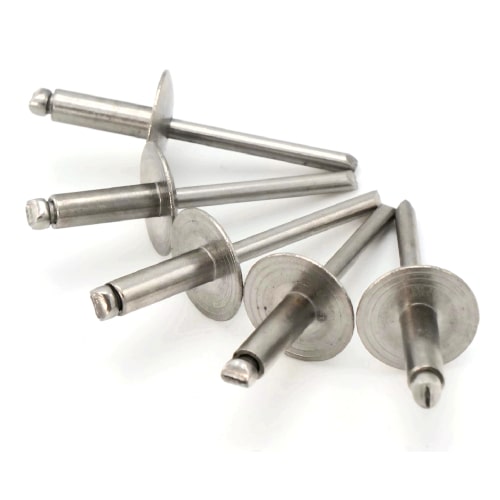
304 Stainless Steel Large Flange Rivets
What are 304 Stainless Steel Large Flange Rivets? 304 stainless steel large flange rivets are blind rivets, also called POP rivets, with a wider head than standard dome head rivets. The larger flange helps spread load over more surface area on the front side of the material, making these rivets useful for sheet metal, panels, signs, brackets, guards, covers, and applications where stainless steel material and a wider bearing surface are preferred.
Why Choose 304 Stainless Steel Large Flange Rivets?
304 stainless steel large flange rivets are useful when an application needs a stainless steel blind rivet with a wider head. The large flange helps distribute load over more surface area, which can be helpful when fastening thin sheet metal, softer materials, panels, plastics, oversized holes, or surfaces that need additional bearing support.
This category includes 304 stainless steel large flange POP rivets for one-sided fastening applications. These rivets are commonly selected for maintenance, fabrication, panel fastening, equipment repair, shop work, signage, and applications where corrosion resistance and a larger rivet head are useful.
Common Uses for 304 Stainless Steel Large Flange Rivets
304 stainless steel large flange rivets are commonly used for fastening sheet metal, panels, signs, brackets, guards, covers, enclosures, trim, equipment parts, trailers, HVAC components, plastics, and repair panels.
They are especially useful when the installer can only access one side of the assembly and the application benefits from a wider bearing surface. Choose the rivet diameter, grip range, head style, material, and tool compatibility based on the total material thickness and joint requirements.
How 304 Stainless Steel Large Flange Rivets Work
304 stainless steel large flange rivets are installed with a compatible rivet tool. The rivet is placed through a prepared hole, and the tool pulls the mandrel to expand the rivet body behind the material. Once the rivet is set, the mandrel breaks off and the rivet holds the joined materials together.
The large flange remains on the front side of the assembly and helps spread bearing pressure across a larger area than a standard dome head rivet. Proper hole size, grip range, rivet diameter, and tool capacity all matter for a secure installation.
Large Flange Rivets for Wider Bearing Surface
Large flange rivets are often selected when the front side of the joint needs more support than a standard dome head rivet provides. The wider head can help reduce pull-through risk in thin, soft, brittle, or oversized-hole applications.
They are commonly used with sheet metal, signs, panels, plastics, covers, and repair work where the rivet head needs to spread load over more surface area. Match the flange size, rivet diameter, and grip range to the material being fastened.
304 Stainless Steel Large Flange Rivets vs Standard Dome Head Rivets
304 stainless steel large flange rivets have a wider head than standard dome head rivets. This larger head provides more front-side bearing surface and can be helpful for thin material, softer material, or applications where pull-through is a concern.
Standard dome head rivets have a smaller rounded head and are commonly used for general blind riveting. Choose large flange rivets when a wider bearing surface is needed, and choose standard dome head rivets when a smaller rivet head is suitable.
304 Stainless Steel Large Flange Rivets vs Open End Rivets
Large flange rivets can be part of the open end rivet family, depending on the product style. The key difference is the head size: large flange rivets provide a wider bearing surface than standard open end dome head rivets.
Choose standard open end rivets for general blind fastening. Choose large flange rivets when the application needs a larger head to spread load, cover an oversized hole, or provide more support on the visible side of the joint.
304 Stainless Steel Large Flange Rivets vs Closed End Rivets
304 stainless steel large flange rivets are selected primarily for their wider head and stainless material. Closed end rivets are selected when the application needs a more sealed rivet body to help reduce moisture, dirt, air, or debris from passing through the rivet.
Choose large flange rivets when bearing surface is the main concern. Choose closed end rivets when sealing through the rivet body is more important. Some applications may require both a wider head and a sealed rivet style, so compare the exact product specifications before ordering.
304 Stainless Steel Large Flange Rivets vs Aluminum Large Flange Rivets
304 stainless steel large flange rivets are commonly selected when stainless material, corrosion resistance, or higher strength is important. They usually require more setting force than softer aluminum rivets.
Aluminum large flange rivets are often selected for lightweight fastening, aluminum material compatibility, and easier installation. Choose the rivet material based on the joined materials, exposure environment, strength needs, corrosion concerns, and rivet tool capacity.
304 Stainless Steel for Corrosion Resistance
304 stainless steel large flange rivets are commonly selected when corrosion resistance and stainless material are useful for the application. They are practical for many indoor, outdoor, damp, maintenance, equipment, and general-purpose applications where stainless steel is suitable.
For coastal, marine, chemical, salt-exposed, or highly corrosive environments, compare the project requirements with available 316 stainless steel or other corrosion-resistant rivet options when needed.
Rivet Diameter and Grip Range Selection
304 stainless steel large flange rivets should be selected by matching the rivet diameter and grip range to the application. The rivet diameter should match the hole size, joint strength needs, and material being fastened.
Grip range is the total thickness range that the rivet is designed to fasten. Measure the combined thickness of the materials being joined, then choose a rivet with a grip range that covers that thickness.
Rivet Tools for 304 Stainless Steel Large Flange Rivets
304 stainless steel large flange rivets require a compatible rivet tool to pull the mandrel and set the rivet. Stainless steel rivets may take more force to install than aluminum rivets, so tool capacity matters.
Before installation, confirm that the rivet tool supports the rivet diameter and material. For larger stainless steel rivets or frequent installation work, compare tool capacity, nosepiece sizes, access space, and the amount of setting force required.
How to Choose the Right 304 Stainless Steel Large Flange Rivet
Choose the 304 stainless steel large flange rivet based on the rivet diameter, grip range, flange size, hole size, joined materials, corrosion exposure, appearance requirements, and rivet tool compatibility.
If the material is thin, soft, or has an oversized hole, a large flange rivet may provide better front-side bearing support than a standard dome head rivet. If the application needs a more sealed rivet body, compare closed end rivets. If the application needs easier installation or lightweight fastening, compare aluminum large flange rivets.
Related Rivet Categories
Browse related rivet categories to compare 304 stainless steel large flange rivets, large flange rivets, stainless steel open end rivets, aluminum open end rivets, stainless steel closed end rivets, aluminum closed end rivets, rivet washers, rivet tools, and rivet kits.
- Rivet Products
- Blind Rivets
- Large Flange Rivets
- 304 Stainless Steel Large Flange Rivets
- Stainless Steel Open End Rivets
- Aluminum Open End Rivets
- All Steel Open End Rivets
- Stainless Steel Closed End Rivets
- Aluminum Closed End Rivets
- Rivet Washers
- Rivet Tools
- Rivet Kits
304 Stainless Steel Large Flange Rivet FAQs
What are 304 stainless steel large flange rivets?
304 stainless steel large flange rivets are blind rivets with a wider head than standard dome head rivets. The larger flange helps spread load over more surface area on the front side of the material.
When should I use 304 stainless steel large flange rivets?
Use 304 stainless steel large flange rivets when the application needs one-sided fastening, stainless steel material, and a wider bearing surface for thin materials, softer materials, panels, signs, or oversized holes.
What is the difference between large flange rivets and standard dome head rivets?
Large flange rivets have a wider head that spreads load over more surface area. Standard dome head rivets have a smaller rounded head for general blind riveting.
Are 304 stainless steel large flange rivets good for outdoor use?
304 stainless steel large flange rivets are commonly selected for corrosion resistance in many outdoor and damp applications. For coastal, marine, salt, chemical, or highly corrosive environments, compare project requirements with available 316 stainless steel or other corrosion-resistant options.
Do 304 stainless steel large flange rivets require a special tool?
304 stainless steel large flange rivets require a compatible rivet tool. Stainless steel rivets may require more setting force than aluminum rivets, so confirm that the tool supports the rivet diameter and material.
Are large flange rivets the same as closed end rivets?
No. Large flange describes the wider head style. Closed end describes a sealed rivet body. Choose large flange rivets for a wider bearing surface and closed end rivets when a more sealed rivet body is needed.
How do I choose the right grip range for 304 stainless steel large flange rivets?
Measure the combined thickness of the materials being joined, then choose a large flange rivet with a grip range that covers that total thickness.
How do I choose the right 304 stainless steel large flange rivet?
Choose the rivet based on the rivet diameter, grip range, flange size, hole size, joined materials, corrosion exposure, appearance requirements, and rivet tool compatibility.