

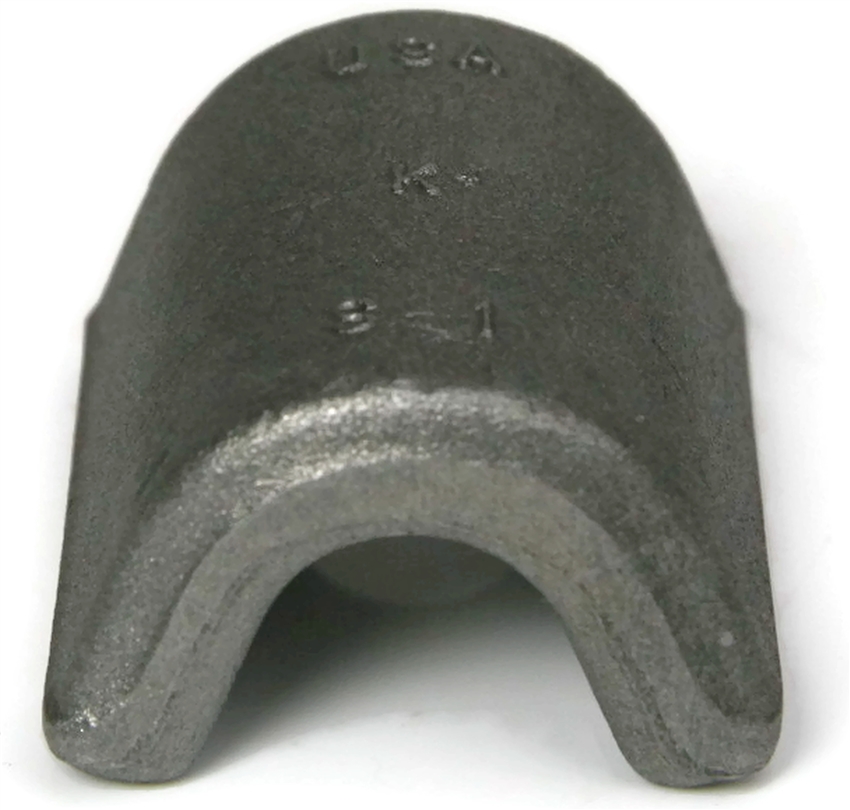
D-Ring Weld-On Clips
What are D-ring weld-on clips? D-ring weld-on clips are the mounting brackets that hold a D-ring to a deck, attached by welding rather than bolting. They are the stronger of the two mounting options and the standard for commercial and heavy duty work, because a properly executed weld cannot loosen under the vibration that eventually works bolts free on a trailer. The clip holds the ring so it pivots down flat when nothing is attached. AlbanyCountyFasteners.com stocks these in C1018-C1020 carbon steel, in 1/2, 5/8, 3/4, and 1 inch to match our D-ring range.
When to choose weld-on over bolt-on
When the anchor is permanent and the load is serious. A weld-on clip develops higher capacity than a bolted equivalent and, more importantly, it cannot work loose. Trailers vibrate constantly, and bolted connections that see thousands of miles of road input need checking and retorquing in a way welded ones never do. That makes weld-on the default for commercial fleets, heavy equipment hauling, and anywhere the anchor points are part of the trailer's permanent specification. The condition attached is that the weld has to be sound. Published ratings for weld-on anchors assume a competent weld by a qualified welder, and an inadequate weld on a load bearing connection is worse than no anchor at all, because it looks like an anchor.
Why choose D-ring weld-on clips
- Higher capacity than bolted mounting in equivalent size
- Cannot loosen under road vibration or cyclic loading
- No holes drilled through the deck, so no water ingress path
- C1018-C1020 low carbon steel welds cleanly without cracking risk
- Standard specification for commercial and heavy duty applications
Sizes stocked
- 1/2 inch, matching 1/2 inch D-rings
- 5/8 inch, matching 5/8 inch D-rings
- 3/4 inch, matching 3/4 inch D-rings
- 1 inch, matching 1 inch D-rings
- Rings sold separately, so order both in matching sizes
Common applications
- Flatbed and equipment trailer permanent anchor points
- Commercial fleet trailers and truck bodies
- Heavy equipment and machinery transport
- Shipping containers and marine deck lashing
- Steel deck structures where bolting is impractical
- Adding permanent anchor points to an existing steel deck
Order matching D-rings alongside these, since clips are sold separately. Where you need to reposition anchors later or have no welding equipment, D-ring bolt-on clips are the alternative.
Related Categories
D-Ring Weld-On Clip FAQs
Can I weld these myself?
Only if you are qualified to. This is a load bearing connection and its rating depends entirely on weld quality. An unqualified weld on an anchor point is a safety issue, since the anchor appears functional whether or not the weld is sound.
Where should I weld the clip?
To structural members rather than sheet decking, so the load path runs into the frame. Welding an anchor to thin deck plate transfers load into material that was never intended to carry it, and the deck tears before the anchor fails.
Should I paint after welding?
Yes. Plain carbon steel corrodes outdoors, and the weld area is bare metal after the heat has burned off any coating. Paint, powder coat, or plate after welding, never before, since coatings compromise the weld.
Why C1018-C1020 rather than a stronger steel?
Weldability. Low carbon steel welds cleanly without the heat affected zone cracking that higher carbon grades risk. The clip does not need the ring's strength, it needs to make a sound weld, and the material reflects that.
Do weld-on clips come with the ring?
Not here, they are sold separately. Order a D-ring in the matching size, since a 3/4 inch clip is designed around a 3/4 inch ring.
Can I remove a weld-on clip later?
Only by cutting it off and dressing the deck afterwards, which is why the choice between weld-on and bolt-on matters at the planning stage. If you expect to reposition anchors, use bolt-on clips.