

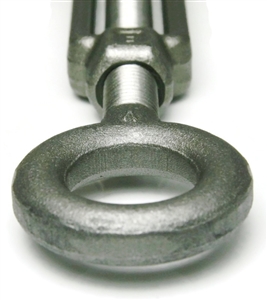
Carbon Steel Eye and Eye Turnbuckles
What are carbon steel eye and eye turnbuckles? These are tensioning assemblies with a closed loop at each end, made from plain carbon steel. The body carries opposing right hand and left hand threads, so rotating it draws both end fittings in or pushes them out without twisting the cable or rod attached. Eye ends are the simplest and strongest fitting, with no moving parts to wear or open under load reversal, which is why they suit permanent structural and marine tensioning. AlbanyCountyFasteners.com stocks these from 1/4-20 through 1-8 with 4-1/2 and 6 inch take-up.
When are eye ends the right choice?
When the connection is permanent and the anchor point accepts a shackle or thimble. A closed eye cannot open, which is its main advantage over a jaw: there is no pin to work loose, no clevis to spread, and nothing that can release if the assembly sees load reversal or slack. That makes eye and eye the standard for mast stays, guy wires, and permanent structural bracing, where the assembly is set once and expected to hold for years. The tradeoff is connection method. An eye needs something passed through it, so you are adding a shackle or thimble at each end. Where you want to pin directly to a pad eye or lug, a jaw end does that in one piece.
Why choose carbon steel eye and eye turnbuckles
- Closed loop with no moving parts, so nothing can open under load reversal
- Strongest and simplest of the end fitting styles
- Opposing thread body adjusts tension without twisting the cable
- Carbon steel is economical compared with stainless
- Suited to permanent structural and marine tensioning
Sizes and take-up stocked
- 1/4-20 with 4-1/2 inch take-up
- 3/8-16, 1/2-13, 5/8-11, 3/4-10, and 1-8 with 6 inch take-up
- Take-up is the travel available, so size it to the adjustment range you need
- Turnbuckles are specified as thread diameter by take-up length
Common applications
- Mast stays, shrouds, and standing rigging
- Guy wires on towers, poles, and masts
- Permanent structural bracing and cable tensioning
- Fence and gate bracing
- Awning, canopy, and shade structure tensioning
- Agricultural and industrial cable runs
Where you need to pin directly to a fixed lug or pad eye, carbon steel jaw and jaw turnbuckles connect without a shackle. For outdoor exposure, our hot dipped galvanized and 316 stainless options resist corrosion where plain carbon steel will not.
Related Categories
- Eye and Eye Turnbuckles
- Carbon Steel Jaw and Jaw Turnbuckles
- Carbon Steel Stub and Stub Turnbuckles
- Carbon Steel Turnbuckle Bodies
- Turnbuckles
Carbon Steel Eye and Eye Turnbuckle FAQs
What does take-up mean?
The total travel available in the assembly, from fully extended to fully closed. A 6 inch take-up gives you 6 inches of adjustment. Size it so your working tension sits mid range, leaving room to tighten further as cable stretches or settles.
How do I connect an eye end?
Through a shackle, thimble, or ring passed through the loop. The eye cannot open, so anything connecting to it must pass through and then close. That is why eye ends pair naturally with shackles and jaw ends do not need them.
Will carbon steel rust outdoors?
Yes. Plain carbon steel has no protective coating and will corrode in outdoor exposure. Paint or coat it after installation, or specify hot dipped galvanized for exterior work and 316 stainless for marine and coastal service.
Which way do I turn the body to tighten?
The body has right hand thread on one end and left hand on the other, so rotating it draws both ends in together. Which direction tightens depends on orientation, so turn a half rotation and check whether the assembly is shortening.
Do I need to lock the turnbuckle once set?
On anything that vibrates or sees cyclic load, yes. Jam nuts, lock wire, or a locking clip prevent the body rotating loose over time. This is standard practice on rigging and structural applications.
How much thread should remain engaged?
Enough that the end fittings are not backed out near their limit. Most manufacturers mark or specify a minimum engagement, and extending past it dramatically reduces capacity. If you need more length, use a longer take-up rather than running the threads out.