

Resources
Lag Bolts
Shop lag bolts, also known as lag screws, for heavy-duty wood fastening, construction, decking and wood-to-masonry applications. Choose from 304 stainless steel, 316 stainless steel, silicon bronze, zinc plated steel and hot dip galvanized lag bolts in a wide range of diameters and lengths.
Videos
Play videoShop Related Categories

.jpg?ts=1755907166)

What Are Lag Bolts?
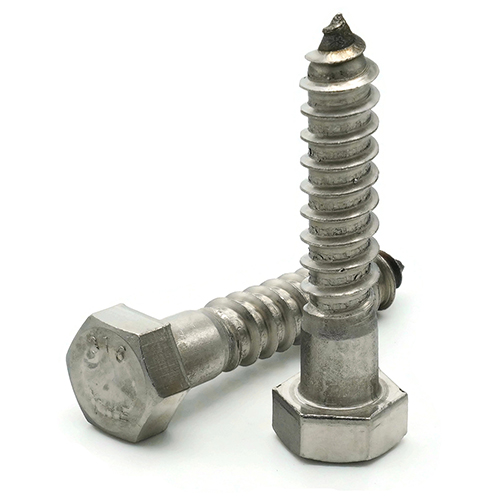
Lag bolts, also called lag screws or hex lag screws, are heavy-duty fasteners with a hexagonal head, pointed tip and deep, coarse threads designed primarily for fastening into wood. Unlike machine bolts, lag bolts are driven directly into the base material and normally do not require a nut. They are commonly used for wood-to-wood connections and can also be used with compatible lag shields for fastening into masonry.
What Are Lag Bolts Used For?
- Decking, ledger boards, and structural wood framing (per code/engineering).
- Mounting posts, brackets, pergolas, and heavy hardware to wood.
- Securing equipment, fixtures, and plates into wood members.
- Wood-to-masonry attachment when used with a compatible masonry anchor or shield.
Lag Bolts vs. Wood Screws
When should you use a lag screw instead of a standard wood screw? Watch our Fasteners 101 comparison to see wood screws and lag bolts used in a real installation and learn how the two fastening methods differ.
Watch: Wood Screws Vs Lag Bolts On Installing a Vice | Fasteners 101 →
Benefits of a Lag Bolts
- High holding power: deep threads bite into wood for strong, long-term connections.
- Positive driving: hex head allows high torque with a wrench or impact driver.
- Versatile options: multiple diameters, lengths, and corrosion-resistant materials.
- Clean installation: wide selection of finishes for indoor or outdoor projects.
Which materials are lag bolts made of?
- 304 / 18-8 Stainless: general corrosion resistance for most outdoor uses.
- 316 Stainless: upgraded resistance for coastal/marine or chemical exposure.
- Hot-Dip Galvanized (HDG): heavy zinc coating for exterior and structural applications; pair with HDG washers.
- Zinc Plated Steel: economical for dry interior environments.
- Silicon Bronze: corrosion resistance and warm appearance for marine/architectural work.
Lag Bolt vs. Lag Screw: What's the Difference?
Is it called a lag bolt or lag screw? The terms "lag bolt" and "lag screw" are commonly used interchangeably for the same fastener. Technically, "lag screw" is the more accurate term because the fastener is driven directly into wood or an anchor rather than assembled with a nut. However, "lag bolt" is widely used throughout the construction and fastener industries. Also called "lags", they are often called "lag bolts" and "lag screws" and the terms are used interchangeably. The correct term according to ANSI and ASTM standards (and most engineering specifications) is “lag screws.”
They are technically screws, not bolts, because:
-
They are driven with a wrench or hex head, but they do not use a nut.
-
They form their own threads in wood or lag shields (unlike bolts, which are used with a nut or tapped hole).
Lag Bolt Sizes & Selection
Lag screws are specified by diameter × length (e.g., 3/8" × 4"). Common diameters range from 1/4" to 1/2" (larger sizes are available). Length is measured from under the head to the tip. Choose a diameter and embedment appropriate to the load, wood species, and code requirements.
How to Install Lag Bolts
- Pre-drill: Drill a pilot hole sized near the screw’s minor (root) diameter; in harder woods, increase the pilot slightly. Drill a clearance hole through any fixture being attached.
- Use washers: Place a flat washer under the head to distribute load and protect the surface.
- Drive: Use a wrench or impact driver; tighten snugly without crushing the wood fibers. Avoid over-torque.
- Masonry: When fastening to concrete, brick, or block, use a compatible masonry anchor or shield sized for the lag screw.
Tip: For stainless-to-stainless assemblies, a small amount of anti-seize can help reduce thread galling.
Related Hardware
- Flat and fender washers (HDG or stainless to match)
- Masonry anchors/shields for wood-to-masonry installations
- Structural screws or bolts (alternative solutions when required by code)