

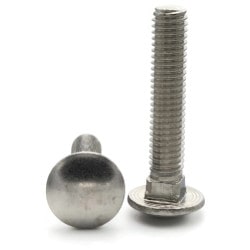
Carraige Bolts
What are carriage bolts?
Carriage bolts, also called round head square neck bolts, feature a smooth domed head and a square section directly beneath the head that helps prevent the bolt from turning during installation. Commonly used in wood, decking, fencing, construction, machinery, and outdoor assemblies, carriage bolts provide a secure through-bolted connection with a smooth, low-snag finished surface.
Videos
Play video
What Are Carriage Bolts?
Carriage bolts are round, domed-head bolts with a square neck directly beneath the head. Also known as round head square neck bolts, they are designed so the square neck seats into wood or a prepared opening and helps prevent the bolt from rotating while the nut is tightened from the opposite side.
Unlike hex bolts, carriage bolts do not have an external drive on the head. Once installed, the exposed side has a smooth, rounded surface. This makes carriage bolts especially useful for wood construction, decking, fencing, outdoor structures, equipment, and assemblies where a protruding wrench-driven head is undesirable.
How Do Carriage Bolts Work?
A carriage bolt is inserted through a pre-drilled hole until the square neck beneath the head contacts the material. As the nut is tightened, the square neck seats into the wood or mating surface and resists rotation. This allows the nut to be tightened without holding the bolt head with a wrench.
The result is a through-bolted connection with the smooth domed head remaining on the exposed side of the assembly.
What Are Carriage Bolts Used For?
Carriage bolts are commonly used for fastening wood to wood, wood to metal, and other through-bolted assemblies. Their smooth head and anti-rotation square neck make them particularly useful where the exposed side of the fastener should remain clean and low profile.
- Decks and docks for fastening structural wood components and hardware
- Fences and gates for secure through-bolted connections
- Pergolas and outdoor structures
- Playground and park equipment where smooth exposed fastener heads are preferred
- Timber and wood construction
- Trailer floors and stake bodies
- Agricultural equipment
- Machinery and equipment assemblies
- Wood-to-metal connections using compatible mounting holes
Why Do Carriage Bolts Have a Square Neck?
The square neck on a carriage bolt helps keep the bolt from spinning while the nut is tightened or removed. In wood, the corners of the square neck can seat into the material and create resistance against rotation.
This design is particularly useful because the round carriage bolt head does not provide a wrenching surface. Once the square neck is properly seated, installation can generally be completed from the nut side of the connection.
Carriage Bolt Materials & Finishes
Selecting the correct carriage bolt material or finish depends on the environment, corrosion exposure, strength requirements, and the other hardware used in the assembly.
18-8 / 304 Stainless Steel Carriage Bolts
18-8 and 304 stainless steel carriage bolts provide good corrosion resistance for many indoor and outdoor applications. Stainless steel is a popular choice for decks, outdoor structures, equipment, and installations exposed to moisture.
316 Stainless Steel Carriage Bolts
316 stainless steel carriage bolts provide increased resistance to chlorides and corrosive environments. They are commonly selected for marine, coastal, dock, waterfront, and other applications with frequent saltwater or chloride exposure.
Hot-Dip Galvanized Carriage Bolts
Hot-dip galvanized carriage bolts have a relatively thick zinc coating that provides corrosion protection for exterior construction, timber structures, fencing, decks, and other outdoor applications.
Zinc-Plated Steel Carriage Bolts
Zinc-plated carriage bolts provide economical corrosion protection and are commonly used for indoor and light-duty applications where severe weather or corrosive exposure is not expected.
How Are Carriage Bolts Sized?
Carriage bolts are typically specified by diameter × thread pitch × length. For example, an inch carriage bolt may be listed as 3/8"-16 × 3" or 1/2"-13 × 4". Metric carriage bolts are specified using metric diameter, thread pitch, and length.
Carriage bolt length is measured from directly beneath the head to the end of the bolt. The domed head itself is not included in the stated bolt length.
- Diameter: The nominal diameter of the threaded shank
- Thread: Threads per inch for inch fasteners or thread pitch for metric fasteners
- Length: Measured from underneath the head to the end of the bolt
- Material/finish: Selected according to environment and application
How to Choose the Right Carriage Bolt
Start by determining the required diameter, length, material, finish, and thread size. The bolt must be long enough to pass completely through the materials being joined while leaving sufficient thread engagement for the washer and nut.
For outdoor or corrosive applications, consider the environment carefully. Hot-dip galvanized fasteners are commonly used for exterior construction, while stainless steel provides corrosion resistance without relying on a surface coating. 316 stainless steel is particularly useful in coastal, marine, and chloride-rich environments.
Carriage Bolts vs. Hex Bolts
Carriage bolts and hex bolts are both used to create bolted connections, but their head and installation designs are different.
| Feature | Carriage Bolt | Hex Bolt |
|---|---|---|
| Head Style | Smooth, round domed head | External hex head |
| Anti-Rotation Feature | Square neck beneath head | Head is held with a wrench or socket |
| Head-Side Tool Required | Generally no | Usually yes |
| Exposed Surface | Smooth, low-snag profile | Raised hexagonal head |
| Common Applications | Wood, decks, fencing, timber, equipment | Machinery, structural assemblies, equipment, general construction |
Choose a carriage bolt when a smooth exposed head and anti-rotation square neck are useful. Choose a hex bolt when wrench access to the bolt head is acceptable or when the application specifically calls for a hex-head fastener.
Carriage Bolts vs. Lag Screws
A carriage bolt is a through-bolt that normally passes through the materials being joined and is secured with a nut. A lag screw has coarse threads designed to engage directly into wood or another suitable material and does not normally require a nut.
Carriage bolts are useful when both sides of the assembly are accessible and a through-bolted connection is desired. Lag screws are often selected when fastening directly into wood and access to the opposite side is unavailable or unnecessary.
How to Install Carriage Bolts
- Select the correct bolt diameter and length for the materials being joined.
- Drill the appropriate hole through the workpieces.
- Insert the carriage bolt with the smooth domed head on the exposed side.
- Seat the square neck into the material beneath the head.
- Install a washer and nut on the threaded end where required.
- Tighten from the nut side while making sure the square neck remains properly seated.
Avoid excessive tightening that damages the wood, deforms the mounting surface, or causes the square neck to lose its grip.
Do Carriage Bolts Need Washers?
A flat washer is commonly installed beneath the nut, particularly when fastening wood. The washer distributes the clamping load across a larger area and can help prevent the nut from embedding into or damaging the material.
The exact hardware required depends on the application, material, loading, and installation requirements.
Carriage Bolts for Outdoor & Marine Applications
For exterior applications, choose a carriage bolt material or coating suitable for the expected environment. Hot-dip galvanized carriage bolts are commonly used in outdoor wood construction, while stainless steel carriage bolts provide corrosion resistance for wet and exposed environments.
For docks, coastal construction, saltwater exposure, and other chloride-rich environments, 316 stainless steel carriage bolts provide greater corrosion resistance than standard 18-8 / 304 stainless steel.
Whenever possible, use compatible bolts, nuts, and washers throughout the assembly and consider the materials being joined when selecting fastener materials.
Carriage Bolt FAQs
What is a carriage bolt?
A carriage bolt is a bolt with a smooth, rounded head and a square neck directly beneath the head. The square neck helps prevent the bolt from rotating while a nut is tightened on the threaded end.
What are carriage bolts used for?
Carriage bolts are commonly used for wood construction, decks, docks, fencing, gates, outdoor structures, playground equipment, timber assemblies, trailers, machinery, and other through-bolted connections.
Why are carriage bolts square under the head?
The square section beneath the head helps prevent the carriage bolt from spinning during installation. It seats into wood or a compatible opening so the nut can be tightened from the opposite side.
Are carriage bolts good for wood?
Yes. Carriage bolts are commonly used in wood because the square neck can seat into the material and resist rotation while the smooth head provides a finished exposed surface.
How do you measure a carriage bolt?
Carriage bolt length is measured from directly beneath the domed head to the end of the bolt. The head itself is not included in the stated length.
Do carriage bolts need a washer?
A flat washer is commonly used beneath the nut, especially when fastening wood. It spreads the clamping load over a larger area and helps protect the material.
Can carriage bolts be used in metal?
Yes, carriage bolts can be used in metal assemblies when the hole or mating surface is designed to properly accommodate and restrain the square neck beneath the head.
What is the difference between a carriage bolt and a hex bolt?
A carriage bolt has a smooth round head and square neck that resists rotation. A hex bolt has an external hexagonal head designed to be held or turned with a wrench or socket.
What is the difference between a carriage bolt and a lag screw?
A carriage bolt passes through the materials being fastened and is normally secured with a nut. A lag screw threads directly into wood or another suitable material and generally does not use a nut.
Which carriage bolts are best for outdoor use?
Hot-dip galvanized and stainless steel carriage bolts are commonly selected for outdoor applications. The appropriate material depends on moisture, weather, chemical exposure, and the materials being fastened.
Which carriage bolts are best for saltwater or coastal environments?
316 stainless steel carriage bolts are commonly selected for coastal, marine, and chloride-rich environments because of their increased corrosion resistance.
Carriage Bolt Installation Resources
Need help selecting the correct drill size or installing a carriage bolt? Our Fasteners 101 and blog resources explain how the square neck seats into the material, how carriage bolts are tightened, and how to choose the appropriate hole size before installation.