

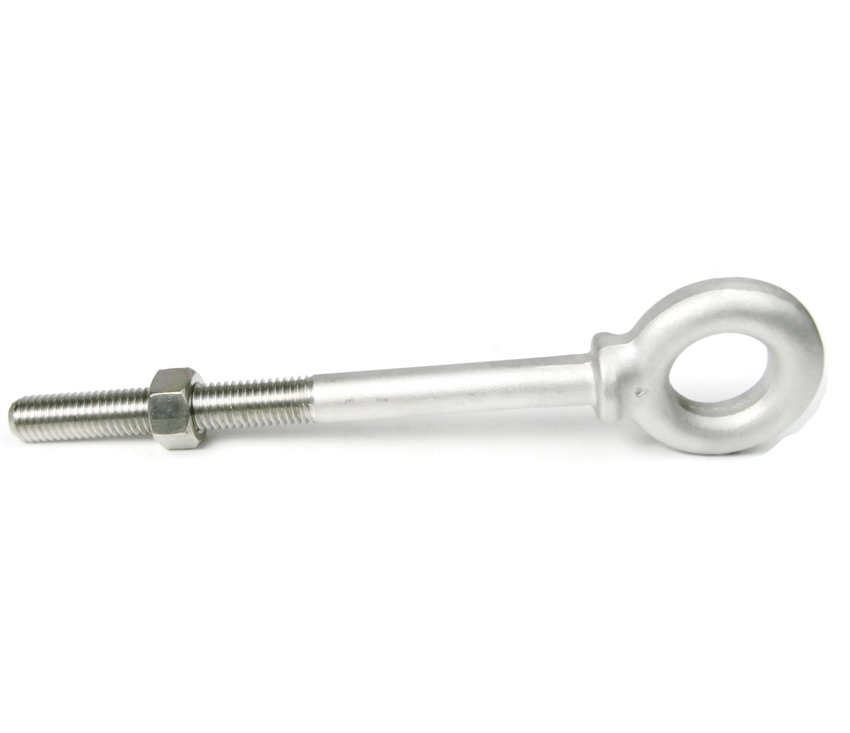
316 Stainless Steel Shoulder Pattern with Nut Eye Bolts
What are 316 stainless shoulder pattern with nut eye bolts? 316 stainless steel shoulder pattern with nut eye bolts are shouldered nut eye bolts made from marine-grade 316 stainless, for angular and vertical through-hole lifts. The molybdenum-alloyed grade resists salt and chloride corrosion, and the shoulder handles side loads when seated flush.
Why choose 316 stainless for shoulder nut eye bolts?
316 stainless adds molybdenum for far better resistance to salt and chloride pitting than 304, so a 316 shoulder nut eye bolt holds up in coastal, marine, and wash-down settings while allowing angular lifts and mounting through a hole with a nut on the far side. The angular rules apply: seat the shoulder completely flush and derate for load angle, with capacity dropping to about 25% of the vertical rating at 45 degrees. Pair it with 316 stainless nuts and washers for a fully marine-grade assembly. For general freshwater use, 304 is more economical. Always confirm the rated capacity, ensure the shoulder is flush, and inspect before each lift.
Why choose 316 stainless shoulder pattern with nut eye bolts
- Marine-grade corrosion resistance: molybdenum-alloyed for salt and chlorides.
- Angular and vertical lifts: shoulder handles side loads when seated flush.
- Through-hole mount: secures with a nut on the far side.
- Match grade: pairs with 316 stainless hardware.
Common applications for 316 shoulder nut eye bolts
- Marine and coastal angular through-hole lifts
- Boats, docks, and saltwater rigging
- Wash-down and chemical environments
- Mounting through plates and panels with side loads
For general freshwater use, see 304 stainless shoulder pattern with nut eye bolts, and browse every material on the main eye bolts category.
316 Stainless Shoulder Pattern with Nut Eye Bolts FAQ
Can I use these for angular lifts?
Yes, if the shoulder is seated completely flush and the capacity is derated for the load angle. At 45 degrees, capacity drops to about 25% of the vertical rating.
Why choose 316 over 304?
316 adds molybdenum for much better resistance to salt and chloride pitting, making it the choice for coastal, marine, and wash-down use.
Does the shoulder need to be flush?
Yes. The shoulder must seat completely flush against the load surface to function safely under angular loads.