

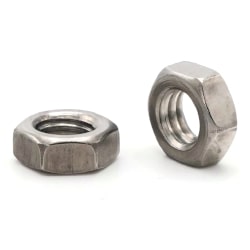
Stainless Steel Hex Jam Nuts
What are hex jam nuts? Hex jam nuts are thin hex nuts used as a secondary nut to lock a primary nut in place or to set position in tight clearances. Made from 18-8, 304, and 316 stainless, plus A4 metric, they resist rust while providing a low-profile locking or spacing function outdoors and in wet conditions.
How to lock two nuts with a jam nut
To jam two nuts, you thread the thin jam nut on first, then the full nut on top, and tighten them against each other so they wedge on the threads. Done correctly this resists loosening without a nylon insert. Jam nuts are also used alone where a standard nut is too thick, such as setting the position of a rod end or sensor. Their thin profile is the whole point, so do not substitute a full nut where clearance is tight. Match the grade to the environment, with 316 or A4 for coastal exposure.
Why choose stainless steel hex jam nuts
- Low profile: thin body fits tight clearances.
- Locking function: jams against a primary nut to resist loosening.
- Corrosion resistance: 18-8, 304, 316, and A4 hold up in wet and outdoor use.
- Grade options: 18-8 or 304 for general use, 316 or A4 for coastal exposure.
Common applications for hex jam nuts
- Locking a primary nut on a bolt or stud
- Setting position on threaded rod and rod ends
- Tight-clearance assemblies
- Outdoor and marine hardware (316 or A4)
For standard-height nuts, see stainless hex finish nuts, and browse every hex nut style on the main hex nuts category.
Stainless Steel Hex Jam Nuts FAQ
What grades do hex jam nuts come in?
18-8, 304, and 316 stainless, plus metric A4. Use 316 or A4 for coastal and saltwater exposure.
Which nut goes on first when jamming two nuts?
The thin jam nut goes on first, then the full nut on top, tightened against each other so they wedge on the threads and resist loosening.
Is a jam nut as strong as a full nut?
No. Its thin body offers less thread engagement, so it is not a substitute for a full nut carrying the main load.