

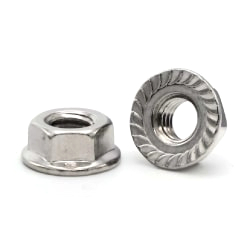
Stainless Steel Serrated Flange Nuts
What are serrated flange nuts? Serrated flange nuts are flange nuts with teeth under the flange that bite into the mating surface to create a locking action against vibration. Made from 18-8, 304, and 316 stainless, they resist rust while keeping equipment and machinery joints tight where a smooth nut could work loose.
How the serrations lock a joint
As you tighten a serrated flange nut, the angled teeth dig into the surface and resist the reverse rotation that vibration causes. This gives an all-metal mechanical lock without a nylon insert, so it holds at higher temperatures than a nylon insert nut. The trade-off is that the teeth mark the surface, so serrated nuts belong on structural steel, brackets, and machinery rather than soft or finished material. Match the grade to the environment, with 18-8 or 304 for general use and 316 for coastal exposure.
When to use serrated instead of non-serrated
- Choose serrated: vibration is present and surface marks are acceptable.
- Choose non-serrated: the surface is soft or finished and must not be marred.
- High heat: serrated all-metal locking outperforms nylon insert nuts.
Common applications for serrated flange nuts
- Machinery and motor mounts under vibration
- Automotive, trailer, and equipment frames
- Steel brackets and structural connections
- Outdoor and marine assembly (use 316)
For soft or finished surfaces, see stainless non-serrated flange nuts, and browse every flange nut style on the main flange nuts category.
Stainless Steel Serrated Flange Nuts FAQ
What grades do serrated flange nuts come in?
18-8, 304, and 316 stainless. Use 316 for coastal and saltwater exposure.
Do serrated flange nuts damage the surface?
The teeth leave small marks where they bite. That is normal and part of how they lock, but it means they are best on steel and hard surfaces, not soft or finished material.
Are serrated flange nuts reusable?
They can be reused, but the teeth dull and grip less over time. For a critical locking joint, use a fresh nut.