

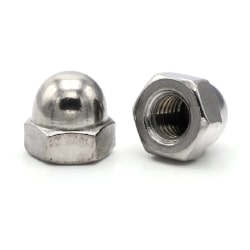
Stainless Steel Standard Cap Nuts
What are standard cap nuts? Standard cap nuts are low-crown domed nuts that cap off a bolt end for a clean appearance and thread protection in most general applications. Made from 304 and 316 stainless, plus A2 and A4 metric, they resist rust on visible outdoor and marine hardware while covering the bolt threads and preventing snags.
When a standard crown is the right height
Standard cap nuts have the lowest dome of the cap nut family, sized to cover a bolt end that finishes roughly flush with the nut. They are the everyday choice for railings, furniture, and fixtures where the bolt does not project far past the nut. If the bolt sticks out well beyond the nut, step up to a high crown or extra tall cap nut so the threads stay fully covered. Match the grade to the environment, with 304 or A2 for general use and 316 or A4 for coastal exposure.
Why choose stainless steel standard cap nuts
- Finished appearance: low dome hides the bolt end for a clean look.
- Thread protection: closed top shields the threads and prevents snags.
- Corrosion resistance: 304, 316, and A2/A4 hold up in wet and outdoor use.
- Grade options: 304 or A2 for general use, 316 or A4 for coastal exposure.
Common applications for standard cap nuts
- Railings, gates, and handrails
- Furniture and visible fixtures
- Marine and dock hardware (316 or A4)
- Any bolt end that finishes near flush with the nut
For longer thread projections, use high crown or extra tall cap nuts, and browse every crown height on the main cap nuts category. See the full stainless selection on the stainless cap nuts page.
Stainless Steel Standard Cap Nuts FAQ
What grades do standard cap nuts come in?
304 and 316 stainless, plus metric A2 and A4. A2 is comparable to 304 and A4 to 316.
How much bolt length can a standard cap nut cover?
A standard cap nut covers a bolt end that finishes roughly flush with the nut. For threads that project further, use a high crown or extra tall cap nut.
Are standard cap nuts locking?
No. In vibration, add threadlocker or run them over a lock nut, since the closed top prevents adding a second nut on the bolt end.