

Wedge Anchors
Resources
Wedge anchors are mechanical expansion anchors designed exclusively for solid concrete applications where maximum holding strength and vibration resistance are required. As the anchor is tightened, an expansion clip is forced outward against the concrete, creating a permanent, high-load connection that excels in structural, industrial, and commercial installations.
At Albany County Fasteners, we stock wedge anchors in multiple diameters, lengths, and materials to meet demanding load requirements in both indoor and outdoor environments. Whether you are anchoring base plates, machinery, columns, or guardrails, wedge anchors provide dependable performance when installed correctly in sound concrete.
Watch: How to Install Wedge Anchors in Concrete | Fasteners 101, over 1 million views!
Wedge Anchors
Standard Wedge Anchors
Standard wedge anchors provide a strong, permanent anchoring solution for securing structural and heavy duty fixtures into solid concrete in commercial, industrial, and construction applications.
ICC-ES Wedge Anchors Approved for Cracked Concrete
Wedge anchors for cracked concrete are engineered and tested to maintain reliable holding strength in both cracked and uncracked concrete, making them ideal for seismic, safety critical, and code compliant installations.
-min.jpg?ts=1755674242 "Acoustical Wedge Anchors")
Acoustical Wedge Anchors
Acoustical wedge anchors are designed for suspending acoustic ceiling systems, threaded rod, ductwork, piping, and other overhead applications while providing a secure attachment to solid concrete.
Videos
Play video
What are Wedge Anchors?
Wedge anchors, also called concrete stud anchors and wedge bolts, are mechanical expansion anchors used to fasten into solid, cured concrete (often called “cement” in searches). They’re frequently chosen for concrete slabs, walls, and filled masonry. Use sleeve or toggle anchors unless the hollow blocks have been completely filled solid with grout.
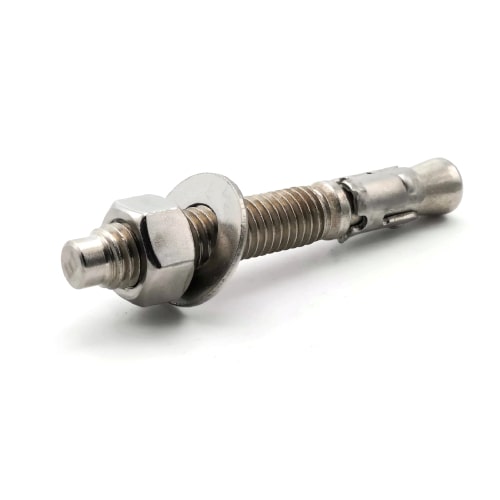
Wedge anchors are torque-controlled expansion anchors consisting of a threaded stud with a permanently attached expansion clip at the embedded end. When the nut is tightened, the clip expands outward against the walls of the drilled hole, locking the anchor securely into the concrete.
Because the expansion occurs at the bottom of the anchor, wedge anchors deliver exceptional resistance to pull-out forces, shear loads, and vibration. Once set, the anchor becomes a permanent part of the concrete substrate.
What parts are in a wedge anchor assembly?
- Threaded anchor body with a tapered section at the tip
- Expansion clip (wedge) that locks against the hole wall during tightening
- Flat washer sized to the anchor diameter
- Hex nut used to draw the clip into expansion and clamp the fixture
The washer and nut are included with most wedge anchors so the assembly is ready to install.
Why use wedge anchors in concrete?
- Fast installation with standard carbide masonry bits and hand tools
- Clean hardware stack above the surface for plates, rails, and brackets
- Broad diameter and length range to match fixture thickness and embedment needs
Wedge anchors work through mechanical expansion. After drilling a hole to the proper diameter and depth, the anchor is inserted through the fixture and into the concrete. Tightening the nut pulls the tapered end of the stud upward, forcing the expansion clip outward until it grips the concrete walls.
Key performance factors include:
-
Proper hole diameter and depth
-
Correct embedment depth
-
Clean hole conditions
-
Accurate torque during installation
When installed correctly, wedge anchors deliver consistent holding power across demanding applications.
High, consistent load capacity in solid concrete and filled masonry-
Where are concrete wedge anchor fasteners used regularly?
- Base plates, post and sign supports, guardrails, and safety barriers
- Equipment pads, racks, machines, and material handling
- Pipe supports, strut framing, electrical and HVAC mounts
- Structural steel connections where drawings specify wedge anchors
Where Wedge Anchors Should NOT Be Used:
Wedge anchors are not recommended for:
-
Brick
-
Block that hasn't been filled in or that is hollow
-
Mortar joints
-
Soft or weak concrete
-
Cracked or deteriorated concrete unless specifically engineered
For masonry materials such as block or brick, sleeve anchors or other expansion anchors designed for hollow substrates are typically a better choice.
What types of materials do wedge anchors come in?
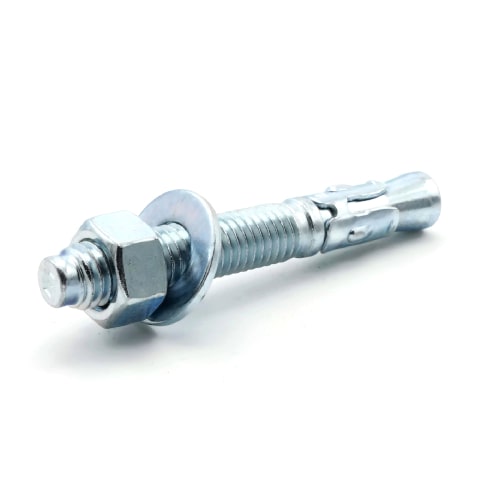
- Zinc plated carbon steel for dry interior conditions
- Hot dip galvanized for outdoor or wet exposure
- 304 stainless steel for general corrosion resistance
- 316 stainless steel for coastal and chemical environments
How wedge anchors work
The anchor is driven into a drilled hole in concrete. Tightening the nut pulls the anchor body upward so the expansion clip rides the taper and wedges firmly against the hole wall, creating friction and mechanical interlock that resist pull-out and shear.

How to install wedge anchors in concrete:
Read our blog article here for step by step installation instructions
- Drill the hole
- Use a carbide tipped bit that matches the anchor diameter; drill perpendicular to the surface.
- Drill deeper than the minimum embedment so dust has room at the tip.
- Clean the hole
- Brush and blow out dust with a wire brush and compressed air or vacuum to ensure full expansion.
- Insert the wedge anchor
- Thread the nut a few turns to protect the threads, then tap the anchor until the washer and nut seat on the fixture.
- Expand the anchor
- Snug the nut to draw the clip into expansion so the anchor grips the concrete.
- Tighten the nut
- Use a wrench to reach the recommended torque for the anchor size.
Tips for successful installation:
- Wear proper PPE; install only in sound, cured concrete
- Maintain required spacing and edge distance to prevent cracking or breakout
- Avoid under- or over-tightening; verify torque after set
Choosing wedge anchors for your project
Which length should the wedge anchor be?
- Concrete thickness at the install point
- Fixture thickness plus nut and washer thickness
- Minimum embedment for the chosen diameter
- Any extra clearance you prefer
Total Anchor Length = Minimum Embedment Depth + Fixture Thickness + Nut Thickness + Additional Clearance
Minimum Embedment Depth For Wedge Anchors
| Diameter | 1/4" | 5/16" | 3/8" | 1/2" | 5/8" | 3/4" | 7/8" | 1" | 1-1/4" |
| Minimum Embedment Depth | 1-1/8" | 1-1/8" | 1-1/2" | 2-1/4" | 2-3/4" | 3-1/4" | 3-7/8" | 4-1/2" | 5-1/2" |
Which material is best for your application?
- 316 stainless for coastal or chemical exposure
- 304 stainless or hot dip galvanized for exterior and wet areas
- Zinc plated for dry interior spaces
What size wedge anchor do I need (inch and metric)?
- Select diameter by load and fixture hole (1/4 in, 3/8 in, 1/2 in, 5/8 in, 3/4 in; M8, M10, M12)
- Length equals required embedment plus fixture and hardware stack
- Follow edge distance and spacing rules for full capacity
Troubleshooting and common issues with wedge anchors:
- Insufficient embedment reduces strength
- Over-tightening can crush concrete or damage hardware
- Under-tightening may allow movement and loss of preload
- Wrong hole size prevents proper expansion
- Near edges or weak concrete may cause cracking; respect distances
- Poor hole cleaning leaves dust that limits holding power
- Incorrect material choice can lead to corrosion or staining
Wedge Anchors vs Other Concrete Anchors
Choosing the correct anchor is critical for safety and performance.
-
Wedge anchors provide the highest holding strength in solid concrete and are ideal for permanent installations.
Sleeve anchors are more versatile and can be used in concrete, brick, and block, but generally offer lower load capacities.
Drop-in anchors are used when a flush surface is required and are often paired with threaded rod or bolts.
Understanding these differences helps ensure the anchor matches both the substrate and the load requirements.
Learn more about Wedge Anchors and Concrete Anchors in our Fasteners 101 Anchors section!
FAQs about Wedge Anchors
Key answers for selection, sizing, installation, and materials in concrete, “cement,” and filled block.
- Do wedge anchors work in concrete, cement, and block?
They are intended for solid, cured concrete (often searched as “cement”) and filled masonry. For hollow block, use sleeve or toggling anchors unless the cell is fully grouted.
- What drill bit size should I use?
Use a carbide tipped bit equal to the anchor diameter unless the product specifies otherwise.
- How deep should the hole be?
Deeper than the minimum embedment so dust has room at the tip. Follow the embedment requirement for your anchor size.
- What parts come with a wedge anchor?
Threaded anchor body, expansion clip, flat washer, and hex nut.
- Can wedge anchors be removed and reused?
Wedge anchors are considered permanent anchors. While the nut and washer can be removed, the embedded anchor cannot be fully extracted without damaging the concrete.
- Do wedge anchors work in cracked concrete?
Some models are qualified for cracked concrete. Verify the rating and follow the installation instructions. We sell wedge anchors specifically for cracked concrete.
- Which finish should I choose for outdoor use?
Hot dip galvanized for most exterior work; 304 or 316 stainless where corrosion exposure is high, with 316 preferred near saltwater.
- Why is hole cleaning important?
Dust left in the hole can reduce expansion and holding power. Brush and blow the hole clean before setting the anchor.
- What if the hole is oversized?
Do not install the wedge anchor. Drill a new hole to the correct diameter for proper expansion and capacity.